

Key Takeaways
- Five firms handle most Fortune 500 placements. Spencer Stuart, Heidrick & Struggles, Korn Ferry, Russell Reynolds, Egon Zehnder.
- Below Fortune 500, the boutique tier dominates. True, Riviera Partners, Daversa Partners, ZRG, and PE-aligned shops.
- Standard fee is one-third of first-year total compensation. Paid in three installments tied to engagement, slate, and placement.
- Search cycle runs 120–180 days. Compressed cycles usually signal a board that already knew who they wanted.
- The quality of the search firm matters more than candidates expect. Calibration honesty, slate discipline, and process integrity predict outcomes more reliably than firm prestige.
I have been on both sides of the technology executive search market for the last twenty years. As a candidate, working with Spencer Stuart, Heidrick, Korn Ferry, Russell Reynolds, and a long tail of boutique firms across roles at adidas, Sweetgreen, Huge, Fantasy, and Bain Capital portfolio companies. As a hiring executive, commissioning searches for VP Engineering, Head of Platform, and senior leadership roles underneath the technology executive seat. The market is more transparent from inside than it looks from outside, and the quality differences between firms matter more than candidates usually account for.
This page is the candidate-side companion to the tech headhunters playbook, which goes deeper on the practitioner experience of navigating executive search across a career. This piece treats the market structure: which firms run it, how engagements are priced and structured, and what separates a good search from a bad one. If you're vetting whether the firm running your search is treating you well, or vetting whether the firm a board has engaged to fill a role under you is the right choice, the patterns below should help.
The Concentrated Top of the Market
The Fortune 500 technology executive search market concentrates around five firms. Spencer Stuart, Heidrick & Struggles, Korn Ferry, Russell Reynolds, and Egon Zehnder each maintain established technology officer practices with dedicated research teams and named partners who cover the CTO, CIO, and CTAIO seats. They compete for the same mandates, and the selection by hiring companies usually comes down to vertical specialization, prior relationships with the CEO or board chair, and the specific partner who would run the engagement.
The five do not differentiate sharply on capability. Each has the research depth, the partner roster, and the candidate network to run a credible Fortune 500 search. The differences that matter to candidates are partner-by-partner rather than firm-by-firm. The partner who covers technology in your city or vertical, who has done diligence on the company before reaching out, who calibrates the role honestly, who represents both sides transparently through the process: that partner produces better outcomes for everyone in the room than a partner at the same firm who treats the search as a transactional placement. Sources for the five-firm concentration pattern: Heidrick & Struggles' annual Route to the Top, Spencer Stuart's published research, and the public client lists each firm maintains.
The Boutique Tier Below Fortune 500
Below Fortune 500, the market opens up considerably. Four firms have built reputations specifically in the technology executive segment.
- True has the deepest relationships in the venture-backed and PE-backed CTO market. Strong partner roster, good slate discipline, post-placement support that the big-five firms don't always match at mid-market scale.
- Riviera Partners specializes in venture-backed tech companies with a strong focus on engineering and product leadership at growth-stage scale. The strongest pure tech-sector specialization in the boutique tier.
- Daversa Partners works heavily in the high-growth and late-stage tech market. Active across CTO, CPO, and CFO searches at the same companies, which gives the firm a broader executive-team view than purely technology-focused boutiques.
- ZRG operates across mid-market and PE-backed search, with a broader geographic and sector footprint than the more tech-specialized boutiques.
A long tail of PE-aligned shops handles the portfolio-CTO market: searches commissioned by sponsors against specific portfolio company needs, often with significant sponsor input on the candidate profile. The economics of these searches differ from sponsor-independent searches in ways that affect candidates. The sponsor's expectations about the candidate's posture (operator versus strategist, hands-on versus delegating) often dominate the role specification, and the candidate's compensation structure typically includes equity rolled into a management incentive plan tied to exit waterfall.
How a Retained Search Engagement Actually Runs
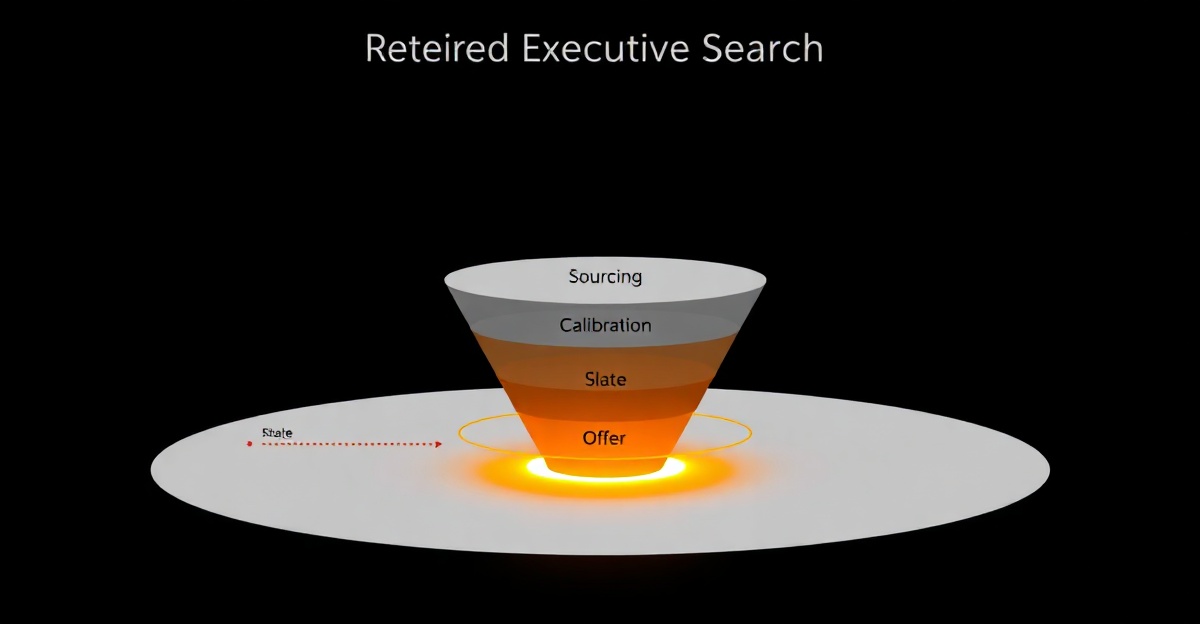
Phase 1 — Calibration (weeks 1–3)
The firm interviews the hiring CEO, the board members involved, the executive committee peers of the open seat, and a sample of key reports. The output is a target profile, a compensation range, a list of must-haves, and a list of dealbreakers. The quality of the calibration determines almost everything downstream. A search firm that has done its diligence here can represent the role honestly to candidates; a firm that has rushed calibration ends up presenting a slate that doesn't quite match what the company actually wants, then iterating the calibration mid-search at high cost to everyone involved.
Phase 2 — Sourcing (weeks 3–10)
The research team identifies a long list of perhaps 100–200 candidates against the calibrated profile. Outreach and screening narrow this to roughly 20–40 candidates worth a partner-level conversation. The conversations themselves are part diligence on fit and part sales pitch on the role. The partner is doing both jobs at once, which is part of why the partner choice matters so much.
Phase 3 — Slate (weeks 10–14)
The firm presents a slate of typically 4–8 candidates to the hiring company. Each candidate gets a written profile, a compensation expectation, a flag on any sensitivities (current role status, geographic constraint, dealbreakers), and the firm's recommendation on relative fit. The hiring company picks the candidates they want to advance.
Phase 4 — Interview rounds (weeks 14–22)
The company runs its process, typically 4–6 interview loops per advancing candidate. References at multiple levels: peer, board-side, and downward-facing. The search firm stays involved through each round, gathering feedback, helping candidates prepare, and helping the company calibrate as the interviews surface new information.
Phase 5 — Offer and onboarding (weeks 18–24)
Offer negotiation, final references, onboarding plan. The firm participates in the negotiation, with both sides expecting it to bridge gaps and bring the deal to close. Post-placement, the best firms stay engaged through the first six months. Both for the client (placement guarantee usually runs 90 days, sometimes extended to a year) and for the candidate (a relationship that lasts past close).
Fee Structure
The standard retained-search fee runs roughly one-third of the placed candidate's first-year cash compensation (base plus target bonus, not equity), paid in three installments. Installment one (typically a third of the total fee, or sometimes a smaller container fee in the $25K–$75K range) on engagement. Installment two on presentation of the qualified slate. Installment three on placement.
For a Fortune 500 CTO role with $1.5M in first-year cash compensation, the total fee runs roughly $500K. For a mid-market $600K cash role, the fee is roughly $200K. Some firms structure flat fees instead of percentage-of-comp; typical ranges run $80K–$200K for mid-market, with $300K+ reserved for the largest Fortune 500 mandates. PE-aligned shops sometimes structure success-fee hybrids tied to candidate retention milestones or to portfolio company performance metrics.
From the candidate side, the fee structure is mostly invisible during the process. It becomes visible only at the negotiation stage, where the firm has a clear interest in the candidate accepting the offer (the third installment is contingent on placement) and may push harder on the candidate to bridge gaps than the candidate expects.
"The partner who has actually done the diligence on the company, the CEO's working style, and the unspoken political reality of the open role is worth more to a candidate than the partner at the more prestigious firm who hasn't."
What Separates a Good Search Firm From a Bad One
Four signals consistently predict whether a search will produce a good outcome for the candidate, independent of which firm is running it.
Calibration honesty. The partner walks you through the company's reality, including the parts that are awkward to talk about. The CEO's working style. The unspoken political reality of the open role. The compensation range the board has actually approved. The candidate the board interviewed three months ago who didn't work out and why. A partner who pitches the role as more polished than it is has either skipped calibration or is hiding the parts that would change your decision.
Slate discipline. A slate of 4–8 genuinely qualified candidates, not a slate padded with names to make the firm look thorough. From the candidate side, you usually find out about slate quality only later, but a partner who can describe in honest terms why each shortlisted candidate is competitive tells you something about how they'll represent you to the client.
Process integrity. Clear timelines, fair representation of multiple candidates to the client, willingness to walk both sides away from bad fits rather than push the placement at any cost. The firms that operate this way produce better long-term outcomes for everyone, including for themselves, even though it sometimes costs a specific placement.
Post-placement work. The best firms stay engaged through onboarding and into the first six months. Both for the client (placement guarantee) and for the candidate (a relationship that lasts past close). The firms that disappear the day the offer is signed are the ones that treat search as a transactional placement rather than a long-term relationship business.
Related Reading
The technology executive pillar covers the broader role context for which executive search exists. The tech headhunters playbook goes deeper on the candidate-side experience across a career. For the variants of the seat, see the sister spokes on AI CIO and AI CTO. For a confidential conversation about a specific search or about a candidate situation, book an expert call.
When the search reveals the company is not yet ready for the full-time hire, the right move is often a fractional CTO, CIO, or Chief AI Officer engagement, or AI strategy consulting as a defined-scope bridge. Both buy senior judgment without committing to a seat the company cannot yet support.
Frequently Asked Questions
Which firms actually run technology executive search at the Fortune 500 level?
Five firms handle most of the market: Spencer Stuart, Heidrick & Struggles, Korn Ferry, Russell Reynolds, and Egon Zehnder. Each has an established technology officer practice with dedicated research teams, named technology partners, and the relationships with sitting CTOs that produce credible candidate slates within the standard 60–120 day window. The five compete for the same Fortune 500 CTO mandates and for board-led CIO searches. Selection by the hiring company usually comes down to industry vertical specialization (Spencer Stuart has historically dominated financial services CIO searches, Heidrick has strong tech-sector reach, Korn Ferry has the broadest geographic footprint), prior relationship with the CEO or board chair, and the specific partner who would lead the engagement.
Who runs technology executive search below Fortune 500?
The boutique tier. True is the most established at the growth-stage CTO market, with deep VC and PE relationships. Riviera Partners has a strong tech-sector specialization, particularly for VC-backed companies. Daversa Partners works heavily in the high-growth tech market. ZRG operates in the mid-market and PE space. Beyond these, a long tail of PE-aligned shops handles the portfolio-CTO market — searches commissioned by sponsors against specific portfolio company needs, often with the sponsor's input shaping the candidate profile heavily. Sub-Series-C startups typically use a sponsor-affiliated recruiter rather than paying for a retained search; the economics of a six-figure retained fee usually don't make sense at that scale until at least one round of capital has closed.
How does the retained search process actually run?
Five phases over roughly 90–180 days (most C-suite tech searches close in 4–6 months; phases overlap in practice). Calibration (weeks 1–3): the firm interviews the hiring CEO, the board, the executive committee peers, and key reports of the open role to develop a target profile, a compensation range, and a list of must-haves and dealbreakers. Sourcing (weeks 3–10): the research team identifies a long list of perhaps 100–200 candidates, narrows through outreach and screening to roughly 20–40 worth a partner-level conversation. Slate (weeks 10–14): the firm presents a slate of 4–8 candidates to the hiring company. Interview rounds (weeks 12–20): the company runs its process through to finalists, typically 4–6 interview loops per candidate. Offer (weeks 18–24): the firm participates in the offer negotiation, references, and onboarding. Cycles compressed below 90 days usually mean the board already had a candidate in mind and used the search to validate the choice.
What does retained executive search cost?
Standard structure is one-third of the placed candidate's first-year cash compensation (base plus target bonus, not equity), paid in three installments. Installment one (typically 33 percent of the total fee) on engagement, installment two on presentation of the qualified slate, installment three on placement. For a CTO role with roughly $1.5M in first-year cash compensation, the total fee runs around $500K; for a $600K cash role, the fee is closer to $200K. Some engagements use a flat fee structure instead of a percentage — typical ranges run $80K–$200K for mid-market, with $300K+ reserved for the largest Fortune 500 mandates. Container fees (partial upfront fees on engagement that get credited against the success fee, usually $25K–$75K) are increasingly common as the market has compressed. Equity-heavy growth-stage roles sometimes use a hybrid fee tied to base plus a multiplier on early equity vesting.
How do candidates actually get on the search firm's radar?
Three pathways dominate. The research team's database — every major firm maintains an internal CRM of senior technology leaders refreshed continuously through outreach, public profile changes, conference attendance, and published thought leadership. Active outreach by the firm's partners — the partner who covers the technology practice in a specific city or vertical typically knows the sitting CTOs and senior VPs in that market personally. Referrals from sitting placements — once you've worked with a search firm as a candidate or as a client, you become part of the firm's network and get called when relevant roles come up. The pattern that most reliably keeps a candidate visible: maintain relationships with the partners at two or three firms across the major sectors you work in, treat their cold outreach as worth a 20-minute call even when you're happy in role, and provide candidate referrals when you're not the right fit yourself.
What separates a good executive search firm from a bad one — from the candidate side?
Four signals consistently predict outcome quality. Calibration honesty: the partner who has done the actual diligence on the company, the CEO's working style, the unspoken dealbreakers, and the political reality of the open role — versus the partner who pitches the role as more polished than it is. Slate discipline: a slate of 4–8 genuinely qualified candidates, not a slate padded with names to make the firm look thorough. Process integrity: clear timelines, fair representation of multiple candidates to the client, willingness to walk both sides away from bad fits rather than push to placement at any cost. Post-placement work: the best firms stay engaged through onboarding and into the first six months, both for the client (placement guarantee) and for the candidate (a relationship that lasts past the close).
How long does the typical technology executive search take?
90–180 days from engagement to offer is the standard range, with most C-suite tech searches landing in the 4–6 month window. Shorter cycles (60–90 days) usually signal one of three things: the board already had a candidate in mind, the role is being filled internally with a search running as cover, or the firm is moving fast because the company is in a crisis hire and needs a CTO yesterday. Longer cycles (200+ days) usually signal the calibration was wrong (the role as described isn't fillable at the stated compensation, or the team profile is too narrow for the available talent), or the company is unable to make a decision through interview rounds. From the candidate side, expect 4–6 interview loops, 1–2 reference checks at multiple levels of detail, and a compensation negotiation that may run another 2–4 weeks after verbal offer.
Should a candidate work with one search firm or multiple?
Multiple, but with discipline. Most senior tech executives maintain active relationships with partners at two or three firms across the sectors they work in. The relationships are not exclusive — search firms understand that senior candidates talk to peer firms — and the firm's professional standard is to represent the candidate transparently rather than try to lock them up. The discipline that matters: be honest with each partner about where else you're active, don't double-submit to the same role through different firms (the conflict gets discovered and damages relationships on both sides), and treat every interaction as part of a multi-year relationship rather than a one-time transaction. A candidate who burns a search firm once usually finds it harder to get represented for the next role.
Need Expert Technology Guidance?
20+ years leading technology transformations. Get a technology executive's perspective on your biggest challenges.
