

Key Takeaways
- A fractional technology executive is a senior CTO, CIO, or Chief AI Officer engaged part-time — typically 2-5 days per month — to own the function at a cost structure that fits the company stage.
- The category spans multiple functions (CTO, CIO, CFO, COO, CMO, CAIO). This hub covers technology. For fractional CFO services, look elsewhere — I do not do CFO work.
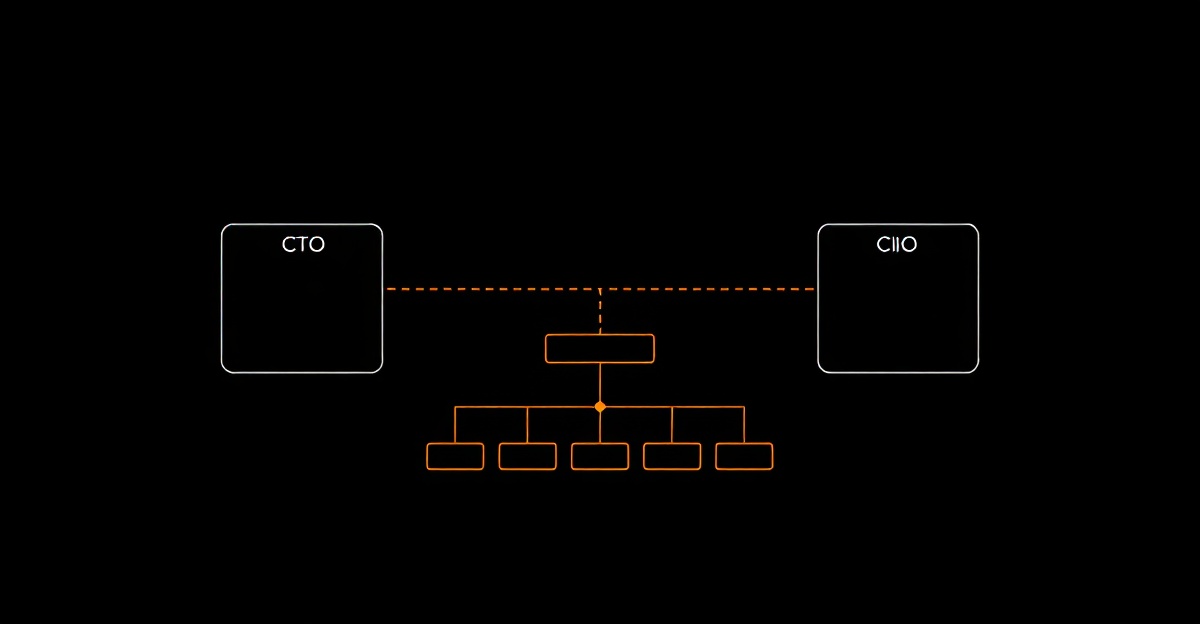
- Three roles, three scopes. CTO: product and engineering. CIO: internal IT, vendor management, compliance. CAIO: AI strategy and infrastructure. The seats can be combined at smaller scale; past ~200 employees they need to split.
- Cost structure: $7K-$70K per month depending on role, intensity, and company stage. Day rates for advisory: $2,500-$5,000. Project fees: $30K-$150K for defined-scope work.
- The fractional model fits between roughly $5M and $200M revenue. Above that scale, the math usually swings to full-time. Below it, the role doesn't yet exist.
The question that opens most discovery calls for fractional executive work isn't whether the company needs senior technology leadership. It's whether senior technology leadership has to come in a $400,000-base, five-day-a-week shape, or whether there is a part-time architecture that delivers the same judgment at a cost structure the company can actually carry. This page is the answer I give over those calls, written down once.
A fractional technology executive is a senior CTO, CIO, or Chief AI Officer engaged on a retainer — typically 2-5 days per month over 12-24 months — to own the function for a company that needs the senior judgment but doesn't yet need or want to commit to the full-time hire. The category includes fractional CFOs, fractional COOs, fractional CMOs, and other functions besides. This hub covers the technology side, which is the area where I have run engagements over the last decade across mid-market, private-equity-backed, and venture-backed companies.
For readers searching for fractional CFO services specifically: I don't do CFO work, and a fractional CFO is a real, separate role with real practitioners. The fractional model is consistent across functions, but the pedigree isn't. The CFO seat requires GAAP, treasury, and equity-structure depth I don't claim. This hub covers CTO, CIO, and Chief AI Officer engagements only.
What a fractional CFO actually does, briefly, since the search intent often lands here: a fractional CFO owns financial planning and analysis, cash management, investor and lender reporting, equity-structure decisions on raises and option grants, and audit readiness, on a part-time retainer typically running $5K to $25K per month at SMB to mid-market scale. The role intersects with mine on capital allocation conversations and on AI spend governance, which is where I sometimes work alongside a company's fractional CFO without taking over their function. For specialist CFO providers, established starting points include BDO and CFO.com coverage of the market, and individual firms such as Preferred CFO and B2B CFO. I do not represent any of these and am not affiliated.
What a Fractional Executive Actually Is
The fractional model isn't part-time work. The hours are part-time; the level of the work is not. The point of the engagement is that the company gets senior executive judgment, calibrated by holding the full-time seat at a comparable company, applied to the decisions that benefit most from it, without paying for the senior executive to occupy the seat full-time.
What that means in practice: the fractional executive sits in the leadership-team meetings, signs off on the major decisions, owns the hiring of senior people in their function, attends the board, and is available for material decisions in between. What they don't do is the operational management, the day-to-day team supervision, or the in-the-building presence that justifies the full-time line item at scale. The trade is real. The company gets the judgment at a fraction of the cost, and the executive's calendar is full because they run the same engagement for three or four companies in parallel rather than one.
The fractional category exists for almost every C-level function now: CFO, COO, CMO, CHRO, CISO, alongside the CTO/CIO/CAIO seats covered here. The model emerged from the same underlying observation across functions. Mid-market companies often need executive-level capability before they need executive-level scale, and the staffing-firm response to that gap has matured into a real engagement model.
Fractional CTO vs CIO vs Chief AI Officer
The three technology fractional seats I run cover different work, with overlap at the edges. Choosing between them is mostly a matter of being precise about what the company actually needs.
Fractional CTO — product and engineering
The fractional CTO owns the technology that the customer touches: product engineering, architecture, the engineering team, developer productivity, build-vs-buy on product platform decisions. The buyer is usually a founder or CEO at a company that has crossed past the stage where the technical co-founder or first VP Engineering can credibly own the function, and is not yet at the scale where a full-time CTO is the right line item. Typical engagement: 2-4 days per month, $10K-$30K retainer, 12-24 month duration. For the full pricing breakdown, the fractional CTO rates page covers it.
Fractional CIO — internal IT and compliance
The fractional CIO owns the technology that the company's employees touch and that the auditors evaluate: enterprise SaaS stack, vendor management, identity and access, security posture, compliance frameworks (SOC 2, HIPAA, GDPR). The buyer is usually a CFO, COO, or operating partner at a mid-market company hitting a compliance threshold, scaling past the point where founder-led IT breaks, or in a post-acquisition professionalization phase. Typical engagement: 2-4 days per month, $7K-$25K retainer at companies up to ~500 employees, scaling to $20K-$45K for higher-intensity engagements at 500-1,000 employee companies.
Fractional Chief AI Officer — AI strategy and infrastructure
The fractional Chief AI Officer owns the AI agenda: AI strategy and roadmap, model and vendor selection across the foundation-model market, data governance for AI workloads, build-vs-buy on AI infrastructure, AI vendor contracts. The role emerged because the work of running AI well at the executive level is now too specialized to fold cleanly into either the CTO seat (product and engineering) or the CIO seat (internal IT, compliance). Typical engagement: 3-5 days per month, $15K-$40K retainer, 6-24 month duration. At smaller companies (under ~100 engineers) the CAIO seat often combines with the CTO seat in the combined Chief Technology & AI Officer (CTAIO) model.
"Most mid-market companies that think they need a fractional CTO actually need a fractional CIO or a fractional CAIO. The inverse is also common. The cheapest mistake to avoid is mislabeling the role before you choose the person."
Which Fractional Seat Does Your Company Actually Need?
The most useful question to start with is what the work actually looks like. Three signals.
- What is being audited, what is being shipped, and what is being trained? If the pressure is from auditors (SOC 2, HIPAA, GDPR), the work is fractional CIO. If the pressure is from product velocity, technical debt, or engineering hiring, the work is fractional CTO. If the pressure is from AI workloads in production or AI spend the CFO doesn't trust, the work is fractional CAIO.
- Who is the buyer inside the company? CFOs and operating partners usually buy the CIO function. CEOs and founders usually buy the CTO function. Boards and CFOs together usually buy the CAIO function. The buyer is a useful signal about which role the company actually thinks it needs, even when the title they ask for doesn't match.
- What is the company size? Under roughly 50 engineers and $20M revenue, one fractional person can often credibly cover CTO + CIO + CAIO. Past 100 engineers or $50M revenue, the roles need to split. Above 500 employees, all three are usually separate engagements (sometimes one full-time and two fractional, sometimes all three fractional, rarely all three full-time).
The full-time vs fractional CTO guide walks through the three questions that decide whether the CTO function should be fractional at all. The same logic applies to the CIO and CAIO functions with minor adaptation.
How a Fractional Engagement Actually Works
A standard fractional engagement starts with a chemistry call, runs through a defined first 90 days, then settles into a steady-state cadence. The shape is similar across the CTO, CIO, and CAIO roles. The specific workstreams vary by function.
Discovery and scoping
Usually one or two calls with the CEO and the function's primary internal owner — CFO for CIO engagements, founder for CTO engagements, board chair for CAIO engagements at PE-backed companies. The scoping conversation defines days per month, board attendance, on-call expectation, hiring authority, and inclusions and exclusions. The most common failure mode in fractional engagements is leaving the scope implicit; the most reliable predictor of success is a written scope letter that both sides have signed before the engagement starts.
First 90 days
Three workstreams in parallel. An assessment of the current state — for CTO engagements this is the platform and engineering team; for CIO engagements it is the vendor and security posture; for CAIO engagements it is the AI inventory. A roadmap defining what gets built, bought, or stopped, on what timeline. And the start of execution against the highest-priority items, usually a quick-win that buys credibility (vendor consolidation for CIO, hiring authority for CTO, model selection for CAIO) plus the longer-arc work that delivers the strategic value.
Months 4-12 and beyond
Execute on the 90-day plan. Run the steady-state cadence: weekly leadership-team participation, monthly board updates if applicable, quarterly strategic reviews. By the end of month 12, the function should be running well enough that the fractional time commitment can often come down, sometimes from 4-5 days per month to 2-3. The engagement frequently extends into year 2 and year 3 with reduced intensity, until the company hits the scale where a full-time hire is the right next move.
Fractional Cost vs Full-Time Cost
For most mid-market companies considering a fractional engagement, the comparison that matters is fractional retainer versus full-time fully-loaded cost. A full-time senior CTO at the senior end typically costs $300,000-$450,000 base, plus benefits and on-target bonus that add 25-40%, plus the executive-recruiting fee (usually one-third of base on a retained search). First-year fully-loaded cost commonly lands between $500,000 and $750,000. A full-time CIO at mid-market scale runs $250,000-$400,000 base with similar loading. A full-time CAIO at the senior end runs $400,000-$600,000 base.
Fractional engagement annualized: typically 30-60% of the fully-loaded full-time equivalent. The fractional model usually wins the cost comparison below $50M-$100M revenue, and a good fractional executive will tell you when the math has crossed over. The crossover point isn't only about revenue — industry, complexity, and how strategic technology is to the business all matter — but the order-of-magnitude frame holds across most companies. Above roughly $150M revenue most companies transition to a full-time hire or an interim (full-time, temporary) shape; the fractional cadence stops fitting the level of presence the function needs.
For the specific rates and what drives the spread inside each band, the fractional CTO rates page has the detailed breakdown.
Fractional Engagements at PE and Portfolio Companies
A meaningful share of the fractional engagements I run are at private-equity or growth-equity portfolio companies. The structure is usually one of three patterns. A platform-wide fractional engagement covering technology due diligence on acquisitions and standardization across portfolio companies. A portfolio-company-specific engagement, usually post-acquisition, professionalizing the technology function during the holding period without a full-time line item. Or an interim engagement covering the gap between when a portfolio CTO leaves and the replacement starts.
The PE buyer values different things than the founder buyer. PE sponsors care about board-facing professionalism (the executive who can sit in front of the investment committee), risk reduction (compliance, security, vendor concentration), and value-creation milestones tied to the holding-period plan. Founders care about hiring outcomes, product velocity, and the relationship with the engineering team. A fractional executive who can flex between both buyer types is rare. One who can't will deliver well on one side and poorly on the other.
For portfolio companies needing technology due diligence specifically — usually at the acquisition stage or during a value-creation review — the technology due diligence guide covers the engagement.
How to Choose a Fractional Technology Executive
Three filters apply across the CTO, CIO, and CAIO roles.
Have they actually held the seat at a company like yours?
The scarce thing isn't function-specific competence. It's the calibration that comes from having held the full-time seat at roughly comparable scale and complexity. A fractional CTO who has only been a VP Engineering will struggle with the board-level conversations and the CEO-peer relationships the role requires. A fractional CIO who has only been a director of IT will struggle the same way at the executive-team layer. Ask for specific seats held, specific decisions made, specific outcomes. Ignore titles that don't map to real executive-level responsibility.
Can they hold scope clean?
Fractional engagements where the executive can't resist scope creep deliver less than the retainer implied. A fractional CTO who agrees to also run the CIO function, the data function, and the customer-success function will be overextended by month three and ineffective by month six. The right answer is multiple fractional engagements when the company needs multiple functions, not one stretched engagement. In the chemistry call, ask about a time they declined scope expansion. If they can't name one, that's the answer.
Do they have real team depth behind them?
Either via a partner firm or a network of contractors they can pull in for specialized skills. Most fractional engagements need at least occasional pull-in support: security specialists for the CIO function, senior engineers for the CTO function, AI infrastructure specialists for the CAIO function. The fractional executive's ability to bring that capacity without the company sourcing it themselves is part of what the retainer pays for. A solo fractional executive without bench depth hits a ceiling on what they can deliver.
Are You Ready for a Fractional Executive Engagement?
The engagements that work and the ones that quietly die look identical for the first two months. What separates them is whether the company was ready before the engagement started. Four readiness signals I check before I take an engagement.
- There is a named buyer with budget authority. CEO, CFO, board, or operating partner. Not a head of engineering hoping to convince the CEO later. If the buyer is downstream of the budget, the engagement stalls at the first decision the buyer cannot make alone.
- The problem can be written down in two sentences. "We are pre-Series B and our infrastructure spend is doubling quarter over quarter." "We are 18 months from a SOC 2 audit and we don't have a CIO." If the problem takes a deck, the company hasn't framed it yet, and the first four weeks will be framing work the company resents paying for.
- Someone internal can act on recommendations. A fractional executive recommends. Internal staff execute. If there is no engineering leader, no IT manager, no head of operations, then either the engagement needs to be a full-time hire instead, or the first deliverable is hiring that person.
- The budget is in the right range. Under $7,000 a month for an executive seat is not a fractional engagement, it is an advisory call dressed up as one. Above $70,000 a month, the cheaper answer is usually a full-time hire. Companies that try to compress an executive engagement into a $3,000 advisory retainer get advice they cannot act on.
If three of those four are clearly true, the engagement has a high probability of working. If two or fewer, I usually push the company toward either a one-off strategy sprint or a referral to a full-time hire, depending on stage.
When the Engagement Ends: Transition to Full-Time
Most fractional engagements are not permanent. The good ones end. The end is almost always one of three shapes.
The most common shape is a planned transition to a full-time hire. The company has grown into the seat, the work has compounded into a real org function, and the fractional executive helps run the search for the person who replaces them. I have done this three times. The handoff usually takes 90 to 120 days: 30 days to write the role spec, 60 days to source and select, 30 days of overlap where the fractional executive shadows the full-time hire through the first product, board, or audit cycle. The fractional engagement closes when the full-time hire has run one full cycle of the work without intervention.
The second shape is structural change at the company. Acquisition, recapitalization, a pivot that retires the function. These end the engagement on a short timeline. The cleanest version of this ending is a final 30-day knowledge-transfer engagement: documentation, vendor handoffs, board memo, and an introduction to whoever picks up the work next.
The third shape is that the engagement should have ended six months earlier and didn't. Both sides drift, the work calcifies into status meetings, the fractional executive's leverage decays, and the company stops getting the seat-level value it is paying for. I have been on the wrong side of this twice. The signal is when three consecutive monthly retainers produce zero portfolio decisions. When that happens, the right move is to close out, not to renew at a lower rate. Lower rates dressed up as "winding down" usually mean the engagement is dead and the invoicing is the last thing still moving.
Summary
A fractional technology executive is the right answer for companies that need senior CTO, CIO, or Chief AI Officer judgment but don't yet need (or want to commit to) the full-time hire. The model fits between roughly $5M and $200M revenue, at engagement intensities of 2-8 days per month, at monthly retainers between $7,000 and $70,000 depending on role, intensity, and company stage. Engagements typically run 12-24 months and frequently end when the company crosses the scale where a full-time hire becomes the right economic decision.
The three technology seats — fractional CTO, fractional CIO, fractional CAIO — cover different work with overlap at the edges, and most companies that come in asking for one of them actually need a different one. The cheapest mistake to avoid is mislabeling the role before choosing the person. If you want help working out which shape fits your company, an expert call is the easiest place to start.
For the full-time variant of the same seat, see technology executive: role, market, job. For AI strategy alongside fractional leadership — or as a project-shaped alternative to a fractional engagement — see AI strategy consulting.
Frequently Asked Questions
What is a fractional executive?
A fractional executive is a senior leader engaged on a part-time retainer to own a C-level function — CTO, CIO, CFO, COO, CMO, Chief AI Officer — for a company that needs the senior judgment but does not yet need (or want to commit to) a full-time line item at that level. The engagements typically run 2-8 days per month over 6-24 months, at a cost meaningfully lower than the fully-loaded cost of a full-time hire. The category emerged from the recognition that mid-market companies often need executive-level capability before they need executive-level scale. This hub covers the technology functions — CTO, CIO, and Chief AI Officer — which is the area where I run engagements.
What is a fractional CTO?
A fractional CTO is a senior technology executive engaged on a part-time basis to own product and engineering leadership: technology strategy and roadmap, engineering team leadership, architecture decisions, hiring for senior engineering roles, build-vs-buy decisions, and the board-facing technology conversation. Engagements typically run 2-4 days per month at companies up to ~$50M revenue ($10K-$30K monthly retainer), or 4-8 days per month at larger or higher-intensity engagements ($25K-$60K monthly retainer). For the full breakdown of what engagements actually cost, the rates page covers it in detail.
What is a fractional CIO?
A fractional CIO is a senior IT executive engaged on a part-time basis to own the business-facing technology function: enterprise SaaS stack and vendor management, identity and access, security posture, compliance audits (SOC 2, HIPAA, GDPR), business-IT alignment, and the internal IT team. The role is distinct from a fractional CTO, which owns product and engineering. Most mid-market companies past 200 employees need the two functions owned separately; below that scale, a single person can sometimes credibly hold both. Engagements typically run 2-4 days per month at $7K-$25K, scaling to $20K-$45K for higher-intensity engagements at 500+ employee companies.
What is a fractional Chief AI Officer?
A fractional Chief AI Officer (CAIO) is a senior executive engaged on a part-time basis to own the AI agenda: AI strategy, model and vendor selection, data governance for AI workloads, the build-vs-buy decisions on AI infrastructure, AI vendor contracts and spend management, and the board-facing AI conversation. The role emerged because the work of running AI well at the executive level is now too specialized to fold cleanly into either the CTO seat (product and engineering) or the CIO seat (internal IT and compliance). Engagements typically run 3-5 days per month at $15K-$40K, scaling to $35K-$70K for larger AI budgets or higher-intensity engagements.
How is a fractional CTO different from a fractional CIO?
The cleanest division: the CTO owns the technology the customer touches; the CIO owns the technology the employees touch. A fractional CTO owns product and engineering platforms, the engineering team, architecture, developer productivity. A fractional CIO owns the SaaS stack, vendor management, identity and access, security posture, and compliance. Under roughly 200 employees one person can credibly hold both hats. Past that scale the two jobs diverge enough that they should be separately owned — usually as two fractional engagements rather than one stretched one, because the cost is comparable and the clarity of ownership compounds.
When does a company need a fractional executive?
Three recurring patterns. One: the company has crossed a scale where the function genuinely needs senior leadership — usually compliance triggers (SOC 2, HIPAA, GDPR) for the CIO role, scaling-up engineering team for the CTO role, or AI workloads moving from experiment to production for the CAIO role. Two: the company is in private-equity or growth-equity ownership and the sponsor wants the function professionalized during the holding period without adding a $300K-$500K full-time line item to the P&L. Three: the company is between executives — bridging a CTO search, replacing a CIO who left, covering during parental leave — and needs continuity with senior judgment in the interim.
How much does a fractional technology executive cost?
Across the three roles I run, monthly retainers cluster in three bands. Fractional CIO: $7K-$25K for 2-4 days per month at companies up to ~500 employees, scaling to $20K-$45K for higher-intensity engagements. Fractional CTO: $10K-$30K for 2-4 days per month at companies up to ~$50M revenue, scaling to $25K-$60K. Fractional CAIO: $15K-$40K for 3-5 days per month, scaling to $35K-$70K at larger AI budgets. Day rates for one-off advisory work run $2,500-$5,000 across all three roles. Defined-scope project work (tech due diligence, strategy sprints, interim leadership) runs $30K-$150K.
Should I hire a fractional executive or a full-time executive?
A useful frame: if the function genuinely needs the full attention of a senior person for five days a week to justify the salary, hire full-time. If the real executive-level work fits in 2-8 days a month, fractional is usually the better economic choice. Most companies under $50M-$100M revenue land squarely in the fractional band. Most companies above $250M revenue land squarely in the full-time band. The contested zone is between, where the right answer often depends on company-specific factors — how distributed the function is, how much travel it requires, how strategic technology is to the business, and how mature the senior team below the executive layer is. The full-time-vs-fractional CTO guide walks through the three questions that decide it.
How long does a fractional executive engagement last?
Most engagements run 12-24 months. Shorter engagements (3-6 months) are usually project-scoped — a technology assessment, due diligence, or interim leadership during a search. Longer engagements (24-48 months) happen when the fractional model continues to deliver more value per dollar than a full-time hire would. The engagement often ends when the company hits the scale where the full-time hire becomes the right decision, when the senior team below has matured enough that the fractional layer is no longer load-bearing, or when company circumstances change (acquisition, restructuring, new strategic direction).
Need Expert Technology Guidance?
20+ years leading technology transformations. Get a technology executive's perspective on your biggest challenges.
