

Key Takeaways
- Owns AI strategy, model and vendor selection, data governance for AI, and the build-vs-buy decisions across the AI stack. Different from a fractional CTO (product and engineering) or fractional CIO (internal IT, compliance).
- The CAIO model makes sense when AI moves from experiment to operating capability — usually with two or more workloads in production and an AI budget large enough to need senior judgment on how to spend it.
- Typical engagement: 3-5 days per month, $15K-$40K per month retainer, 6-24 month duration. Higher-intensity engagements at larger AI budgets run $35K-$70K per month.
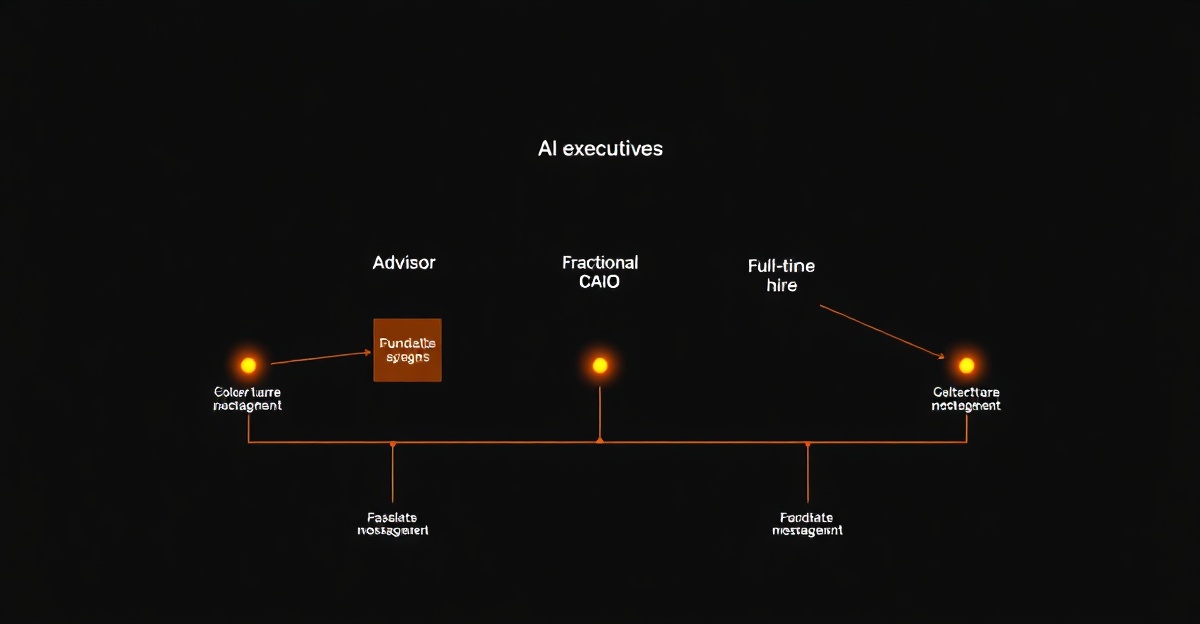
- The engagement spectrum runs from one-day AI advisory through fractional CAIO retainer to full-time hire. Most companies move along the spectrum as AI matures inside the business.
- Combined CTO and AI Officer (the CTAIO model) works under ~100 engineers. Past that scale the two jobs diverge enough to need separate owners. I have held both — the split is usually cleaner past that scale.
The fractional Chief AI Officer is the newest of the three fractional executive roles I run, and it's the one that needs the most explanation. Companies that have absorbed the fractional CTO and fractional CIO models still ask whether the CAIO is a real role or an upmarket version of an AI consultant. It's a real role. It's real because the work of running AI well at the executive level is no longer cleanly part of either the CTO seat or the CIO seat.
What was a few experiments two years ago is now operating capability. Foundation-model selection, AI vendor contracts, governance for AI-generated content, the build-vs-buy decisions on AI infrastructure, the senior judgment on what to invest in and what to wait out: at most mid-market companies this is now too much work for the CTO to credibly own alongside the engineering platform, and too specialized for the CIO to own alongside internal IT. The gap is real, and the fractional model is one of the answers to it.
This page is the practitioner's view of when the model makes sense, what the engagement looks like, and how it relates to the other AI leadership shapes — strategy consulting, AI advisory, and the full-time CAIO hire. It pairs with the Fractional CTO and CIO hub for the broader engagement story, and with the CTAIO service page for the combined-seat option.
What a Fractional Chief AI Officer Actually Owns
The scope concentrates on the decisions that compound. AI work is unusual in how much of the value sits in a small number of structural calls (model gateway architecture, foundation-model vendor mix, governance frame, build-vs-buy line) that, once made, are expensive to revisit. The fractional CAIO exists to bring senior judgment to those calls, and to own the agenda continuously enough that the company doesn't accumulate compounding wrong turns.
- Model and vendor selection. Which foundation models the company uses for which workloads, on what contracts, with what fallback plans. The foundation-model market changes meaningfully every quarter; the calls need someone tracking it continuously.
- AI strategy and roadmap. What the company should build, what to buy, what to wait out, on what timeline, with what investment. This is the document the board signs off on and the leadership team executes against.
- Data governance for AI workloads. What data goes to third-party models, what stays internal, how training data is provenance-tracked, how AI-generated outputs are stored and audited. Increasingly this overlaps with the CIO scope but the AI-specific judgment lives in the CAIO seat.
- AI infrastructure decisions. Build-vs-buy on model gateways, prompt management, evaluation infrastructure, agent orchestration. The infrastructure layer is moving fast enough that the wrong build decision in 2025 can be a write-off by mid-2026, and the wrong buy decision is a multi-year lock-in.
- AI vendor contracts and spend management. Enterprise contracts with frontier-model providers are now large enough to need senior negotiation. Token-arbitrage strategies and multi-vendor architectures need someone with the leverage and the credibility to make them stick.
- Board and customer-facing AI conversations. The questions are coming from both sides. The CAIO is increasingly the executive who owns the answer.
How the CAIO Differs from the CTO and CIO
vs. Fractional CTO
A fractional CTO owns the technology platform the company's product runs on — the engineering team, architecture, developer productivity, the build itself. A fractional CAIO owns the AI capability that runs through the products, internal tooling, and workflows. Under roughly 100 engineers the two jobs collapse cleanly into the CTAIO model, which I have held. Past that scale the model-selection cycle, AI safety governance, and foundation-market knowledge required start to crowd out the time the CTO role needs. The clean split is a CTO who owns the platform and a CAIO who owns the AI capability — fractional, full-time, or combined into a single fractional CTAIO if the scale still allows it.
vs. Fractional CIO
A fractional CIO owns internal IT, vendor management, security posture, and compliance. The overlap with the CAIO is governance — AI usage policies, third-party model data, AI-generated content rules — and both seats often work the same problem from different angles. The clean division: the CIO owns the policy frame and the audit posture; the CAIO owns the AI-specific judgment about what the policy should be and how it applies as the technology changes. At smaller companies one fractional person can credibly hold both; past a certain scale the AI-specific work is enough to need its own seat.
vs. AI Consultant
An AI consultant delivers a recommendation and leaves; a fractional CAIO takes ownership of the AI agenda over time. For one-off questions — vendor evaluation, board prep, a 90-day AI strategy sprint — consulting is often the right shape. For continuous ownership of the agenda as it matures inside the business, the fractional engagement is usually the right shape. Many engagements I run started as a consulting project and converted to fractional when the company realized the agenda needed an owner with continuity, not a sequence of point-in-time recommendations.
vs. AI Advisor
AI advisor is the lower-commitment entry on the same spectrum. A single day of advisory before a board meeting, a two-hour call to evaluate a vendor proposal, a written second opinion on a strategic call. Advisory is a useful first engagement to test whether a deeper fractional shape is the right fit. Most fractional CAIO engagements I run had an advisory call at the start, and many companies that started with advisory stayed at advisory because that was the level of input the business actually needed.
When to Hire a Fractional Chief AI Officer
Three recurring triggers produce most of the fractional CAIO engagements I see.
- Two or more AI workloads in production. Once the company crosses from one experiment to two, the architecture decisions start to compound. Model gateway, prompt management, evaluation infrastructure, observability — the decisions are expensive to reverse, and the wrong defaults applied to the second workload become the wrong defaults applied to the next ten. This is the most common trigger.
- AI budget crosses ~$1M-$2M per year. When the CFO starts asking for credible senior judgment on the AI line item, the company is past the stage where the CTO can comfortably absorb the answer as a side responsibility. The fractional CAIO is the seat that owns the answer.
- External pressure on AI usage. Enterprise customers asking about AI in their data, regulators asking about model governance, the board asking what the AI strategy is. Any one of these can pull the trigger; usually it is the combination, and usually the trigger gets pulled later than it should have.
"The right time to hire a fractional CAIO is the quarter before the company realizes it needed one two quarters ago. The decisions that compound in AI are the ones made before anyone is paying close attention."
What a Fractional CAIO Engagement Looks Like
First 90 days
Three workstreams in parallel. One: AI inventory and assessment — mapping every AI workload in production, every vendor contract, every model gateway, every prompt-management surface, and every shadow-AI usage the leadership team doesn't know about yet. Most companies have meaningfully more AI in production than the executive team realizes. In my engagements the inventory itself typically surfaces 15-30% spend optimization (occasionally higher at companies with serious vendor sprawl), through consolidation, model-tier downshifts on workloads that don't need frontier capability, and identification of unused capacity.
Two: governance baseline — defining the policies for AI usage, third-party model data, AI-generated content, and AI in customer-facing workflows. The bar is "what would a regulator, an enterprise customer, or a journalist need to see to conclude this company is running AI responsibly?" The deliverable is a written policy frame the board can sign off on.
Three: strategic roadmap — what the company should build, buy, or stop investing in, on what timeline, with what investment. The roadmap reflects both the company's strategic context and the realistic state of the AI market at that quarter, because the second variable changes meaningfully every three months.
Months 4-12
Execute on the 90-day assessment. Renegotiate the major AI vendor contracts. Stand up the missing infrastructure layers. Lead the build-vs-buy decisions on the priority workloads. Hire or restructure the internal AI team to fit the operating model. Report quarterly to the board on AI spend, capability progress, and risk posture. By the end of month 12 the AI function should be running at a level the company can sustain without firefighting, and the fractional intensity often comes down from 4-5 days per month to 2-3.
Year 2 onward
Steady-state engagements shift to strategic oversight and periodic intensity bursts. Quarterly strategy reviews. Annual contract negotiation cycles. Specific initiatives — a new AI-native product, an acquisition that brings AI workloads with it, a regulatory regime that requires governance work — bring the fractional CAIO back into higher-intensity mode for the duration. The engagement often ends when the company decides AI is strategic enough to need a full-time CAIO, usually when AI is a meaningful share of revenue or when AI spend crosses roughly $10M per year.
The EU AI Act and What It Means for the CAIO
The EU AI Act entered into force in August 2024 and most of its substantive obligations apply from August 2026, with the prohibited-practices ban already live since February 2025 and the general-purpose AI model rules in effect since August 2025. By the time most companies finish reading this paragraph, parts of the regime that affect them are already enforceable. The CAIO seat sits at the intersection of three obligations that companies operating in or selling into the EU need to own.
- Risk classification of every AI system in the estate. The Act sorts AI systems into prohibited, high-risk, limited-risk, and minimal-risk tiers. The high-risk tier carries conformity assessments, technical documentation requirements, post-market monitoring, and reporting obligations. Most companies have at least one system that lands in high-risk and have not classified it yet. The CAIO owns the inventory and the classification.
- General-purpose AI model obligations. Companies that deploy foundation models (which is most of them now) inherit obligations downstream, including transparency about training data summaries, copyright compliance, and incident reporting for systemic-risk models. Mapping vendor obligations into the company's own deployment posture is CAIO work.
- Human oversight, data governance, and bias monitoring on high-risk systems. Article 14 (human oversight), Article 10 (data governance and bias), and Article 9 (risk management) all require ongoing operational processes, not one-time audits. Writing the operating model that makes those processes real, and the audit trail that proves they ran, sits in the same seat.
Practical posture I take on engagements with EU exposure: inventory in the first 30 days, risk classification by day 60, governance operating model by day 90. Companies that try to fit the full conformity assessment into a single quarter usually miss either the inventory step or the operating-model step, and the gap shows up under regulator scrutiny.
Talent Strategy: AI Capability vs AI Hiring
AI talent strategy now sits with the CAIO at the portfolio level, not as a hiring-requisition exercise. The right question is what mix of in-house capability, vendor-managed capability, and contracted specialist capability the company actually needs at its current stage. Three postures on that spectrum hold up in practice.
The thin in-house posture works for companies under roughly 200 employees with AI in supporting workloads but not in the core product. A small platform team (2-5 engineers) sets the infrastructure, evaluation frameworks, and governance rails. Application teams use the platform with light AI tooling. Specialist capability (model fine-tuning, agent design, evals at scale) comes from a small bench of contracted senior practitioners on retainer. Total AI headcount stays under 8, and the company maintains optionality without overcommitting to a hiring posture it cannot sustain.
The deep in-house posture is for companies where AI is the product or a meaningful share of the product surface. A dedicated AI engineering org with model-platform, evaluation, applied research, and AI product engineering as distinct disciplines. Hiring against ML PhDs and applied-AI engineers at scale. Total AI headcount can range from 30 to several hundred depending on company size. This posture requires the CAIO to also be running a serious recruiting motion against a thin labor market.
The hybrid vendor-led posture is increasingly viable for companies that previously would have hired deep in-house. A small internal AI platform team (3-8 engineers) wraps and operates frontier-model APIs from OpenAI, Anthropic, Google, or open-source equivalents. Vendor capability handles model quality, safety research, and capability frontier. Internal teams handle integration, evaluation, and the specific AI products. This posture has gotten more credible as the vendor APIs have matured, and it is the right answer for many companies that two years ago would have over-hired.
The wrong move is to default to deep in-house because that is the most ambitious posture. Most companies do not need it and cannot staff it, and the in-between version (a 15-person AI org that is not deep enough to be genuinely capability-leading but is too expensive to be a thin platform team) is the most common failure mode I see.
When to Combine the CTO and CAIO Seats
The combined Chief Technology and AI Officer (CTAIO) model — one fractional person owning both the engineering platform and the AI agenda — works at smaller companies. The split isn't a hard number; it's a complexity threshold. Under roughly 100 engineers, with AI spend under ~$2M per year as a rule of thumb, and without AI products in the customer-facing critical path, one senior person can credibly hold both seats. I have held the combined seat in practice, and the economics work because the same underlying judgment about platform decisions translates into the AI infrastructure decisions with relatively low context-switching cost.
Past that scale the model breaks. The foundation-model market moves fast enough that staying current on vendor positioning, model capability, and pricing structures is itself substantial work. AI safety governance is a discipline that doesn't trade off against engineering management cleanly. And the board-facing AI conversation is increasingly its own conversation, not a footnote in the CTO update. The clean answer at larger scale is a CTO who owns the platform and a CAIO who owns the AI capability that runs through it — sometimes both fractional, sometimes one fractional and one full-time, depending on where each function is in its maturity curve.
For companies still inside the scale where the combined seat works, the CTAIO service page covers the combined model directly.
How to Choose a Good Fractional CAIO
Three filters in order of importance.
Have they actually run AI in production at scale?
The CAIO seat is technical enough that bench-time matters. Someone who has only advised on AI strategy without owning production AI workloads will struggle with the operational decisions — model gateway debugging, evaluation infrastructure design, the realistic latency and cost tradeoffs of multi-model architectures. Ask for specific production examples and the calls they made, with numbers.
Are they current on the foundation-model market?
The foundation-model market changes meaningfully every quarter. A fractional CAIO who is anchored on 2024-era vendor positioning will make 2024-era decisions on 2026 questions. The chemistry call should include a current question — a real vendor decision the company is facing — and the candidate's answer should reflect the actual state of the market, not the state of the market when they last had to know.
Can they tell the company what not to do?
Most AI strategy decisions are about restraint. What not to build, what to wait out, where to ride a vendor curve rather than spending engineering capacity. A CAIO who reflexively recommends building everything internally is selling engineering hours; a CAIO who reflexively recommends buying everything is missing the strategic AI investments. The senior judgment is in knowing which is which, on which workloads, in which quarter.
Summary
A fractional Chief AI Officer is the right answer for mid-market companies that have crossed from AI experiments to AI as operating capability and need senior judgment on the decisions that compound. The scope is AI strategy, model and vendor selection, data governance for AI, and the build-vs-buy decisions across the AI stack. The role sits between a fractional CTO and a fractional CIO, and exists because the work of running AI well is now too specialized to fold cleanly into either traditional executive seat.
Engagements typically run 6-24 months at $15,000-$40,000 per month for 3-5 days per month, with the engagement spectrum extending from one-day advisory through fractional retainer to full-time hire. Most companies move along the spectrum as AI matures inside the business. The transition between points on the spectrum is itself a useful signal that the engagement is working — that the company has graduated from one shape of senior AI input to the next.
If you're at the stage where you're trying to work out whether your company needs a fractional CAIO, a one-day advisory engagement is usually the cleanest first move. Book an expert call to start there.
For the full-time variant of this seat, see AI CIO and AI CTO. For the project-shaped consulting alternative when the work has a defined start and end, see AI strategy consulting.
Frequently Asked Questions
What does a fractional Chief AI Officer actually do?
A fractional Chief AI Officer (CAIO) owns the AI agenda for a company: model and vendor selection across the foundation-model market, AI strategy and roadmap, data governance for AI workloads, the build-vs-buy decisions on internal AI infrastructure, AI vendor contracts and spend management, and the executive-level conversations with the board and customers about how the company is using AI. The work is concentrated in decisions that compound — the choice between Anthropic and OpenAI for a core workload, the decision to build an internal model gateway or buy one, the governance frame for AI-generated content — rather than in day-to-day operational management.
How is a fractional CAIO different from a fractional CTO?
A fractional CTO owns the technology platform the company's product runs on — engineering team, architecture, developer productivity, the build itself. A fractional CAIO owns the AI capability that runs through the products, the internal tooling, and the workflows. At smaller companies the two jobs collapse into one (the CTAIO model), which I have held in practice. Past roughly 100 engineers or once AI spend crosses ~$2M per year, the two jobs diverge enough that a single fractional person can no longer credibly own both. Model selection, AI safety governance, and the rapid vendor-evaluation cycle of the foundation-model market are substantial enough work to justify a dedicated seat.
When does a company need a fractional Chief AI Officer?
Three recurring triggers. One: the company has at least two AI workloads in production and is starting to make architecture decisions that will compound — model gateway, prompt management, evaluation infrastructure, agent orchestration. Two: AI budget has crossed roughly $1M-$2M per year and the CFO is asking for senior judgment on how to spend it credibly. Three: the company is starting to face external pressure — enterprise customers asking about AI usage in their data, regulators asking about model governance, the board asking what the AI strategy is. Any one of these triggers the question; usually it is the combination that pulls the trigger.
How much does a fractional Chief AI Officer cost?
Typical engagements run $15,000-$40,000 per month for 3-5 days per month of senior executive time. Higher-intensity engagements at larger companies — usually those with AI spend above $10M per year or with active AI products in customer-facing workflows — run $35,000-$70,000 per month for 5-8 days per month. One-day AI advisory sessions run $3,000-$5,000. Defined-scope project work, such as an AI strategy sprint or a model and vendor evaluation, runs $30,000-$120,000 depending on duration. For comparison: a full-time CAIO at a senior level typically costs $400,000-$600,000 base plus benefits and equity, fully loaded over $700,000 in year one.
What is the engagement spectrum for an AI officer?
Four points along a spectrum. One: AI advisor — one-day or two-day engagements, $3,000-$5,000 per day, for clearly bounded questions (model selection, vendor evaluation, board prep). Two: AI strategy sprint — 4-8 weeks defined-scope project, $30,000-$120,000, producing a strategy document and an investment plan. Three: fractional CAIO retainer — 6-24 month engagement, 3-5 days per month, $15,000-$40,000 per month, owning the AI agenda continuously. Four: full-time CAIO — usually when AI is a meaningful share of revenue or risk, or when the company crosses a scale where the fractional cadence no longer fits. Most companies move along the spectrum as AI matures inside the business; it is rare to start at the right intensity on the first engagement.
Should the AI officer role be combined with the CTO or kept separate?
Combined works at smaller companies — roughly under 100 engineers, AI spend under ~$2M per year, no AI products in the customer-facing critical path. I have held the combined Chief Technology and AI Officer (CTAIO) seat and it is workable at that scale because the same person can credibly own both the engineering platform and the AI agenda without either suffering. Past that scale the two jobs diverge sharply. Model selection cycles, AI safety governance, and the depth of foundation-model market knowledge required start to crowd out the time and attention the CTO role needs. The clean split at scale is a CTO who owns the platform and a CAIO (fractional or full-time) who owns the AI capability that runs through it.
What does a typical fractional CAIO engagement look like in the first 90 days?
Three workstreams in parallel. One: AI inventory and assessment — mapping every AI workload in production, every vendor relationship, every model gateway, every prompt management surface. Most mid-market companies have more AI in production than the leadership team realizes, and the inventory itself typically surfaces 15-30% spend optimization. Two: governance baseline — defining the policies for AI usage, data sent to third-party models, AI-generated content, and AI in customer-facing workflows. Three: strategic roadmap — what the company should build, buy, or stop, on what timeline, with what investment. The deliverable at day 90 is a written strategy with prioritized initiatives, a vendor map, and a governance frame the board can sign off on.
What is the difference between a fractional CAIO and an AI consultant?
An AI consultant typically delivers a recommendation and leaves; a fractional CAIO takes ownership of the AI agenda over time and is accountable for the outcomes. The consultant's product is the analysis. The fractional CAIO's product is the running capability and the cumulative judgment about how it evolves. For one-off questions — a vendor evaluation, a board prep, an AI strategy sprint — consulting can be the right shape. For continuous ownership of the AI agenda as it matures inside the business, the fractional engagement is usually the right shape. Many engagements start as consulting and become fractional once the company realizes the agenda needs an owner with continuity, not a series of point-in-time recommendations.
Need Expert Technology Guidance?
20+ years leading technology transformations. Get a technology executive's perspective on your biggest challenges.
