
Week by week
Right subtrochanteric femur fracture, April 21, 2026. Where the leg actually was each week.
- SurgeryApr 21 Cycling crash at 15:00, on the operating table by 23:00. One titanium nail, calcar involvement. Done
- Week 1Apr Seven days inpatient, then discharge. Non-weight-bearing locked in for six weeks. Done
- Week 2Apr/May Home physiotherapy starts. First passive straight-leg raise, the leg still drops under its own weight. Done
- Week 3May Sutures out, the two-week X-ray reads clean, and the first unassisted straight-leg raise lands. Done
- Week 4May Off all prescription painkillers. Pool and stationary-bike work begin, strictly off-load. Done
- Week 5May Single crutch indoors. Walking in water without holding the rail. Done
- Week 6Jun 3 The X-ray shows bridging callus. Cleared from non-weight-bearing straight to 50%, past the textbook 25% step. Done
- Week 7Jun First time holding full bodyweight on the operated leg alone. Fifteen seconds, shaking the whole way. Done
- Week 8Jun Single crutch everywhere, the work commute included. First real swim, and the first steps with no crutch at all. Done
- Week 9Late Jun The knee finally holds straight through stance. Breaststroke back alongside freestyle, and the first spin session hard enough to draw a sweat. Now
- RaceJul 4 '27 Challenge Roth, the comeback start line. Fourteen months out from surgery. Target
What Happened
On April 21, 2026, at around 15:00 local time in Ho Chi Minh City, I went out on my first outdoor ride with aerobars on a rental Cannondale. Reaching for the aero bars with my right hand while rolling, the bike began to swerve. I went down laterally onto my right side: helmet, right shoulder, right hip. Intense pain on impact, and the leg would not hold any weight. Right femur, subtrochanteric. I knew before the X-ray confirmed it.
Friends in the swim community escalated me from a small local clinic directly to BVDK Tâm Anh in Tân Bình, the orthopaedic destination in HCMC. Pre-operative imaging confirmed a comminuted intertrochanteric fracture extending subtrochanterically, with calcar femorale involvement and a lesser-trochanter avulsion. On the pre-op CT 3D reconstruction the closest AO/OTA match is 31A3, the reverse-oblique intertrochanteric pattern that behaves clinically like a subtrochanteric injury. The hospital's discharge documentation describes the location as subtrochanteric and uses ICD-10 S72.1 (intertrochanteric), reflecting how mixed these patterns can be in practice. Surgery began the same evening. I was on the operating table by about 23:00 ICT, roughly eight hours after the crash.
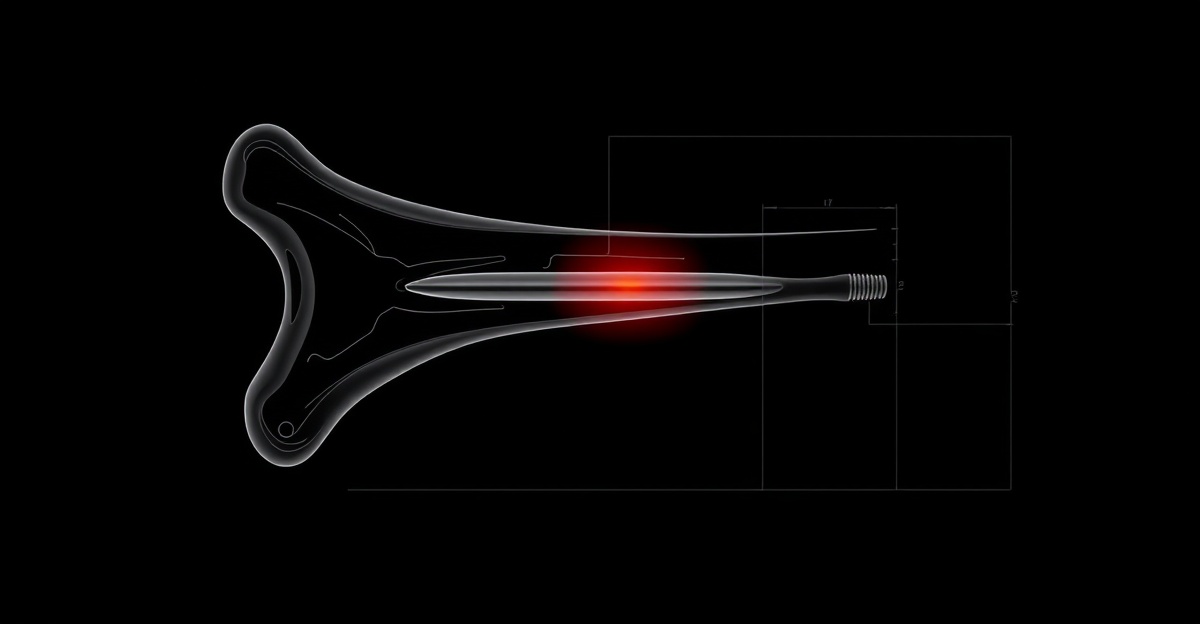
The operation was performed by ThS.BSCKII Nguyễn Văn Lưu and his team. Cephalomedullary intramedullary nail, cephalic lag screw, distal interlock, end cap. The full hardware specification, and what each part actually does mechanically, is covered in the surgery explained spoke.
The Hardware
For anyone landing here after a similar injury and wondering what is actually inside your leg — here is mine, lifted from the official implant card my hospital provided.
- Implant type: Cephalomedullary intramedullary nail + cephalic lag screw + distal interlock
- Model: Mediox Proximal Femoral Nail (PFN), 130° cervico-diaphyseal angle, cannulated
- Manufacturer: MEDIOX Orvosi Műszergyártó Kft, Hungary
- Material: Ti6Al4V ELI titanium alloy (ASTM F136) — MRI-conditional
- Side and site: Right femur, proximal/subtrochanteric region
- Implanted: 21/04/2026, ~23:00 ICT
- Surgeon: ThS.BSCKII Nguyễn Văn Lưu
- Hospital: BVDK Tâm Anh, Tân Bình, HCMC
- Diagnosis code: ICD-10 S72.1 (intertrochanteric, as used by the hospital for this mixed pattern)
- Removal plan: Not planned. Earliest reconsideration in 2028, only if clearly indicated.
My surgeon flagged early that the emergency-stock nails available on the day were not ideally sized for a 94 kg, 196 cm muscular frame. That one sentence reframed the whole rehab strategy. The bone was reduced anatomically. The implant has the right geometry. But the construct is not the most over-engineered version of itself for my body composition. The surgery explained article goes into what a calcar fracture means for early loading.
The Weight-Bearing Protocol
My weight-bearing plan is more conservative than the textbook IM-nail recipe. The reason is the fracture pattern, not over-protection.
- Weeks 1 to 6: non-weight-bearing on the right leg. Three-point gait on crutches. The crutches and the right leg advance together with zero load; the healthy left leg swings through with body weight on the crutches.
- Week 6 (June 3, 2026): follow-up X-ray with BS Lưu at BVDK Tâm Anh confirmed bridging callus on the medial cortex. The clearance skipped the textbook 25% step and went straight to 50% partial weight-bearing.
- Weeks 6 to 9: the progression ran ahead of the conservative script. Single-crutch transition around Week 8, first crutch-free steps soon after, and effectively full weight-bearing held by Week 8 — gated on gait quality, not the clock. The crutch goes back the moment the gait limps or pain climbs.
- Weeks 8 onward: early stationary cycling reopened, building to the first real sweat-drawing spin session in Week 9. Pool work and light swimming back online.
- Month 4 onward: return to running progression once gait is symmetric without a crutch and single-leg strength is restored on the operated side. Still ahead.
The textbook protocol for stable A1-pattern or diaphyseal-shaft femoral fractures often allows 25% partial weight-bearing at Week 4. For a comminuted AO 31A2 or 31A3 pattern with calcar disruption, current orthopaedic literature consistently uses non-weight-bearing or toe-touch only until Week 6, with weight bearing gated on radiographic bridging callus. BS Lưu's call is mainstream-conservative for this fracture pattern, not over-protective. The day-by-day breakdown lives in the broken femur recovery timeline.
Medication and Supplement Stack
Two separate stacks run in parallel: the prescription medication that handles pain, inflammation, infection prophylaxis, and DVT prevention, and the bone-healing supplement stack that handles the substrate side of fracture union.
Initial prescription (Day 1 to Day 14)
- Cefuroxim: first-generation oral antibiotic for infection prophylaxis through the early wound-healing window.
- Celecoxib: COX-2 selective NSAID for inflammation and pain. Emerging evidence suggests short-course COX-2 use may have less impact on callus formation than non-selective NSAIDs, though surgeon preference still varies.
- Ultracet (paracetamol 325 + tramadol 37.5): moderate breakthrough analgesia.
- Esomeprazole: PPI for gastric protection during NSAID use.
- Rivaroxaban 10 mg: direct oral anticoagulant for deep vein thrombosis prophylaxis during the early immobilization window.
- Gabapentin: neuropathic pain coverage at night, also helps sleep through the first two weeks.
Renewal prescription (Day 15 to Day 28)
After the Week 2 visit, BS Lưu's renewal carried Celecoxib BID, Ultracet TID, NextG Cal (calcium + vitamin D3 + K1), and Gabapentin HS, dropping Rivaroxaban once the operative DVT window closed and the daily ankle pumps plus walking with crutches took over as the primary mechanical prophylaxis. That 14-day course ended on Day 28. I have been off all prescription analgesia since Week 4, holding at a 1–2/10 baseline without anything for pain — the bone-healing supplement stack is the only thing still running.
The bone-healing supplement stack
Decided in collaboration with my Ironman coach Rob Wilby and confirmed against my own pre-existing blood work (a comprehensive panel from January 2026 was the operating baseline).
- Vitamin D3 + K2: ~5,000 IU D3 per day with MK-4 K2. D3 keeps serum 25(OH)D in the upper range during the healing window. K2 routes calcium into bone instead of soft tissue.
- Calcium: targeting ~1,200 mg/day total (supplement plus diet) via Aquamin F (red seaweed-derived calcium with better absorption than plain carbonate) and the NextG Cal hydroxyapatite tablet from the renewal Rx.
- Magnesium citrate: 400 mg elemental at night, supports sleep, muscle function, and bone remodelling. Spaced from calcium by at least two hours to avoid absorption competition.
- Omega-3 (NOW Ultra): 2.25 g EPA + DHA per day, anti-inflammatory without the bone-healing impairment seen with sustained higher-dose NSAIDs.
- Creatine monohydrate: 5 g/day. Best-documented anti-atrophy compound during immobilization. Also neuroprotective post-anaesthesia.
- Zinc: 15–30 mg/day, osteoblast cofactor essential for bone repair. Taken with food, separated from calcium.
- Vitamin C: 500–1,000 mg/day, collagen-synthesis cofactor.
- Hydrolyzed collagen peptides: 15–20 g pre-PT with 500 mg vitamin C, from Week 2 onward when tissue loading begins.
- Protein target: 1.6–2.0 g/kg/day, hit through food (~180 g/day at 94 kg).
Deliberately not in the stack: standing NSAIDs past the acute pain window, calcium carbonate on an empty stomach, alcohol for at least the first 12 weeks, and any "bone broth as protein source" thinking. The things that demonstrably impair callus formation (alcohol, nicotine, sleep deprivation, under-eating) are red lines for me, not preferences.
Physiotherapy
PT started on Day 7 (discharge day), with the hospital's resident physiotherapist running the first session in my apartment. Day 1 to Day 7 inside the hospital was almost entirely positioning, ankle pumps, and bed-based isometric work to prevent rotation deformity and DVT.
Once home, the protocol stacked up across multiple practitioners:
- Hospital-referral home PT (Nhựt Vinh): took over from Day 9, twice a week through the first three weeks. Driving the Phase-2 plan he sent through Zalo on Day 11: passive-assisted straight-leg raises, side-lying and supine hip abductions, standing-with-support work, sit/stand practice.
- Independent home-visit PT (Billy, from Phan/Martin's team): first session Day 18, US-trained background. Different perspective on standing progression and deep-tissue scope over the IM-nail entry. Sessions weekly.
- ACC clinic physio (Phương): introduced from Day 20 for the clinic-style sessions while waiting on the FV outpatient referral letter from BVDK Tâm Anh.
- Daily self-PT: ankle pumps, isometric quads/glutes/hamstrings, heel slides, straight-leg raises (passive, then assisted, then unassisted by Day 20), supine hip abductions. Two rounds per day minimum, three on heavier days.
Movement milestones from the daily log so far:
- Day 9: first passive-assisted SLR introduced. Right leg could not lift unassisted.
- Day 11: first deep-tissue manual therapy session over the surgical area with Vinh. Cleared verbally with BS Lưu at Day 15.
- Day 15: sutures removed, Week 2 X-ray confirms hardware in original position, fracture appearance fine, very early periosteal callus haziness on the medial cortex.
- Day 16: first night without breakthrough pain. 7.5 hours of largely unbroken sleep on the new renewal Rx.
- Day 18: first shower post-surgery, silicone scar-care protocol started, two PT sessions in one day (Billy AM + Vinh PM).
- Day 20: first unassisted right-leg straight-leg raise. Active hip-flexor control with no manual assist. Nine days from passive-assisted introduction to active execution. This was a real moment.
- Day 28 (Week 4): off all prescription painkillers. Baseline pain settled to 1–2/10 with nothing for it.
- Day 43 (Week 6, June 3): the X-ray showed bridging callus. Cleared from non-weight-bearing straight to 50% partial weight-bearing — past the textbook 25% step.
- Day 50: first time holding full body weight on the operated leg alone in a single-leg stance — about 15 seconds, shaking the whole way. Neuromuscular, not structural; the benchmark that gates symmetric gait.
- Day 53: single crutch everywhere, including the work commute — two crutches retired. Same day, the first real swim: a gentle full stroke with a light flutter kick.
- Day 54: first crutch-free walking. Effectively full weight-bearing, walked only as far as the gait held clean.
- Week 9 (late June): single-crutch walking with the operated leg fully extended through stance — the straight-knee load tolerance finally landing. Breaststroke back alongside freestyle, and the first spin session hard enough to break a proper sweat: the cardio engine reopening.
The full day-by-day arc, with the numbers behind each of these, lives in the recovery timeline.
Recovery as a Hybrid Athlete
Most femur-fracture recovery content is written for a generic patient. A generic patient wants to walk to the bathroom unaided. I want to walk to the bathroom unaided, then deadlift 140 kg again, then run 10 km under 50 minutes again, then push a 150 kg sled 50 metres at a HYROX station, then race an Ironman in July 2027. The bone heals at the same speed for both of us. Everything around the bone — fitness, fear, identity, race calendar — does not.
Before the crash I was deep in a Challenge Roth 2026 build. December 2025 lab work: lactate threshold 2 at 5:10/km @ 166 bpm, FTP 261 W (2.77 W/kg at 94 kg race-prep weight), max HR 190, resting HR 59–63. Marathon prediction 3:49. A handful of HYROX events in the legs, a few swimrun races, a long history with the 10 km and half-marathon. By the time you read this, none of those numbers are still mine. Detraining started the moment the femur cracked. The job for the next six months is not to keep them. The job is to know which engines I can keep running while the bone heals.
Swim engine: stays on first
The swim is the discipline I lose fastest in normal life and the one that returns first in this recovery. Pool work is cleared as soon as the wounds are fully sealed and the surgeon signs off on submersion, typically Week 4 to Week 6. The protocol that opens the pool door is pull-only with a float or buoy between the knees: zero load through the femur, zero kick, full upper-body and lat engagement. CSS pace will drop, but the aerobic engine survives. By Week 8 to Week 10 I expect to be doing 2,500–3,000 m sessions three to four times a week, pull-dominated, with light kick reintroduction late in the window.
For an Ironman comeback specifically, this matters more than it looks on paper. The Ironman swim is 3.8 km of steady aerobic load with almost no leg involvement if you draft correctly. Of the three disciplines, the swim is the one where lost form returns inside weeks, not months. Roth 2027 starts in the water, and the swim leg is the one I am most confident about hitting on schedule.
Bike engine: stationary first, road later
Stationary cycling on an indoor trainer is the bridge between immobilization and outdoor sport. The exact start date depends on the Week 6 X-ray (June 3, 2026) showing bridging callus on the medial cortex. With clearance, the progression is short and slow at first:
- Week 6 to Week 8: 20–30 minute sessions, low resistance, cadence 80–90, heart rate aerobic. The point is range of motion and venous return, not training.
- Week 8 to Week 12: longer sessions, low-moderate resistance, occasional 5–10 minute steady-state efforts. The leg is loaded in a closed kinetic chain with zero impact, which is exactly what the construct can tolerate.
- Month 3 to Month 4: structured sweet-spot work, FTP rebuild. Outdoor cycling re-introduced cautiously, on flat roads, with zero aerobar work. The aerobar progression that caused the crash gets done indoors, on a trainer, with no traffic.
FTP for a trained cyclist typically loses 5–10% per month of total detraining and recovers at roughly half that rate during rebuild. Realistic FTP target for the start of the Roth 2027 build: 230–240 W by Month 6, back to 260+ W by Month 10, holding race-day power for 180 km the limiter rather than the peak number.
Run engine: the slowest discipline back
Running is the discipline that has to wait. Impact loading is what the bone and the construct need protection from for the longest. The progression looks like this, with each step gated on the operated leg absorbing the load without pain, swelling, or compensation in the gait:
- Walking unloaded: from Week 6 if the X-ray cooperates, gradually transitioning from crutches to cane to nothing.
- Hiking and treadmill walking: Month 3 onward. Incline work to build glute and calf strength on the operated side.
- Walk-jog intervals on soft surface: Month 4 to Month 5. 30-second jogs with two-minute walks, on a track or treadmill. The first easy minute of jogging will be a milestone the daily log marks specifically.
- Continuous easy running: Month 5 to Month 6. Time on feet, not pace. 20–40 minute aerobic runs, three to four times a week, on soft surface for the first month.
- Structured run training: Month 7 onward. Tempo, threshold, long runs. Mileage built carefully, with PTTD vigilance running in parallel (see the PTTD playbook — that vulnerability is still on the operating system).
For an Ironman marathon leg specifically, the question is not whether I can run 42 km. It is whether I can run 42 km after a 180 km bike at Ironman pace. That gets answered in the brick sessions of Month 12 to Month 13. Targeting a 4:00–4:30 Ironman marathon split is realistic. Targeting a marathon PR on tired legs in Roth 2027 is not. Finishing Roth standing, with the operated leg intact, is the only KPI that matters.
HYROX is not on the table in 2026
HYROX deserves its own paragraph because the demands are different from a marathon or a triathlon, and they map badly to a healing femur. A HYROX event is eight kilometres of running broken by eight workout stations: sled push, sled pull, burpee broad jumps, walking lunges, wall balls, farmer's carry, sandbag lunges, rowing, and SkiErg. Several of those stations apply exactly the loading patterns that put the implant at risk during early recovery.
- Sled push and pull: high horizontal force through extended hip and knee on the driving leg. Compression and shear at the femur are significant. Off the table until well past full weight bearing.
- Walking lunges (with or without sandbag): deep hip flexion under load, asymmetric loading on the working leg. The Day-15 BS Lưu instruction explicitly warned against deep squatting, kneeling, cross-legged sitting, and leg-crossing — lunges live in the same neighbourhood.
- Burpee broad jumps: jump landing absorbs 4–6× bodyweight at the hip. The first jump-landing on the operated leg is months away.
- Wall balls and SkiErg: the two stations a healing femur can survive earliest. SkiErg is upper-body dominant. Wall balls are loaded squats — the shallowest squat depth I can find without violating the no-deep-flexion rule.
Realistic HYROX timeline: no event in 2026. A doubles or relay entry in late 2027 if the comeback is fully on rails. A solo HYROX in 2028, not before. The Roth 2027 build takes priority through July; HYROX re-entry is a downstream question.
Strength training: the contralateral and ipsilateral order
Strength work runs through three phases during the recovery.
- Weeks 1 to 6 — contralateral and upper body: heavy single-leg work on the intact left leg (Bulgarian split squats from a chair once positioning allows, single-leg presses, step-ups), and unrestricted upper-body work seated or supine. Contralateral neural drive carries to the operated side. Upper body keeps the engine running, mood up, and a sense of training intact.
- Week 6 to Month 3 — gentle ipsilateral reintroduction: very light bilateral movements (leg press at low loads, glute bridges, supported step-ups onto a low box) once partial weight bearing is cleared. The goal is reactivation and neural pattern restoration, not load.
- Month 3 onward — symmetric strength rebuild: bilateral squats, deadlifts, and posterior-chain work at progressive loads. Single-leg benchmarks (single-leg press, single-leg Romanian deadlift, single-leg calf raise) tracked against the contralateral side, with a target of 90%+ symmetry before any return-to-run progression.
The hybrid-athlete background helps here. Years of strength training before the injury means the muscle architecture and motor patterns are not starting from zero. The contralateral training effect lands on a system that already knew how to recruit the operated leg correctly. The rebuild is shorter than it would be for an athlete with no strength base.
What 46 changes
Age 46 (47 by the time of Roth 2027) changes three things specifically. First, the bone heals at the same speed as it did at 26, but the soft-tissue recovery from the surgical insult is slower. Plan a few extra weeks of swelling, stiffness, and scar maturation. Second, the aerobic engine returns less elastically. The VO2max ceiling I had at 35 is gone; the question is how cleanly I can rebuild what I had at 45. Third, the recovery window for hard sessions is longer. The weekly periodization for the Ironman build will carry one fewer hard day than I would have run at 30, with the time going into easier aerobic volume and recovery work. Nothing about that is tragic. It is just real, and pretending otherwise breaks the rebuild.
Race Implications
The 2026 season is closed. The 2027 season has one named target and a short list of conditional entries.
Cancelled in 2026
- Da Nang 70.3 (May 10, 2026): the closest race on the calendar at the time of the crash. Day 19 post-op on race day. Medical deferral submitted with the surgeon's letter, the operative note, and an off-sport estimate. Race credit transferred toward a future entry through the IRONMAN deferral process. The deferral worked cleanly; the process is well-suited to medical withdrawals when you bring the right documentation.
- Challenge Roth (July 5–6, 2026): the A-race the whole 2026 build was pointed at. Eleven weeks post-surgery on race day, which is biomechanically impossible for any version of the marathon leg with this fracture pattern. Formal deferral submitted to Challenge Family through the dedicated window. Registration transferred to Challenge Roth 2027 (Sunday, July 4, 2027). The deferral fee covers the transfer; my entry rolls forward intact.
- Valencia Marathon (December 6, 2026): the late-season backstop in the original plan, a flat fast course where I had hoped to chase a sub-3:45 marathon. Roughly 7.5 months post-surgery on race day. Theoretically inside the return-to-running window, practically incompatible with a conservative protocol on a comminuted pattern. Deferred formally; decision point was the Week 8–10 imaging series, and the answer has been "no" since the Day-15 visit reframed the timeline. Not chasing it.
2027 calendar
- Challenge Roth 2027 (Sunday, July 4, 2027): the named comeback target. Fourteen months post-surgery. The goal is to finish, not to PR. Finishing time secondary to crossing the line standing, with the operated leg structurally intact and pain-free. Realistic, not certain.
- Tune-up 70.3 in Q1–Q2 2027: a B-race in the build, somewhere flat with reliable weather. Used as a fitness check, not a result. Likely candidates: Vietnam (Da Nang or Phú Quốc) for the credit-transfer entry, or a European race that fits the geography around the Roth build.
- Optional half-marathon in Q1 2027: a dry run for the run engine before the Ironman build hits volume. Not chasing a time; the data point is whether the leg holds at race pace for 90 minutes.
Looking past Roth 2027
Roth 2027 is the goal. What follows is conditional on getting there in good shape:
- Late-2027 marathon: a real autumn or winter marathon with a time goal, run off the back of the Roth build. Amsterdam in October is likely off — too tight a turnaround after a July Ironman — which leaves Valencia in December on the docket, a flat fast course, conditional on reaching sub-4 shape by then. The question I cannot answer in mid-2026 is what a realistic post-femur marathon time looks like at 47. The honest answer is somewhere between "PR is gone" and "PR is on the table if the rebuild is clean," and the gap between those two is exactly what the year of work is for.
- HYROX re-entry in late 2027 or 2028: probably doubles or relay first, solo later. The implant tolerates sled work, but the question is whether the 47-year-old version of me wants to push a 152 kg sled with hardware in his femur. To be reviewed once the bone is fully remodelled.
- Roth 2028 or Kona qualification chase: the open-ended ambition. If the comeback Ironman in 2027 goes well, the build for a meaningful age-group result becomes the next chapter. Probably 2028 or 2029, not earlier.
The detailed periodization plan for the Roth 2027 comeback lives in the Road to Roth 2027 article. The short version is the same as the discipline-by-discipline arc above: swim engine first, bike engine second, run engine last, Ironman build proper starting once the operated leg can absorb impact at jogging pace.
What I'm Tracking Daily
Every evening at 21:10 I write a one-line entry into a markdown log: pain 0–10, sleep hours, mood 1–5, bowel movement Y/N, PT and walks Y/N, win of the day, concern of the day. The raw log lives in a separate repository. What surfaces on prommer.net is the structured public version of it. The recovery timeline spoke pulls the most important entries forward into a single readable arc.
Trends I watch over time, with thresholds:
- Pain should fall ~10–20% per week. A plateau or rise calls the surgeon.
- Sleep should hold ≥7 hours. Falling means pain is not controlled, anxiety is up, or the sleep position is wrong.
- Mood Week 2 to Week 4 is the lowest window. Three consecutive days under 5/10 triggers a coach call.
- Bowel movements daily by Week 1. Two skipped days means more water, more magnesium citrate, more fibre.
Why This Page Exists
When I started looking for first-person accounts of an active adult coming back from a subtrochanteric femur fracture with an IM nail, the search results were thin. Hospital marketing case studies. A handful of Reddit threads. One Slowtwitch forum post titled "I Broke My Femur: A Short Story from a Lifelong Triathlete." A YouTube clip of an NFL player. The medical literature is dense and aimed at clinicians, not patients. The forum posts are scattered and stop the moment the writer goes back to work.
This page, and the spokes around it, are the resource I wish I had been able to read on Day 3. The actual surgical detail. The medications and doses and the night they failed. The PT progression with the dates that mattered. The conversations with the surgeon and the coach that shaped every decision. I am writing this as a 46-year-old endurance athlete who was training for an Ironman when the crash happened. If that is roughly your starting point, I hope the next click is one of the spokes below and that something here lands.
Last updated 2026-06-28. This page will be re-edited as the recovery progresses and as imaging milestones change the picture. Comments and questions through the contact form.
The Full Cluster
Spokes in progress, linked from this pillar as they go live:
- Surgery Explained: The Mediox PFN Intramedullary Nail. What each piece of hardware does, why an IM nail beats a plate for this pattern, what calcar involvement means.
- Recovery Timeline: Day 0 to Week 24. The day-by-day arc, what changed when, real numbers.
- Weight-Bearing Progression. NWB to 25% to 50% to 75% to 100%, gated on X-ray and PT (planned).
- Pain Management. The medication stack, the night paracetamol failed, the renewal Rx that fixed sleep (planned).
- DVT Prophylaxis. Rivaroxaban, ankle pumps, and the flight risk after anticoagulation stops (planned).
- Physical Therapy Protocol. The four-week NWB exercise library and the Phase 2 plan that comes after (planned).
- Return to Running. The conservative walk-jog-run progression, gated on full weight bearing and single-leg strength (planned).
- Return to Cycling. Stationary trainer to road, and why the aerobar progression starts indoors next time (planned).
- Return to Triathlon. The full Ironman comeback build, pull-only swim engine first (planned).
- Crash Prevention: Aerobar Progression Done Right. What I will do differently when the next bike build starts (planned).
- Nutrition for Bone Healing. The supplement stack, protein math, blood work (planned).
- Mental Recovery. Week 2 to Week 4 mood drop, dependency, identity (planned).
Frequently Asked Questions
How long does a broken femur take to heal?
For an adult with surgical fixation, the bone itself typically achieves clinical union at 12–16 weeks, with full remodeling continuing for 6–12 months. My specific fracture (right subtrochanteric, AO 31A2/A3 pattern with calcar involvement) is non-weight-bearing for the first six weeks, with weight bearing progressed only after the Week 6 X-ray confirms bridging callus. Healing time is not the same as return-to-sport time — that depends on the fracture pattern, hardware, age, training history, and the specific demands of the sport you are returning to.
What kind of surgery is used for a broken femur in an active adult?
For most proximal and shaft femur fractures in adults, the modern standard is an intramedullary nail — a titanium rod placed inside the medullary canal of the femur, locked at both ends with screws. My implant is a Mediox Proximal Femoral Nail (PFN): a cephalomedullary nail with a 130° angle, a cephalic lag screw that runs up into the femoral neck and head, plus a distal interlocking screw. The construct is statically locked, which is what you want for controlled early loading.
Can you walk after a broken femur?
Eventually, yes — but the early weight-bearing protocol depends entirely on the fracture pattern and hardware. For stable fracture patterns, many surgeons allow weight bearing as tolerated within days of surgery. For comminuted intertrochanteric or subtrochanteric patterns with calcar involvement (mine), the implant alone bears the load until callus bridges the gap, and the protocol is non-weight-bearing for six weeks with crutches and a three-point gait. Self-accelerating weight bearing risks varus collapse, lag-screw cut-out, or implant fatigue.
Can you die from a broken femur?
A femur fracture is a serious injury with two main acute risks: bleeding (the femoral shaft can hold up to a litre of blood internally) and pulmonary embolism from a deep vein thrombosis. Both are managed in hospital with timely surgery, fluid resuscitation, and anticoagulants such as Rivaroxaban or enoxaparin. With prompt care, mortality in healthy active adults is low — but the injury is dangerous enough that any femur fracture is a hospital admission, not a wait-and-see situation.
When can I run again after a femur fracture?
For my fracture pattern and hardware, the realistic return-to-running window is 4–6 months post-surgery, gated on radiographic union and clinical milestones (full weight bearing, normal gait, restored single-leg strength, no pain on impact loading). Earlier running risks stress reaction at the bone-hardware interface. Faster patterns exist for stable shaft fractures with rigid IM nails, but the conservative path is what holds the comeback together long-term. My named target is Challenge Roth 2027, 14 months post-surgery.
Do you need the metal rod removed after a femur fracture?
Modern titanium intramedullary nails are designed to stay in. Hardware removal is generally only indicated if it causes pain, soft-tissue irritation, or rare hardware-related complications. For active patients planning to return to sport, leaving the nail in place is the default. My surgeon and I have agreed that removal will not be considered before 2028, and only if clearly indicated. The implant is MRI-conditional at 1.5T and 3T, cleared for airport security, and not a contraindication to any other surgery.
What is a Mediox Proximal Femoral Nail?
Mediox is a Hungarian medical device manufacturer (MEDIOX Orvosi Műszergyártó Kft, Felsőtárkány). Their Proximal Femoral Nail is a cephalomedullary IM nail system with a 130° cervico-diaphyseal angle, cannulated design, with a cephalic compression screw, distal locking screw, and end cap. It is built from Ti6Al4V ELI titanium alloy (ASTM F136) — the same medical-grade titanium used across the orthopedic industry. The implant is MRI-conditional and non-ferromagnetic.
How do you train for an Ironman with hardware in your femur?
You do not train for an Ironman in the first six weeks after a femur fracture. You train for the Ironman after the hardware is no longer the limiting factor on healing — typically 6–12 months post-op. The early work is upper-body strength, contralateral leg work (heavy single-leg loading on the intact side preserves neural drive to the injured side), motor imagery, and aggressive nutrition for bone healing. Once cleared, the return looks like pool work, stationary cycling, walking, jogging, then running, in that order, with the swim engine and bike engine doing most of the early fitness work.
Ready to Train Smarter?
Get personalized training zones, race predictions, and performance insights with our free calculators.
