
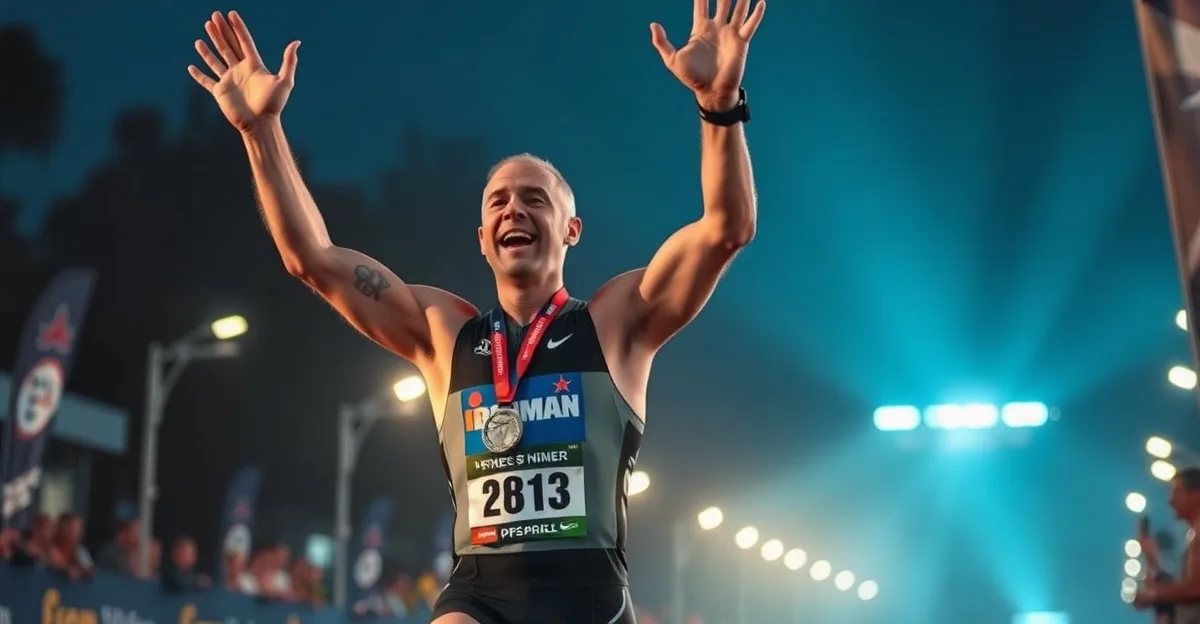
As of late June 2026 (Week 9), the leg is carrying full weight, the crutches are gone, and the swim and bike engines are back online. The Roth 2026 slot was cancelled and transferred to Challenge Roth 2027 on Sunday, July 4, 2027. The original first-Ironman plan didn't end on April 21 — it just got a new race date and a 14-month runway instead of 6.
April 21, 2026: the crash
First outdoor ride on the rental Cannondale in HCMC. Reaching down for the aero bars at around 15:00 ICT, the bike swerved and I fell laterally onto my right hip. The diagnosis at BVDK Tam Anh HCMC was a right femur subtrochanteric fracture, comminuted at the proximal end. Surgery the same day at ~23:00 ICT installed a cephalomedullary intramedullary nail (PFNA/TFN-style), titanium hardware (MRI-safe, confirmed by BS Lưu), with a cephalic lag screw and distal interlock.
The crash mechanism is mundane and worth naming: aerobars on an unfamiliar rental bike, first outdoor ride on Vietnamese roads, no time on the new geometry. Reach down, swerve, fall onto a hip that was never going to absorb that mass. If you're new to a tri bike, do your first 10 hours on a closed loop or a turbo trainer before going out into traffic. I didn't, and this is the consequence.
This week: cancelled Roth 2026, transferred to Roth 2027
The original plan had the 6-week post-op imaging milestone (June 3) gating the Roth 2026 decision. This week I made the call earlier and didn't wait. Two reasons:
- The clinical reality. By July 5, 2026 I'd be ~11 weeks post-op. Even on an aggressive subtrochanteric IM-nail return-to-sport timeline, that's too early for a full-distance Ironman effort. Bone needs time.
- The logistical reality. Roth slots sell out in under a minute when registration opens for the next year. Holding the existing 2026 slot and transferring it to 2027 was cleaner than letting it lapse and trying to grab a new slot at the open. I now have a confirmed 2027 entry instead of a hopeful "maybe."
The 2027 race date is Sunday, July 4, 2027 — first weekend of July, per Challenge convention. That gives a 14-month rebuild window from surgery, which is the kind of runway a first Ironman actually deserves.
May 19, 2026 — registration carry-over confirmed. The 2026 entry has been formally carried over to Challenge Roth 2027 and the 2027 registration fee is paid. The slot is locked in; no need to fight the sub-minute sell-out at the next open.
May 21, 2026 — payment received. mika:timing confirmed receipt of the €794 transfer for DATEV Challenge Roth 2027. Registration ID CR:JEH5. Participant account balanced, entry complete.
Recovery — where it stands at Week 9
The medical state as of late June 2026 (roughly Week 9 post-op):
- Hardware: titanium cephalomedullary IM nail. MRI-safe at any field strength. Removal option after 2 years (April 2028+) per surgeon.
- Weight-bearing: the Week 6 X-ray (June 3) confirmed bridging callus and cleared a jump straight to 50% partial weight-bearing — past the textbook 25% step. Single crutch by Week 8, first crutch-free steps soon after, effectively full weight-bearing by Week 8. The crutch still comes back the moment the gait limps.
- Gait: the work-in-progress. A fully extended leg under load only started feeling solid around Week 9 — clean single-crutch walking with the knee straight through stance is the thing that's finally landing.
- Pain control: off all prescription painkillers since Week 4 (Day 28). Baseline holds at 1–2/10 with nothing for it.
- DVT prophylaxis: Rivaroxaban stopped once the operative window closed; ankle pumps and load-bearing took over as the mechanical defence.
- Swim + bike: both back online. First real swim around Week 8 (freestyle, then breaststroke back by Week 9), and the first sweat-drawing spin session in Week 9 — the cardio engine reopening, hip kept off-load on the bike.
- Physical therapy: Phase 2 — glute-med-led strength, gait re-education, loaded stretching and cable rows leading the gains.
The unglamorous part is unchanged: sleep, enough protein, and not outrunning the gait. Bone healing isn't trainable. The body decides the schedule, and the job is to load it exactly as fast as it earns — no faster.
Objectives that carry over from the 2026 plan
The race date moved. The goals didn't:
- Finish a full Ironman. Same primary objective as the 2026 plan. The route to it is different — recovery first, then base, then Roth-specific build — but the destination is the same.
- Coaching with Team Oxygen Addict. Coach Rob Wilby continues. The 14-month timeline gives more rebuild runway, which suits the recovery curve better than a rushed 6-month build would have.
- Marathon and HYROX background as the foundation. The endurance base built in 2024-2025 (Berlin, Valencia, multiple HYROX races) is still the platform. Aerobic capacity decays slower than running mileage — most of that work survives the detraining window.
- Roth-specific bike work. Long aero rides, two-lap brick simulations, Solarer Berg climbing repeats. The course doesn't change between 2026 and 2027. The bike handling work I needed for 2026 is the same bike handling work I need for 2027 — just with a more cautious return-to-the-aero-bars protocol the second time around.
- GLP-1 protocol resumed June 2026 — now on semaglutide. Tirzepatide stayed paused through the high-risk early healing window while the body did its fracture-repair work. With weight-bearing back, it's on again — but as Ozempic (semaglutide), not Mounjaro, which isn't reliably stocked in Vietnam. First injection went in June 29. See the update below.
What's dropped from the 2026 plan: the C-race at Challenge Vietnam 70.3 (cancelled), the 19-week build that pre-supposed June 2026 fitness levels, and the assumption that this would be a clean linear ramp.
June 22, 2026: GLP-1 resumes — now Ozempic — with a race-weight target
Weight-bearing is back and the leg is holding, so the GLP-1 protocol comes off pause. One change from the original plan: it isn't tirzepatide (Mounjaro) this time. Mounjaro isn't reliably stocked in Vietnam — several Saigon clinics confirmed it — so after an endocrinology consult my doctor prescribed semaglutide (Ozempic) instead. Same drug class, single GLP-1 receptor rather than the dual mechanism. I wrote up the tradeoff in Ozempic vs Mounjaro.
The target is deliberately modest: 96 kg down to 92 kg over two months — about 0.5 kg a week. Slow on purpose. This isn't a recomposition sprint; it's shedding the weight that crept on during a non-weight-bearing layoff without starving the bone remodel or the muscle I'll need when running resumes. Titration starts at 0.25 mg/week and steps up over four-week blocks, which lines up with the early base-rebuild phase where light appetite control helps and training load is still low. Full protocol detail lives on the GLP-1 page.
June 29 — first injection. The prescription on June 22 was the paperwork; the first semaglutide dose went in on the morning of June 29 — 18 units, before breakfast. It was well tolerated: no hunger through the morning, no nausea. Starting deliberately low and titrating slowly, in step with a leg that's still remodelling and a training load that's still a fraction of normal.
Recovery milestones — done and ahead
Cleared so far:
- June 3, 2026 — 6-week X-ray. Bridging callus confirmed. Cleared straight to 50% PWB, skipping the 25% step.
- Weeks 7–8 — full weight-bearing. Single crutch around Week 8, first crutch-free steps soon after, effectively full weight-bearing by Week 8 — ahead of the typical 8–12 week window, gated on gait quality rather than the clock.
- Weeks 8–9 — swim and bike back. Freestyle then breaststroke returned; stationary cycling built up to the first sweat-drawing spin session in Week 9.
Still ahead:
- Mid-2026 onward — race-weight target. 96 kg → 92 kg over ~2 months on resumed GLP-1 (Ozempic), ~0.5 kg/week, timed with the light early rebuild block.
- September-October 2026 — return-to-running window. Surgeon-cleared range is 3-5 months for IM-nail subtrochanteric. Conservative: walk-jog progressions on a soft surface, no track work yet.
- November 2026-February 2027 — base phase. All three disciplines back online. Aerobic capacity rebuild. No race intensity yet.
- March-June 2027 — Roth-specific build phase. Long aero rides, brick sessions on rolling terrain, heat acclimation block in the final 4 weeks. A possible C-race in 2027 — likely a European 70.3 in May or June — is on the table once I see how the rebuild handles intensity.
- Sunday, July 4, 2027 — Challenge Roth 2027. First Ironman.
- Late 2027 — a marathon off the back of Roth. Amsterdam in October is likely off — too tight after a July Ironman — leaving Valencia in December on the docket, conditional on reaching sub-4 shape by then.
What's next on this page
This page is the live record going forward. Updates land here as recovery and training progress — weekly during recovery while there's something concrete to report, less often once the rebuild settles into a normal training rhythm. The 2026 timeline page stays online as the historical record of the original plan, with the April 21 entry pinned at the top.
If you're following along: with full weight-bearing and the swim and bike back, the next concrete milestone is the return-to-running window in autumn 2026. That's the one that decides whether the 2027 calendar holds.
More
- Challenge Roth 2027 — race guide
- First Ironman — 2026 training log (archived)
- Full Ironman training guide
- GLP-1 protocol — paused post-crash, planning to resume
Frequently Asked Questions
What happened to Roth 2026?
On April 21, 2026 I crashed on my first outdoor ride and fractured my right femur (subtrochanteric, comminuted at the proximal end). Same-day surgery installed a titanium intramedullary nail. This week I cancelled the Roth 2026 registration and transferred the slot to Challenge Roth 2027 (Sunday, July 4, 2027).
How long does a femur fracture take to recover from?
For a subtrochanteric femur fracture fixed with an intramedullary nail, the broad shape is: 4-6 weeks non-weight-bearing, then partial weight-bearing gated by callus formation on the 6-week X-ray, full weight-bearing usually 8-12 weeks, return to running in the 3-5 month window. My first-Ironman comeback timeline targets July 2027 — about 14 months post-op.
Why transfer to Roth 2027 instead of waiting and seeing?
Two reasons. The clinical reality: 11 weeks post-op for a subtrochanteric fracture is too early for an Ironman effort, even by the most aggressive published return-to-sport timelines. The logistical reality: Challenge Roth slots sell out in under a minute. Transferring early secures a 2027 slot now and removes the 'maybe' from training planning. The bone needs the time.
Are you keeping Team Oxygen Addict and the same coaching setup?
Yes. Coach Rob Wilby and Team Oxygen Addict carry over to the 2027 plan. The training architecture also carries over — Roth-specific bike work (long aero rides, two-lap brick simulations, Solarer Berg-style climbing repeats), heat tolerance work, swim re-entry from canal-friendly water. The 14-month timeline gives more rebuild runway than the 6-month timeline I had for 2026.
Did you stop the GLP-1 protocol?
It was paused right after surgery on April 21, 2026, then resumed on June 22 once weight-bearing was back and bone healing was on track — but as semaglutide (Ozempic) rather than tirzepatide (Mounjaro), which isn't reliably stocked in Vietnam. The biggest takeaway from the earlier run: going well below the prescribed dose stopped working for binges and sugar cravings; at the prescribed dose it worked very well. The restart targets a slow ~0.5 kg/week race-weight cut.
Ready to Train Smarter?
Get personalized training zones, race predictions, and performance insights with our free calculators.
