
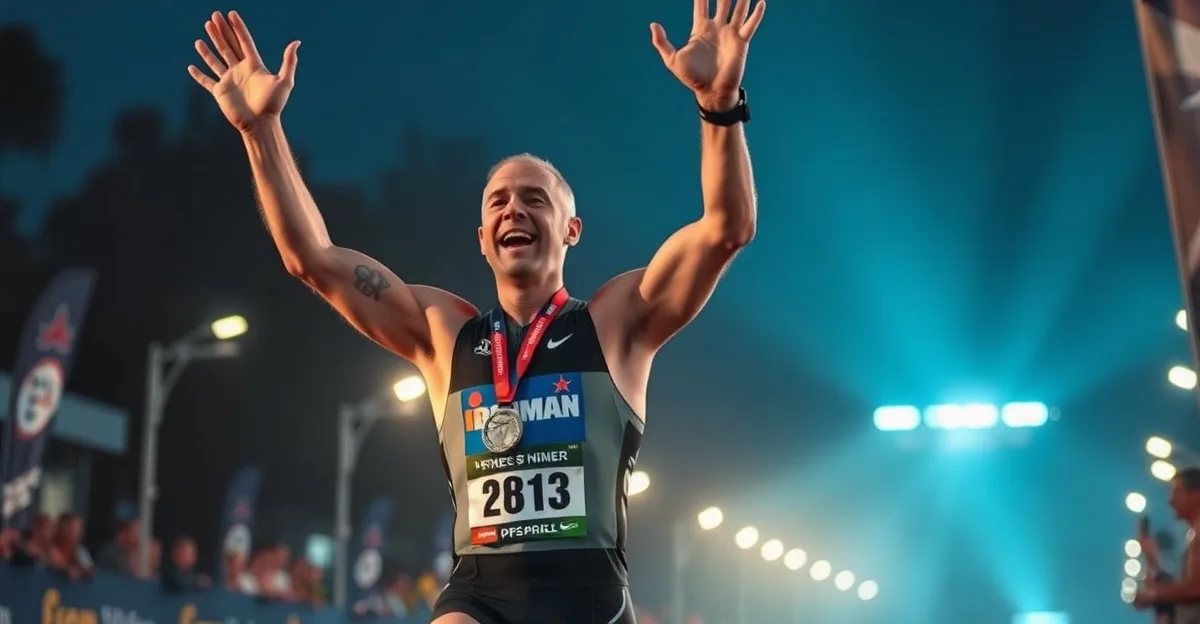
I was registered for Challenge Roth 2026 as my first full-distance triathlon. On April 21, 2026 I crashed on my first outdoor ride and fractured my right femur — same-day surgery, titanium intramedullary nail, currently Week 3 of recovery. This week I cancelled the 2026 entry and transferred my registration to Challenge Roth 2027 (Sunday, July 4, 2027). The race guide below stays as a reference for anyone else racing this year.
Roth 2027 race guide → Recovery + Road to Roth 2027 log →
Challenge Roth 2026 at a glance
Challenge Roth is the largest long-distance triathlon in the world by field size and, by most measures, the best. 3,500 individuals, 650 relay teams, and 260,000 spectators crammed into a small Bavarian town for one Sunday in July. The atmosphere is unlike anything else in the sport. If you're going to do one full-distance triathlon in your life, this is the one to pick.
Unlike an Ironman-branded race, Roth is organised by Challenge Family and the local DATEV group. The distances are identical to Ironman (3.8 km / 180 km / 42.2 km), but Roth has a faster course profile, a more generous 15-hour cutoff, and a finish-line atmosphere that regularly reduces veterans to tears.
Key facts
| Detail | Information |
|---|---|
| Race date | Sunday, July 5, 2026 |
| Location | Roth, Bavaria, Germany |
| Distance | 3.8 km swim · 180 km bike · 42.2 km run |
| Total elevation | ~100m swim current-aided · ~1,300m bike · ~110m run |
| Cutoff time | 15 hours |
| Field size | ~3,500 individuals + ~650 relays (largest in the world) |
| Water temperature (avg) | 20-23°C — wetsuit legal in nearly every edition |
| Expected 2026 entry fee | ~695 EUR individual / ~795 EUR relay (3p) |
| Registration window | Opens Monday after race day — sells out in ~1 minute |
| Course world best | 7:35:39 (Jan Frodeno, 2016 — held the world best until 2022) |
The swim — Main-Donau Canal
Roth's swim is in the Main-Donau Canal, a ruler-straight shipping canal cut through Bavarian farmland. It's a one-lap, rolling-start swim with waves leaving every 6 seconds in self-seeded pace groups — the cleanest, calmest start in long-distance triathlon. You swim 1.9 km out, loop under a pontoon bridge, and swim 1.9 km back. The canal is about 55m wide, which means even a field of 3,500 athletes spreads out within the first 200m.
The water is consistently 20-23°C in early July — cold enough for a wetsuit, not so cold that your hands go numb. There's no current, no chop, and no marine life of note. For swim-weak triathletes (hi), this is about as friendly as long-distance swim courses get.
Expected swim times by level:
- Pro: 45-50 minutes
- Strong age grouper: 55-65 minutes
- Mid-pack: 70-80 minutes
- Back-of-pack / swim-weak: 85-100 minutes (cutoff is 2:20)
The bike — two laps through Franconia
The Roth bike course is 180 km across two identical 90 km laps through the rolling farmland, forests, and villages of Middle Franconia. It's described as "rolling" rather than flat — there's always something happening. The two headline climbs are Greding (at km 40 and km 130) and Solarer Berg (at km 55 and km 145).
Solarer Berg is the reason most athletes sign up. It's a 1 km climb with gradients hitting 12%, lined wall-to-wall with tens of thousands of spectators screaming, ringing cowbells, and pushing athletes up the hill. Tour-de-France style. It's the single loudest moment in triathlon. You ride it twice. Nobody forgets it.
Total elevation is about 1,300m over 180 km, which makes Roth a fast bike course by Ironman standards — comparable to Ironman Frankfurt, slower than Florida or Texas, faster than Nice or Lanzarote. If you aero well, Roth rewards you.
Expected bike splits (intermediate male age grouper, 35-44): 5:30-6:15. Pros are closer to 4:15.
The run — canal marathon
The Roth marathon is a two-lap out-and-back along both sides of the Main-Donau Canal, with a loop through the town of Roth itself on each lap. The canal path is flat, paved, and shaded in sections — nearly identical to a city marathon profile apart from the final run into the finish stadium.
The marathon atmosphere in Roth is exceptional. Each aid station (every 2-3 km) is themed and staffed by a local village, with music and costumes. The finish line in the Triathlon Park stadium is widely regarded as the best in long-distance triathlon — you run down a ramp into an enclosed arena with 10,000+ seated spectators, a light show, and Roth-specific anthems.
Expected marathon splits (intermediate male age grouper, 35-44): 4:00-4:45.
Registration & qualification
Challenge Roth does not use a qualification system. Entry is first-come-first-served and 2026 race registration sold out in under 60 seconds when it opened on the Monday after Challenge Roth 2025.
If you're planning to race in 2027 or later, here's the drill:
- Create an account on challenge-roth.com now — don't wait for race day
- Set a calendar reminder for 18:00 CET on the Monday after the race (the exact time and date are announced at the finish-line party on race Sunday)
- Have your credit card pre-filled in the account
- Relay entry is the easier path — team slots sell slightly slower than individual
- Charity entries via Challenge Family partner orgs are another way in, though they come with fundraising commitments
Getting to Roth
By air
- Nuremberg Airport (NUE) — the closest airport, 40 minutes by car or S-Bahn to Roth. Best connections from within Europe
- Munich Airport (MUC) — 1h 45m by train (ICE to Nuremberg, then S-Bahn). Better for long-haul arrivals
- Frankfurt Airport (FRA): 2h 30m by ICE to Nuremberg, or 3h 30m direct by car
By train
- ICE trains to Nuremberg from across Europe, then local S-Bahn S2 to Roth station (~25 minutes)
- Roth has its own station, 15 minutes' walk from the race expo and Triathlon Park
- Deutsche Bahn offers bike transport on ICE trains for €10 with reservation
By car
- A9 Munich-Nuremberg autobahn, exit Roth — the town is signposted from there
- Parking near the race start fills up by 4:30 AM on race Sunday. Use the official park-and-ride from Nuremberg or nearby towns
- If you're driving from western Europe with your bike, factor in 10-12 hours from Paris, 8-9 from Amsterdam
Where to stay
- Roth itself — limited hotels but the most atmospheric option. Book 12+ months ahead. Airbnb apartments come up during race week
- Nuremberg — 25 minutes by S-Bahn, the practical choice for most international athletes. Large range of hotels across budgets
- Schwabach (10 minutes north) — cheaper and quieter than Nuremberg, good mid-range hotels
- Hilpoltstein and Greding (along the bike course) — rural guesthouses, best for spectators who want to watch the climbs
- Challenge Family maintains an official hotel list on their website with negotiated rates
Training specific to Roth
Roth rewards three things: strong aero bike legs, an efficient run economy, and heat tolerance. If you're preparing for this race, bias your training toward:
- Long aero rides — 4-6 hour rides in your race position are essential. Roth's bike course doesn't let you sit up often
- Brick sessions on rolling terrain — the run has enough elevation change to wreck an unprepared pacing strategy
- Heat training in the 4 weeks before race day — July in Bavaria can hit 32°C. Train in warmer conditions or use a sauna protocol
- Pool-to-open-water transition — the canal is friendly but still open water. Do at least 6 open water swims in the 8 weeks before race day
- Nutrition dress rehearsal on race-distance bike rides — 180 km is a long time to discover your stomach doesn't tolerate maltodextrin
See my live training log for Challenge Roth 2026 →
Challenge Roth vs Ironman: which should you pick?
The distances are identical. What differs is the feel:
| Challenge Roth | IRONMAN (branded) | |
|---|---|---|
| Brand | Challenge Family (DATEV group) | IRONMAN / WTC |
| Field size | ~3,500 individuals | 2,000-3,000 typically |
| Course character | Two laps, rolling, Solarer Berg | Varies by race |
| Atmosphere | Tour de France-style crowds, stadium finish | Varies — Kona and Frankfurt strong; others quieter |
| Cutoff | 15 hours | 17 hours |
| Cost | ~695 EUR | 800-1,500 EUR depending on race |
| Registration | First-come-first-served, sells out in minutes | Open registration (some require qualification) |
| Qualification slots | None — no Kona slots available | Kona slots (IRONMAN races only) |
Short version: if you want Kona, do an IRONMAN race. If you want the best single-day experience in long-distance triathlon, do Roth. Most athletes who do both say Roth is the better experience.
More information
- Official Challenge Roth website
- My live Challenge Roth training log
- Full Ironman training guide (distances, phases, methodology)
- Triathlon as a sport — distances, formats, finish times
Frequently Asked Questions
When is Challenge Roth 2026?
Challenge Roth 2026 takes place on Sunday, July 5, 2026 in Roth, Bavaria, Germany. Race week activities (expo, briefings, warm-up swim, pasta party) begin the preceding Thursday.
Is Challenge Roth harder than an Ironman?
The distances are identical — 3.8 km swim, 180 km bike, 42.2 km run. The courses are different though. Roth has ~1,300m of climbing on the bike (two laps with the Solarer Berg, Greding, and Kalvarienberg) and a net-flat marathon along the Main-Donau Canal. Roth is faster on average than most Ironman courses, which is why it held the world best time (7:35:39 by Jan Frodeno) until 2022.
How do I qualify for Challenge Roth?
Challenge Roth does NOT use a qualification system. Entry is first-come-first-served and sells out within a minute when registration opens each year (usually the Monday after race day). Set a calendar reminder for 18:00 CET on that Monday and have your account logged in and ready. Team relay slots sell slightly slower.
What makes Solarer Berg so famous?
Solarer Berg is a 1 km climb on the Roth bike course that's lined with tens of thousands of spectators on race day — it's often compared to a Tour de France climb. It's the single loudest moment in triathlon. You ride it twice (once per bike lap). Many athletes describe it as the reason they signed up.
How much does Challenge Roth cost?
2026 individual entry is approximately 695 EUR. Relay teams are around 795 EUR total for a three-person team. Both prices are before the mandatory Challenge Family membership and race pack fees. Factor in travel, accommodation in Nuremberg or Roth, bike transport, and race-week meals — budget 1,500-2,500 EUR all-in for an international athlete.
Where should I stay for Challenge Roth?
Roth itself is a small town and hotels fill up 12+ months in advance. Most international athletes stay in Nuremberg (25 minutes by car / S-Bahn) or in nearby towns like Schwabach, Hilpoltstein, or Greding. Airbnb apartments in Roth are the best option if you can book early. The Challenge Family has an official hotel list on challenge-roth.com.
What's the water temperature in July?
The Main-Donau Canal in Roth is typically 20-23°C on race day in early July. Wetsuits are nearly always legal (cutoff is 24.5°C for age groupers). The swim is a one-lap rolling start in clean, flat canal water — no currents, no chop, and the 2-abreast width means faster traffic overtakes cleanly.
when is challenge roth 2026
Challenge Roth 2026 takes place on Sunday, July 5, 2026, in Roth, Bavaria, Germany.
Ready to Train Smarter?
Get personalized training zones, race predictions, and performance insights with our free calculators.
