

Key Takeaways
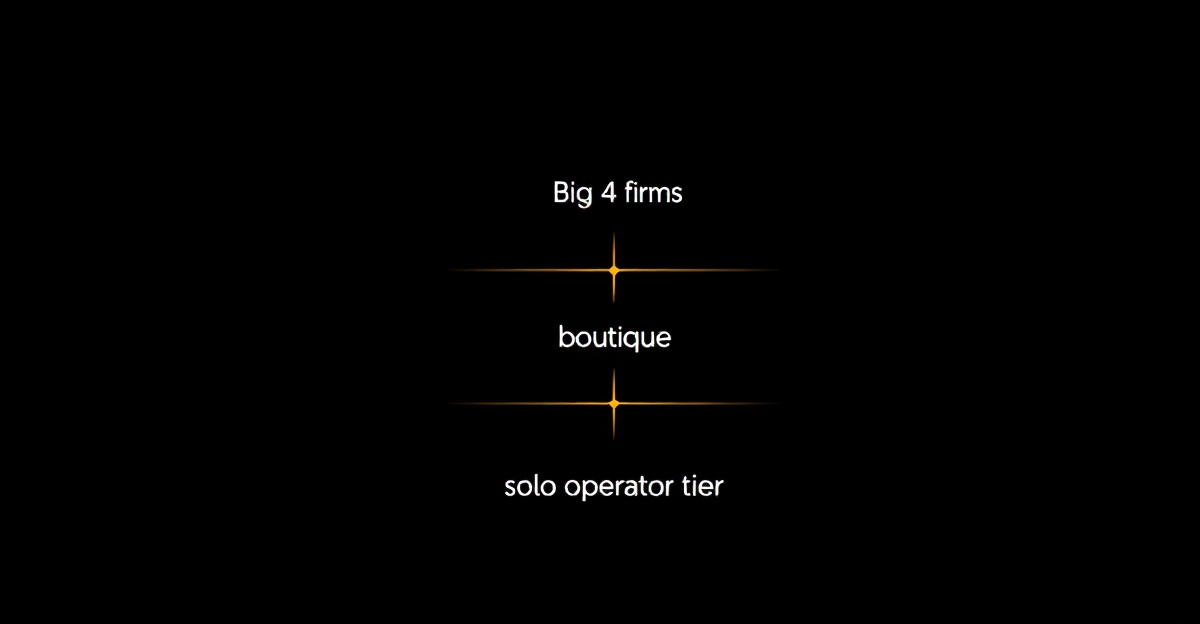
- Three tiers cover the market. MBB and Big 4 strategy houses, credible AI-focused boutiques, solo-operator fractional executives.
- Pick by bottleneck, not brand. The MBB tier fits when the bottleneck is analytical breadth; solo operators fit when it is at the decision layer.
- The wrong-tier match wastes more money than the wrong-firm-within-tier choice. A McKinsey engagement that a fractional CAIO would have solved is the most common $800K mistake in mid-market AI.
- QuantumBlack and BCG Gamma have converged. Both are full-stack AI consulting groups. The differentiation now lives in client relationship continuity, not deliverable quality.
- Boards still pay for tier-one brand cover. A McKinsey, BCG or Bain logo on the strategy document is sometimes worth more than the marginal execution quality from a boutique. Know which one matters to you.
Every January this page gets updated, because the market shifts. The shifts in 2026 are smaller than they were in 2023 or 2024. The firms that were going to consolidate have consolidated, the boutiques that were going to fold have folded, and the solo-operator tier has stabilized into a recognizable shape. The three-tier structure described below has held for about 18 months and is likely to hold through 2027.
I write this from a specific position. I have hired Big 4 consulting firms from inside a Fortune 500 CTO seat. I have run engagements at the boutique tier as an outside hire. I run a fractional practice today. The view is biased by experience; it is also biased by being the only useful kind of view, which is the operator's view. If you want the analyst's view, the Big 4 produce them by the gigabyte and they are useful for different things.
This is a comparison page, not a ranking. Ranking implies one right answer; the right firm depends on the company's stage and the question being asked.
The MBB Strategy Houses: McKinsey, BCG, Bain
The strategy houses are where Fortune 500 companies go when AI is being elevated to a board-level conversation. What they sell well is rigorous strategy documents that survive board scrutiny, signaling seriousness to investors and analysts, and the analytical breadth to compare a company's AI options against a peer set only the firm has visibility into. Where they struggle is implementation handoff and matching senior partner attention to mid-market scope.
McKinsey (QuantumBlack)
McKinsey's AI work runs through QuantumBlack, the AI-focused unit acquired in 2015 and progressively absorbed into the broader practice. QuantumBlack has the deepest in-house ML talent in MBB and produces the most credible technical deliverables. Engagement pricing typically runs $600K–$1.2M for 10–14 weeks of strategy work, with implementation phases that often add $1M–$3M over the following year. Best fit: Fortune 500 companies where the AI program needs board-level legitimacy, the AI spend is genuinely in the $10M+ range, and the implementation will be staffed internally with QuantumBlack supervision.
BCG (Gamma)
BCG Gamma sits at roughly the same scale and price point as QuantumBlack, with a heavier weighting toward mathematicians and operations-research talent. The deliverable shape is similar; the differentiation has narrowed over the last three years. Choice between McKinsey and BCG usually comes down to existing client relationships rather than meaningful deliverable difference. Best fit: same profile as QuantumBlack, with a slight tilt toward companies whose AI work is heavy on optimization and forecasting rather than generative use cases.
Bain
Bain's AI practice is smaller than McKinsey's or BCG's, with a stronger emphasis on commercial-impact framing. Bain engagements typically run $400K–$900K and tend to be tighter in scope. Bain partners are usually more present on the engagement than the equivalent McKinsey or BCG partners, which matters at the $500K–$800K scope where senior attention is the differentiator. Best fit: large companies with a defined commercial AI question (pricing, segmentation, customer lifetime value) where the implementation is staffed elsewhere.
The Implementation-Heavy Firms: Deloitte, Accenture, IBM, Capgemini
The implementation-heavy firms are where companies go when the strategy is already settled and the harder question is how to ship a multi-business-unit AI program at scale. They typically run larger engagements ($2M–$10M+) over 12–24 months, with mixed staffing from strategy senior associates through to junior implementation engineers.
Deloitte (AI Institute)
Deloitte is the largest of the four by AI consulting headcount. The Deloitte AI Institute is the brand wrapper for the strategy work; the implementation muscle sits in the broader consulting and engineering practice. Best fit: Fortune 500 companies running multi-year AI transformation programs where the integration with existing systems (SAP, Oracle, Salesforce, etc.) is the dominant complexity. Deloitte's existing footprint inside enterprise IT is the structural advantage.
Accenture
Accenture has aggressively rebuilt around AI over the last three years. The strategy capability is weaker than the Big 3 but has improved; the implementation capability is among the strongest in the market. Pricing is typically 70–85% of MBB rates for equivalent scope. Best fit: companies where the AI program is genuinely an IT transformation program, and the strategy work is more about sequencing than choosing.
IBM Consulting
IBM's AI consulting work is concentrated around watsonx and the broader IBM AI stack. The strategy work is narrower than Accenture's; the implementation work is strong on enterprise integration. Best fit: companies already running significant IBM infrastructure where the AI work needs to integrate with existing systems of record. Outside that profile, IBM is rarely the right first choice.
Capgemini
Capgemini sits as the European-anchored implementation house with a growing US footprint. The strategy work is thinner than MBB's; the implementation work is strong, particularly in European Fortune 500 contexts. Best fit: European-headquartered companies with significant US operations, or US companies with material European operations where Capgemini's regional bench strength matters.
The Credible Boutiques
The boutique tier is where most of the genuinely interesting AI consulting work happens in 2026. Smaller firms, deeper AI bench strength as a percentage of headcount, and a senior-partner-on-the-engagement staffing model that the MBB and Big 4 firms cannot match below $1M scope. The trade-off is brand legitimacy. A McKinsey logo on the board deck is sometimes worth the price difference for political reasons.
Slalom
Slalom is the strongest US-based mid-market AI consulting firm in 2026. Engagements typically run $200K–$600K with a heavier weighting toward implementation than the strategy houses. Best fit: companies in the $200M–$2B revenue range that need the credibility of an established firm without Big 4 pricing.
The successors to Element AI
Element AI's acquisition by ServiceNow seeded a generation of AI-focused boutiques staffed by former Element practitioners. The strongest of these have stabilized into 50-to-200-person firms with deep technical capacity. Best fit: companies where the work is genuinely technical — model selection, evaluation design, implementation supervision — rather than capital allocation.
Regional boutiques
Most major metro areas now have at least one credible AI consulting boutique in the 20-to-100-person range. The quality varies; the best are competitive with Big 4 strategy work at 30–50% of the price. Diligence requirement is high: the staffing model has to be examined carefully, because many regional boutiques use junior associates for the same work MBB and Big 4 firms use junior associates for, without the senior partner cover. Best fit: companies with strong regional preferences (cost of senior practitioner time on-site, regulatory familiarity, language) and the capacity to vet the engagement model rigorously.
The Solo-Operator and Fractional CAIO Tier
The newest tier, and the fastest-growing in 2026. Senior practitioners (former CTOs, CIOs, CDOs, and Chief AI Officers) running fractional engagements at one to two days per week. Pricing runs $15K–$40K per month for ongoing engagements, or $75K–$250K for defined 90-day sprints. Almost no overhead, no junior staffing, and the senior person is the engagement.
This is the tier I work in. The structural advantage over Big 4 engagements is that the bottleneck in mid-market AI strategy is almost always at the decision layer rather than the analysis layer. A solo operator who has held the executive seat can make decisions and defend them; a Big 4 partner who runs six engagements can do the same in principle but is rarely available enough to do it in practice.
The structural disadvantage is single-point-of-failure risk. If the engagement requires deep analytical work that one person cannot produce in the available time, the solo model breaks down. Most mid-market AI strategy work does not require that kind of analytical depth, but a candid assessment of the actual scope is the right first step before choosing the tier.
"The most common $800K mistake I see is a McKinsey engagement that a fractional CAIO would have solved in three months. Wrong-tier match costs more than wrong-firm-within-tier."
How to Pick the Right Tier
The bottleneck question is the most useful filter. Honest answers:
- If the bottleneck is analytical breadth. The company genuinely needs a parallel team to research the AI landscape, benchmark against a peer set the company has no visibility into, and produce a rigorous deliverable. MBB is correct, with the caveat that the implementation phase is what determines whether the engagement was worth the money.
- If the bottleneck is implementation capacity. The strategy is settled and the company needs hands to execute across multiple business units. Deloitte/Accenture/IBM/Capgemini are correct, sometimes paired with a smaller strategy advisor.
- If the bottleneck is decision-making. The company has the analysis but cannot get to a yes-or-no on the next 12 months. Solo operator or fractional CAIO is correct. This is the most common condition in mid-market AI strategy and the one where wrong-tier matching is most expensive.
- If the bottleneck is signaling. The board needs to see a credible brand on the strategy document to approve the budget. MBB is correct on those grounds alone, and the actual deliverable quality matters less than the brand.
The diligence question I would ask any consulting firm before signing: walk me through a recent engagement at our scale where you ended up recommending less work than the company expected to buy. Firms that have never recommended less work do not have the structural ability to tell a company the right answer when the right answer is "you do not need most of this."
Annual Update Note
This page gets revised each January. The 2027 update will likely document the continued growth of the solo-operator tier, further consolidation among mid-tier boutiques, and the increasing pressure on Big 4 pricing as the cost of doing strategy work falls. The three-tier structure described above is likely to hold; the relative weights are shifting toward the boutique and solo tiers, slowly but visibly.
Last updated: May 2026. Next scheduled refresh: January 2027.
Where to Go Next
- AI strategy consulting hub — the practitioner-versus-firm framing and engagement model overview.
- What does an AI strategy consultant actually do? — the day-to-day work that the firms above are selling.
- AI consultant salary — the compensation data behind firm and solo pricing.
- AI consulting for small businesses — why the firms above almost never fit SMB engagements.
- Technology executive — when hiring an executive is the better answer to the same problem.
- Fractional CTO, CIO, Chief AI Officer — the executive-seat alternative to a consulting firm engagement.
Frequently Asked Questions
Which is the best AI consulting firm in 2026?
There is no single best firm. The right firm is determined by the company's stage, the question being asked, and whether the bottleneck is analytical or decisional. For Fortune 500 strategy work that needs broad analytical capacity, McKinsey (via QuantumBlack), BCG (via Gamma), and Bain remain the strongest brands and produce the most rigorous strategy documents. For implementation-heavy engagements, Deloitte, Accenture, IBM, and Capgemini are better matched. For mid-market companies that need decisions rather than analysis, a solo-operator fractional CAIO almost always outperforms an MBB or Big 4 engagement at 25–35% of the cost.
How much does McKinsey charge for AI consulting?
McKinsey AI strategy engagements typically run $600K–$1.2M for a 10–14 week project, depending on scope and partner involvement. QuantumBlack (McKinsey's AI arm) engagements often run higher because they staff with senior AI practitioners. The headline number understates the total spend: most McKinsey AI strategy work spawns implementation phases that add another $1M–$3M over the following 12 months. The same scope from a boutique runs roughly 40–60% of the Big 3 (McKinsey/BCG/Bain) price.
What's the difference between McKinsey QuantumBlack and BCG Gamma?
Both are the AI-focused units inside their parent firms. QuantumBlack (acquired by McKinsey in 2015) tends to staff deeper on the modeling and engineering side; BCG Gamma tends to staff with mathematicians and operations-research-heavy profiles. In practice the differentiation has narrowed over the last three years — both are now full-stack AI consulting groups with strategy plus implementation capacity. The choice usually comes down to the existing client relationship rather than a deliverable difference.
Are AI consulting boutiques better than the Big 4?
For specific scopes, yes. The credible boutiques (Slalom, the successors to Element AI, and regional firms with deep AI bench strength) typically execute better than the partner-plus-associates staffing model the MBB and Big 4 firms deploy on engagements under $1M. The trade-off is brand legitimacy in board reporting: a McKinsey logo on the strategy document is sometimes worth more to the CEO than the marginal execution quality of a boutique. For internal credibility, boutiques win on execution; for external signaling, the tier-one brands still win.
When should a company hire a solo AI consultant instead of a firm?
Three conditions, all together. The company has already done the analytical work (or has the internal capacity to do it). The bottleneck is at the decision layer rather than the analysis layer. The annual AI spend is below roughly $5M, where a fractional engagement captures most of a full-time CAIO's value at 10–20% of the burn. Below $500M revenue, this is almost always the right model. Above that, the firm versus solo trade-off depends more on whether the company needs visible Big 4 cover for board reporting.
What AI consulting firms work with small businesses?
Very few of the named firms in this market actively work with companies under $50M revenue. The engagement economics do not support it. Small businesses are served almost entirely by the solo-operator and small-boutique tier: independent practitioners, two-to-five-person consulting groups, and the AI-focused arms of small regional firms. The pricing structure that fits an SMB ($5K–$25K per engagement) is incompatible with the overhead structure of any MBB, Big 4, or major boutique. See the SMB-focused guidance for the engagement shapes that actually work.
how does mckinsey compare to accenture in ai delivery
McKinsey (via QuantumBlack) leads on strategy with rigorous board-level documents and deep in-house ML talent. Engagements run $600K to $1.2M for 10-14 weeks, plus $1M to $3M implementation phases. Accenture is weaker on strategy but has among the strongest implementation capability in the market, priced at roughly 70-85% of MBB rates. McKinsey fits when AI needs board legitimacy and $10M+ spend with internal staffing under QuantumBlack supervision. Accenture fits when the AI program is essentially an IT transformation and strategy is more about sequencing than choosing.
is bcg considered a top ai consulting firm
Yes. BCG is listed among the MBB strategy houses at the top tier of AI consulting firms, alongside McKinsey and Bain. Its AI work runs through BCG Gamma, which sits at roughly the same scale and price point as McKinsey's QuantumBlack, with a heavier weighting toward mathematicians and operations-research talent. BCG Gamma fits Fortune 500 clients needing board-level legitimacy, with a slight tilt toward optimization and forecasting work rather than generative AI use cases.
how do mbb firms compare with the big four on ai capabilities
MBB firms (McKinsey, BCG, Bain) sell rigorous board-level strategy, analytical breadth, and brand cover for AI programs. McKinsey's QuantumBlack has the deepest in-house ML talent in MBB. BCG Gamma is similar in scale, tilted toward optimization and forecasting, while Bain runs tighter, commercially framed engagements. The Big Four style firms (Deloitte, Accenture, IBM, Capgemini) are implementation-heavy, taking larger $2M–$10M+ programs over 12–24 months, with strengths in enterprise integration (SAP, Oracle, watsonx) rather than strategy depth.
which is the best ai strategy consulting firm
The page doesn't name a single best AI strategy consulting firm and rejects that framing, calling itself "a comparison page, not a ranking" because the right firm depends on company stage and question. Among the MBB strategy houses, McKinsey (QuantumBlack) is described as having the deepest in-house ML talent. BCG Gamma tilts toward optimization and forecasting, while Bain fits tighter commercial-impact questions with more senior partner presence. Pick by bottleneck, not brand.
how strong is mckinsey’s reputation in ai consulting
McKinsey's AI work runs through QuantumBlack, which has the deepest in-house ML talent among MBB firms and produces credible technical deliverables. Its reputation carries board-level legitimacy, and a McKinsey logo on a strategy document is sometimes worth more than the marginal execution quality from a boutique. Engagements typically run $600K to $1.2M for 10 to 14 weeks, often followed by $1M to $3M in implementation over the next year. Best fit is Fortune 500 companies with genuine $10M+ AI spend where implementation is staffed internally under QuantumBlack supervision.
how strong is quantumblack compared to palantir or accenture
The page compares QuantumBlack to other consulting firms, not to Palantir (which isn't discussed). It describes QuantumBlack as having the deepest in-house ML talent within MBB and producing highly credible technical deliverables, with engagements at $600K–$1.2M for 10–14 weeks plus $1M–$3M implementation phases. Versus Accenture, the page frames them differently. QuantumBlack sits in the strategy tier for board-level Fortune 500 AI programs. Accenture is implementation-heavy, weaker on strategy but among the strongest on execution, priced at 70–85% of MBB rates. The page doesn't rank one above the other, it says pick by bottleneck: strategy breadth points to QuantumBlack, IT-transformation delivery points to Accenture.
which management consulting firm has the strongest ai capabilities
No single firm is strongest across the board. The page frames it as tier fit rather than a ranking. Within the MBB strategy houses, McKinsey's QuantumBlack has the deepest in-house ML talent and produces the most credible technical deliverables. BCG Gamma sits at the same scale and price, weighted toward mathematicians and operations-research talent. The two have converged so much that the differentiation now lives in client relationship continuity, not deliverable quality. Bain's AI practice is smaller and framed around commercial impact. For pure implementation muscle rather than strategy, Accenture is called out as among the strongest in the market.
are consultants at top firms involved in ai strategy or implementation
Both, but split by tier. MBB strategy houses (McKinsey/QuantumBlack, BCG/Gamma, Bain) sell board-level AI strategy, with implementation typically staffed internally under their supervision. Implementation-heavy firms like Deloitte, Accenture, IBM, and Capgemini run the large multi-year shipping programs, usually after strategy is settled. McKinsey engagements often start at $600K to $1.2M for 10 to 14 weeks of strategy, then add $1M to $3M in implementation over the following year.
Need Expert Technology Guidance?
20+ years leading technology transformations. Get a technology executive's perspective on your biggest challenges.
