What is Swimrun?
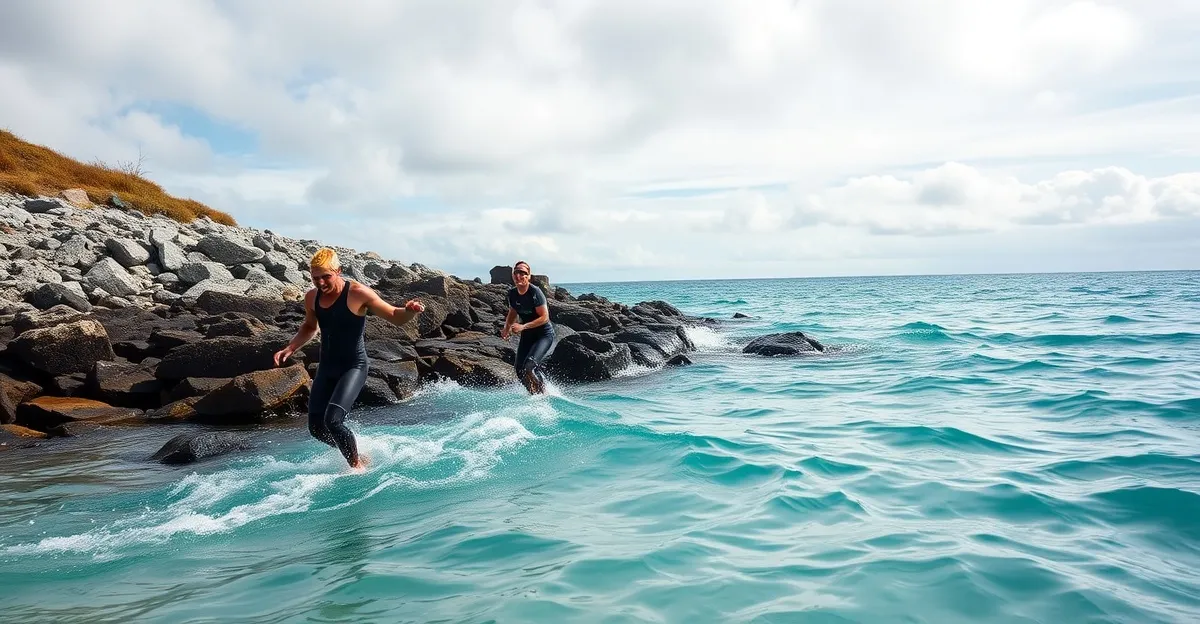
Swimrun is a team endurance sport in which pairs of athletes alternate between open-water swimming and trail running across natural terrain, carrying all of their equipment from start to finish. There are no formal transition zones, no gear bags waiting at checkpoints, and no individual glory. You swim in your running shoes. You run in your wetsuit. And you do it all with a partner tethered to your side.
The sport traces its origins to a drunken bet made in 2002 at a dinner party on the Swedish island of Utö. Four friends — Jesper Svindland, Anders Malm, Mats Skott, and Janne Lindberg — wagered that they could traverse the Stockholm archipelago from Sandhamn to Utö on foot and by swimming, island to island, covering roughly 75 kilometres of coastline, forest trail, and open Baltic water. Two of them actually attempted the crossing. Both finished. The idea stuck.
By 2006, that bet had been formalized into the first OTILLO (Swedish for "island to island"), a race that would become the World Championship of swimrun and the template for every swimrun event that followed. The original course — 75km across 26 islands in the Stockholm archipelago — remains one of the most demanding endurance events on the planet.
From that single race in 2006, swimrun has expanded to over 500 races across 24 countries by 2026. Race series including OTILLO, My Swimrun Championships, Mudskipper, Breca, and dozens of independent events now span every continent except Antarctica. In October 2025, World Triathlon officially recognized swimrun as a discipline within its governance framework, a milestone that signals the sport's transition from niche Scandinavian adventure to mainstream endurance category.
What distinguishes swimrun from every other multisport discipline is the absence of separation between its two components. In triathlon, you change clothes, swap shoes, and move between clearly defined zones. In swimrun, there is no buffer. You crest a hill, hit a shoreline, and wade straight into the water. You haul yourself onto a rock on the far side, find the trail marker, and start running again. Your wetsuit stays on. Your shoes stay on. Your hand paddles are tucked into your suit or strapped to your wrists. The sport rewards athletes who can manage constant transitions between two fundamentally different movement patterns without losing rhythm, body temperature, or composure.
The team element is the other defining feature. In most major swimrun races, you compete as a pair. You are tethered to your partner by an elastic cord. You must stay within 10 metres of each other at all times. You cross the finish line together or not at all. This creates a dynamic that exists in no other individual endurance sport — the need to pace as a unit, to support each other through the low points, and to make real-time tactical decisions as a team about drafting, pacing, nutrition, and equipment.
How Swimrun Works
A swimrun race consists of alternating sections of open-water swimming and trail running, with a minimum of two swim segments and two run segments separated by at least three transitions. In practice, most races feature far more: a typical medium-distance event might include 8 to 12 swim sections and 8 to 12 run sections over 20 to 30 kilometres. The OTILLO World Championship packs in over 50 transitions across its 75km course.
The critical distinction from triathlon is the absence of formal transition zones. There is no tent, no rack, no changing area. When the trail ends at water's edge, you walk in and start swimming. When you reach the next shore, you climb out and start running. The clock never stops. The transitions themselves become part of the race — how quickly you can shift from running gait to swimming stroke, how efficiently you can secure your paddles, how well you manage the thermal shock of entering cold water after a hard uphill effort.
Teams are connected by an elastic tether, typically 2 to 3 metres in length, clipped to a belt or harness on each athlete. The tether serves several purposes: it prevents teams from separating beyond the 10-metre rule, it allows the stronger swimmer to tow the weaker swimmer on certain sections, and it creates a physical reminder of the partnership at the core of the sport. Tether management — knowing when to pull, when to slack, when to draft — is a genuine racing skill that develops over time.
Equipment rules are straightforward. Athletes may use hand paddles and a pull buoy during swim sections — these are not optional luxuries but practical necessities. Because you swim in trail shoes (which create significant drag), paddles help offset the propulsion loss, and the pull buoy keeps your legs elevated despite the weight of waterlogged shoes. All equipment must be carried from start to finish. You cannot drop items at an aid station and pick them up later. You cannot receive equipment from spectators. What you start with is what you finish with.
Races typically start in waves, with elite teams going first. Aid stations are positioned at key points along the course, offering water, energy gels, fruit, and sometimes warm drinks. Course marshals monitor the swim exits and run sections. Safety boats patrol the longer open-water crossings. Cut-off times are enforced — if you arrive at a checkpoint after the cutoff, your race is over.
Navigation is generally straightforward. Courses are marked with buoys in the water and flags or tape on land. Some races, particularly those in remote archipelago settings, require basic orienteering skills — knowing which island to aim for when swimming across a channel, or which trail fork leads to the next transition. This element of route-finding adds a layer of tactical awareness that pure road-based endurance events lack entirely.
Swimrun Race Distances
Swimrun races are categorized by total distance, though the distribution between swimming and running varies significantly by course. Most events follow a roughly 80/20 split — 80 percent running, 20 percent swimming — but this can shift depending on geography. An archipelago course might feature more frequent, shorter swims. A lakeland course might include fewer but longer crossings.
The standard distance categories in 2026 are:
- Sprint / Experience (5-10km total): 2 to 4 swim sections, 2 to 4 run sections. Designed for first-timers and as an introduction to the format. Most can be completed in 1 to 2 hours. These events often have relaxed rules — some allow solo entries and reduce equipment requirements.
- Short (10-15km total): 4 to 6 swims, 4 to 6 runs. A step up that introduces longer open-water crossings and more demanding trail sections. Typical finish times range from 1.5 to 2.5 hours for fit athletes.
- Medium (15-30km total): 6 to 12 swims, 6 to 12 runs. The most popular race distance globally, balancing challenge with accessibility. Expect 3 to 5 hours of racing. This is where most teams compete after their first season in the sport.
- Long (30-50km total): 12 to 20+ swims, 12 to 20+ runs. A serious endurance test requiring dedicated training, solid open-water swimming ability, and strong trail running fitness. Finish times of 5 to 8 hours are typical.
- Ultra (50-75km+ total): 20+ swims, 20+ runs. Reserved for the most experienced swimrun athletes. The OTILLO World Championship sits at the top of this category at approximately 75km with over 50 transitions. Expect 8 to 12+ hours of racing. Qualification is usually required.
One important note on distances: the swim-to-run ratio matters more than the total distance alone. A 25km race with 6km of swimming is substantially different from a 25km race with 3km of swimming. When selecting races, look at the course breakdown carefully. The longest individual swim section is often the deciding factor in whether a race suits your current ability — a 2km open-water crossing in choppy conditions is a very different proposition from ten 200-metre swims across calm bays.
The Team Element
Ask any experienced swimrun athlete what makes the sport different from triathlon, ultra-running, or open-water swimming, and the answer is almost always the same: the partner. Swimrun is fundamentally a team sport disguised as an endurance race. The partnership is not a nice-to-have — it is the load-bearing structure of every race, every training session, and every tactical decision made on course.
Partner selection is the single most consequential decision in swimrun. The ideal team pairs two athletes whose strengths complement each other — one who is a stronger swimmer with a slightly weaker runner, the other a faster runner who is competent but not dominant in the water. Perfect symmetry is rare. What matters more is that both athletes can maintain a shared pace across both disciplines without one partner consistently holding the other back in either element.
The gap between partners matters less than the ability to manage that gap. If your partner swims 1:45/100m and you swim 2:00/100m, the tether and drafting can close most of that difference on race day. If the difference is reversed on the run, the faster runner moderates their pace while the slower runner pushes slightly beyond their comfort zone. Over a 4-hour race, these micro-adjustments accumulate into a rhythm that defines the team's performance more than either individual's fitness.
Tethering technique is a skill that takes practice to get right. The elastic cord — typically 2 to 3 metres of bungee with carabiners at each end — clips to a belt or harness worn by each athlete. In the water, the stronger swimmer leads while the weaker swimmer drafts behind, reducing their effort by an estimated 15 to 20 percent. The tether must be taut enough to transfer the drafting benefit but slack enough to avoid jerking the lead swimmer off rhythm. On land, the tether is usually coiled and tucked away to avoid snagging on rocks or branches, though some teams keep it loosely deployed on flat trail sections to maintain contact.
Communication during the race is constant and critical. Before entering the water: "How are you feeling? Fast start or steady?" During a long swim: checking breathing patterns, adjusting pace if one partner is struggling. On a steep climb: deciding whether to hike or run, managing energy expenditure relative to what's ahead. At aid stations: coordinating nutrition timing, refilling bottles, adjusting equipment. The best swimrun teams develop a shorthand over the course of a season — hand signals in the water, single-word commands on land, an intuitive sense of when to push and when to back off.
Mental support is perhaps the most undervalued aspect of the team dynamic. Endurance sport is largely a mental exercise, and swimrun's constantly shifting demands — cold water, steep terrain, fatigue, navigation uncertainty — create frequent low points. Having a partner who recognizes when you're struggling, who talks you through a difficult swim or paces you up a climb, who shares the load when your body wants to stop — this is what swimrun athletes consistently describe as the best part of the sport. It creates a bond that solo endurance events simply cannot replicate.
Tactical drafting extends beyond the water. On exposed run sections with headwinds, the taller or larger partner leads to break wind. On technical descents, the more confident trail runner goes first to set the line. On long beach runs, teams run side by side to maintain morale. On the approach to swim exits — where races are often decided — teams coordinate their effort to hit the shore together and start running without losing momentum.
The partnership transforms race strategy entirely. In solo endurance sport, you pace yourself against your own limits. In swimrun, you pace the team against the course, constantly recalculating based on how both of you are feeling, how much of the race remains, and what the next section demands. This collaborative decision-making under fatigue is what elevates swimrun from a physical contest to something genuinely different.
Major Swimrun Race Series
The swimrun calendar has grown from a single event in 2006 to a global circuit featuring hundreds of races. Three major series dominate the landscape, each with its own character, qualification system, and community.
OTILLO
OTILLO is the original swimrun race series and remains the most prestigious name in the sport. Founded by Mats Skott in 2006, the series takes its name from the Swedish phrase meaning "island to island" and is built around the race format pioneered in the Stockholm archipelago. In 2026 — its 20th anniversary — OTILLO operates a global circuit of 12+ races spanning May through November, with events in Sweden, Switzerland, Italy, Croatia, New Zealand, and beyond.
The crown jewel is the OTILLO World Championship, held each September in the Stockholm archipelago. The course covers approximately 75km across 26 islands, with roughly 65km of running and 10km of swimming split across over 50 transitions. Athletes swim through open Baltic channels, scramble over granite rock faces, and run forest trails connecting islands that range from tiny skerries to larger inhabited landmasses. The cutoff time is approximately 14 hours, though elite teams finish in under 7.
Entry to the World Championship requires qualification through OTILLO's merit system. Athletes accumulate points by competing in other OTILLO events and ranking within their category. This creates a genuine season-long competitive arc — performing well at a Sprint distance in May can secure your spot for the World Championship in September. OTILLO races are generally priced at a premium ($300 to $500+ per team) but the production quality, course design, and safety infrastructure justify the cost.
My Swimrun Championships
My Swimrun Championships operates a global qualifier series with 14+ events across Europe and beyond. The series targets competitive swimrun athletes seeking a structured qualification pathway, with events in locations ranging from Paris and Athens to the lakes of northern Italy and the Greek islands. Each qualifier feeds into an annual World Championship held at a rotating venue.
My Swimrun events tend to feature courses in the medium to long distance range (20 to 40km) with challenging terrain and significant open-water crossings. The organization places heavy emphasis on course safety — particularly water temperature monitoring and mandatory equipment checks. Entry fees are generally lower than OTILLO, making the series a popular choice for competitive teams building their race resumes.
Mudskipper
Mudskipper is North America's largest swimrun series, operating 12+ races across the United States and Canada. The series was founded to make swimrun accessible to a broader audience and has succeeded — Mudskipper events range from beginner-friendly Sprint distances (5km) to demanding Full courses (30km+), with pricing that undercuts European series significantly ($100 to $250 per team).
Mudskipper courses tend to use lake and river environments rather than ocean or sea — reflecting North American geography — and feature well-marked trails with frequent aid stations. The community atmosphere is welcoming to first-timers, and many events offer clinics or practice sessions the day before racing. For anyone based in North America looking to enter the sport, Mudskipper is the natural starting point.
Independent Races and Regional Series
Beyond the three major series, dozens of independent swimrun races operate globally. Breca Swimrun runs events in Scotland, Norway, and the Lake District with an emphasis on dramatic natural landscapes. Backwaterman operates in Spain and Portugal with warm-water courses that attract off-season northern European athletes. National federations in France, Germany, and Italy now sanction their own swimrun championships, further expanding the competitive calendar.
The breadth of the 2026 race calendar means that regardless of where you live, there is likely a swimrun event within reasonable travel distance. Europe remains the sport's heartland — particularly Scandinavia, the Mediterranean coast, and the British Isles — but North America, Oceania, and Southeast Asia all have growing calendars.
Essential Swimrun Gear
Swimrun's equipment philosophy is defined by a single constraint: everything you carry at the start line, you carry at the finish. There are no gear bags, no transition zones, and no opportunity to swap equipment mid-race. This forces a set of gear decisions that are unique in multisport — every item must work for both swimming and running, or it must be light enough to carry as dead weight during the discipline where it serves no purpose.
Wetsuit
The swimrun wetsuit is the single most important piece of equipment and the item that differs most dramatically from triathlon wetsuits. A triathlon wetsuit is designed exclusively for swimming — thick neoprene (4 to 5mm), maximized buoyancy, minimal mobility required because you remove it immediately after the swim. A swimrun wetsuit must do double duty: provide thermal protection and buoyancy in the water while allowing full range of motion for running on land.
Swimrun-specific wetsuits use thinner neoprene — typically 1.5 to 3mm — to reduce bulk and heat retention during run sections. The legs are often cut shorter (above the knee) or perforated to allow running without restriction. Shoulder panels are reinforced but flexible. Most swimrun wetsuits feature front-zip or partial-zip designs that allow ventilation during hard running efforts, plus integrated pockets for storing gels, a whistle, or small items.
Many athletes modify their wetsuits by cutting the legs to a custom length or adding pockets. This is not only acceptable but expected — a swimrun wetsuit is a tool to be customized, not a pristine garment to be preserved. Leading brands include Ark (the gold standard in swimrun-specific design), Colting Wetsuits (the original Swedish swimrun brand), Orca (known for quality neoprene), and HEAD (offering accessible entry-level options). Budget between $200 and $500 depending on brand and neoprene thickness.
Trail Shoes
Your trail shoes must perform in two environments: providing grip and support on rocky, muddy, and technical terrain while draining quickly after each swim. This combination eliminates most standard trail shoes — you need aggressive tread for wet rock, a mesh upper that sheds water in seconds, and a fit snug enough that the shoe stays on your foot during swimming (where water pressure and kicking forces can loosen a poorly fitted shoe).
The most popular swimrun shoes include the Salomon Speedcross (aggressive lugs, decent drainage, reliable fit), VIVOBAREFOOT models (minimal cushion, excellent ground feel, fast-draining), and Inov-8 trail shoes (lightweight, technical grip). Some athletes drill additional drainage holes in the midsole to accelerate water evacuation — a modification that voids the warranty but is common practice at competitive levels.
Budget $120 to $150 for a quality pair. Replace them more frequently than you would standard trail shoes — the combination of salt water, sand, and rock abrasion shortens their lifespan significantly.
Hand Paddles
Hand paddles are essential, not optional. Swimming in trail shoes creates substantial drag — your feet act like anchors rather than propellers. Paddles offset this by increasing the surface area of each stroke, boosting propulsion by an estimated 10 to 15 percent. They also reduce the energy cost per metre of swimming, which matters enormously over a race with 10 or more swim sections.
Paddles come in various sizes. Larger paddles generate more propulsion but increase shoulder fatigue over long races. Most athletes settle on a medium-sized paddle after some experimentation. During run sections, paddles are typically tucked inside the wetsuit, strapped to the wrist, or held in hand. Finding a carrying method that does not interfere with your running form is part of the learning curve. Budget $30 to $50.
Pull Buoy
The pull buoy provides buoyancy for your lower body during swim sections. Because waterlogged shoes and a wetsuit designed for running (rather than maximum buoyancy) tend to drag your legs down, the pull buoy helps maintain a horizontal body position in the water. This is particularly important during longer swims where fatigue compounds the drag effect.
Most swimrun pull buoys are smaller than pool versions — compact enough to tuck into the leg of your wetsuit during run sections. Some athletes strap the pull buoy to their thigh during running. Like paddles, finding a carrying system that works for you takes experimentation. Budget $20 to $30.
Additional Equipment
- Calf guards / compression sleeves: Protect shins and calves from rocks, barnacles, and underwater debris. Many athletes consider these essential rather than optional after their first race leaves their legs scratched raw.
- Race whistle: Mandatory in many events (particularly OTILLO races) as a safety device. Must be attached to the wetsuit and accessible at all times. Usually provided at registration but worth carrying your own.
- Tow rope / tether: The elastic cord connecting partners. Some races provide these; others require teams to bring their own. Lengths of 2 to 3 metres with carabiner clips at each end are standard. Carrying a spare carabiner is wise.
- Nutrition: Energy gels, bars, and electrolyte tabs stored in wetsuit pockets or a small race belt. Plan for roughly 200 to 300 calories per hour of racing. Liquid nutrition is easier to manage when transitioning constantly between water and land.
- Swim goggles: Standard pool or open-water goggles worn on the forehead or pushed up during runs. Anti-fog lenses are worth the small premium.
- Swim cap: Usually provided by the race organizer (mandatory for visibility). Bring your own silicone cap as a backup.
For a detailed breakdown of every equipment category, including brand comparisons and budget recommendations, see the full Swimrun Gear Guide.
Swimrun vs Triathlon
Swimrun is often described as "triathlon's wild cousin," and the comparison is inevitable — both are multisport endurance events that include swimming and running. But the similarities are largely superficial. The two sports differ fundamentally in format, equipment, culture, and the physical demands they place on athletes.
Disciplines: Triathlon combines swimming, cycling, and running in a fixed sequence (swim-bike-run). Swimrun combines only swimming and running but alternates between them repeatedly — a typical race might include 10 or more transitions compared to triathlon's two.
Transitions: In triathlon, transitions are formal, timed events. You enter a designated area, change shoes, put on a helmet, rack your bike. In swimrun, there are no transition zones. You run to the water's edge and swim. You climb out of the water and run. The clock does not distinguish between disciplines and transitions — it is all one continuous effort.
Equipment changes: A triathlete changes their entire outfit and equipment between disciplines — wetsuit to cycling kit to running gear. A swimrun athlete wears the same wetsuit, the same shoes, and carries the same equipment throughout. You swim in trail shoes. You run in neoprene. This permanence of equipment is the defining constraint of the sport.
Team vs individual: Triathlon is overwhelmingly an individual sport (relay categories exist but are marginal). Swimrun is overwhelmingly a team sport — most major races require pairs. This single difference changes everything about pacing, strategy, mental management, and race-day experience.
Terrain: Triathlon courses are controlled environments — open-water swim in a marked course, cycling on closed or semi-closed roads, running on paved or groomed paths. Swimrun courses use raw natural terrain — rocky coastlines, forest trails, open-water crossings between islands, scrambles up slippery granite. The unpredictability of the terrain is part of the sport's appeal and its difficulty.
Bike component: The obvious difference. Triathlon includes cycling, which typically accounts for 50 to 60 percent of total race time. Swimrun has no bike. This makes swimrun more accessible in terms of equipment cost (no bike, no helmet, no cycling shoes) but shifts the physical demand entirely to running and swimming fitness.
Cost comparison: A competitive triathlon setup (bike, wetsuit, helmet, shoes, race kit) can easily exceed $3,000 to $5,000. A competitive swimrun setup (wetsuit, shoes, paddles, pull buoy) costs $400 to $700. Race entry fees are comparable at the mid-tier level ($100 to $300), though premium events in both sports command higher prices.
Community: Triathlon has a large, established global community with professional circuits, Olympic representation, and deep corporate sponsorship. Swimrun's community is smaller, more grassroots, and more closely connected — athletes at a swimrun race are more likely to know each other, share gear advice, and stay for the post-race gathering. The sport retains the feel of a movement rather than an industry.
Neither sport is inherently harder or better. They demand different things. A strong triathlete transitioning to swimrun will find that their aerobic base transfers well but that swimming in shoes, running in a wetsuit, and coordinating with a partner require genuine adaptation. For a detailed comparison, see Swimrun vs Triathlon: Key Differences Explained.
How to Get Started
The barrier to entry in swimrun is lower than most people assume. You do not need to be an elite athlete. You do not need years of open-water swimming experience. You do not need expensive equipment. What you need is a partner, a willingness to get uncomfortable, and a structured approach to building the specific skills that swimrun demands.
Here is a step-by-step path from complete beginner to your first race:
Step 1: Find a partner. This is the non-negotiable first step. Your partner does not need to be a faster or more experienced athlete — they need to be someone whose pace is within reasonable range of yours, who is reliable, and who shares your goals for the race (finish comfortably vs. compete for a podium). Start by asking at your local running club, triathlon club, or masters swimming group. Online swimrun communities (particularly on Facebook and Strava) are active and welcoming to partner-matching requests. Many race organizers also maintain partner-finding boards.
Step 2: Test the basics in a controlled environment. Before buying any swimrun-specific gear, run a simple test. Put on a pair of running shoes and go to a swimming pool. Swim 200 metres in those shoes. Feel the drag. Understand what paddles need to offset. Then get out of the pool and run 1km on a treadmill or track in a wet T-shirt and wet shoes. Feel how different the running mechanics are when everything is soaked. This 30-minute experiment will teach you more about swimrun's demands than hours of reading.
Step 3: Practice open-water swimming in a wetsuit with shoes. This is the most important training step. Pool swimming in shoes gives you a taste, but open water adds currents, sighting, cold water shock, and the psychological challenge of not seeing the bottom. Start in calm, supervised open-water venues (many cities have designated swim spots or open-water swim clubs). Wear your wetsuit and shoes from day one — do not train in clean swim gear and expect to adapt on race day.
Step 4: Enter a Sprint or Experience distance (5 to 10km). Your first swimrun race should be short enough that fitness is not the limiting factor. Sprint distances — with their 2 to 4 swim sections and 2 to 4 run sections — give you a complete taste of the format without the endurance demands of longer events. Focus on learning: how transitions feel, how to manage your paddles, how to communicate with your partner, how to pace the start (everyone goes out too fast in their first swimrun).
Step 5: Build gradually. After your first Sprint, assess what worked and what did not. Most athletes identify open-water confidence and run-to-swim transitions as their biggest areas for improvement. Train these specifically — practice entering water at running pace, practice exiting water and immediately running hard for 200 metres. As your confidence grows, target a Medium distance (15 to 25km) race as your second or third event.
Fitness benchmarks: As a rough guide, if you can run 10km comfortably (any pace) and swim 1km continuously in open water (any stroke, any speed), you are physically ready for a Sprint swimrun. For a Medium distance, aim for a half-marathon running base and 2km of continuous open-water swimming. These are minimum thresholds, not targets — the more run and swim volume you carry into race day, the more you will enjoy it.
Training structure: A typical swimrun training week for a Sprint-distance goal includes 2 to 3 run sessions (one long run, one interval session, one easy recovery run), 2 swim sessions (one technique-focused pool session, one open-water practice in shoes), and 1 combined session where you practice transitions — run to a lake, swim across, run back. Total volume of 5 to 7 hours per week is sufficient for a first Sprint race. For detailed training plans, see the Swimrun Training Guide.
Swimrun for Triathletes
If you are coming to swimrun from a triathlon background, you hold significant advantages — and face some specific adjustments that can catch you off guard. Understanding both will help you transition efficiently and avoid the common mistakes that experienced triathletes make in their first swimrun season.
What transfers directly: Your aerobic base is your biggest asset. Triathlon training builds deep cardiovascular fitness that swimrun rewards at every distance. Your open-water swimming skills — sighting, navigation, drafting, managing currents — translate directly. Your run fitness provides a strong foundation, though swimrun's trail-heavy terrain demands more lateral stability and ankle strength than flat-road triathlon running.
What does not transfer: Swimming in shoes is a fundamentally different experience from swimming in a wetsuit designed for maximum propulsion. Trail shoes add approximately 10 to 15 seconds per 100m to your swim pace due to drag and altered body position. Your first few swims in shoes will feel inefficient and frustrating — your legs sink, your kick is useless, and your stroke rate must increase to compensate. This is normal. Paddles and a pull buoy mitigate most of the difference, and within 4 to 6 sessions, you will adapt.
Running in a wetsuit presents its own challenges. On warm days, thermal regulation becomes the primary concern — a wetsuit designed for cold-water insulation traps heat during sustained running efforts. Learn to manage your wetsuit's ventilation (unzipping the front, pulling the neck seal open on climbs) and adjust your hydration strategy accordingly. On cold days, the wetsuit is an advantage — providing insulation that keeps your core warm during exposed ridge runs.
The biggest adjustment is mental, not physical: working as a team. If you have spent years racing as an individual — pacing yourself, managing your own nutrition, making your own tactical decisions — the shift to constant partnership requires a genuine mindset change. You cannot surge when you feel good if your partner is struggling. You cannot fade without affecting someone else's race. You must communicate constantly, honestly, and constructively. Many strong triathletes find the team element either the most rewarding or the most frustrating part of swimrun — rarely anything in between.
Your fastest path to race readiness: Maintain your existing swim and run volume. Add one session per week of swimming in shoes (pool is fine initially). Add one session per week of running immediately after swimming (simulating transitions). Practice with your partner at least once per week for the month before your race. These four additions will prepare you adequately for a Sprint or Medium distance. For a comprehensive crossover guide, see Swimrun for Triathletes.
Finding Your First Race
The swimrun calendar in 2026 offers more entry points than ever. Choosing the right first race — the right distance, the right location, the right time of year — will shape your experience of the sport and determine whether you come back for a second.
For first-timers, start with a Sprint or Experience distance. Every major series offers short-format events designed as introductions. OTILLO Sprint events (6 to 10km) combine the prestige of the OTILLO brand with courses specifically designed for newcomers — shorter swim crossings, well-marked trails, and generous cutoff times. Mudskipper Sprint events (5 to 8km) in North America are similarly welcoming, with lower entry fees and a community atmosphere that takes the pressure off.
2026 calendar highlights to consider:
- OTILLO Sprint Stockholm (June 2026): The spiritual home of swimrun, in a Sprint format. Swim in the Stockholm archipelago, run on the islands that started it all. A bucket-list experience even at the shortest distance.
- Mudskipper Lake Tahoe (July 2026): Stunning Sierra Nevada scenery, warm-ish water, well-organized. One of the best first-race options in North America.
- My Swimrun Championships Paris (May 2026): Urban swimrun in the lakes and parks around Paris. A unique format that combines accessibility with genuine competitive racing.
- Breca Lake District (August 2026): Dramatic fell-running terrain combined with Lake District swims. Ideal for UK-based athletes seeking a more rugged introduction to the sport.
- OTILLO World Championship (September 7, 2026): The 20th anniversary of the original swimrun race. Not a first-race option — qualification required — but worth marking in the calendar as an aspirational goal.
Choosing by location: Water temperature is the factor most beginners underestimate. Scandinavian and Northern European races (May through September) typically feature water temperatures of 12 to 18 degrees Celsius — cold enough that wetsuit quality and cold-water acclimatization matter. Mediterranean and warm-water races (Southern Europe, Southeast Asia) offer 20 to 25 degrees Celsius water temperatures that are significantly more comfortable for swimmers new to open water. If cold water is a concern, target warmer venues for your first race and build cold-water tolerance gradually.
Choosing by series: OTILLO races carry the most prestige and the highest production quality, but also the highest price points and the most competitive fields. My Swimrun Championships events offer strong competition with a qualification framework. Mudskipper events prioritize accessibility and community. Independent races vary widely — some are beautifully organized, others are bare-bones. Check reviews and race reports before committing to an independent event.
Registration timing: Popular swimrun events sell out, sometimes within weeks of registration opening. OTILLO World Championship slots are allocated through the qualification system and are always oversubscribed. Sprint and Experience events are less pressured but still worth registering for early — particularly for summer dates in Scandinavia and the Mediterranean.
For a comprehensive race calendar organized by region and distance, visit the Swimrun hub.
Whether you are a seasoned triathlete looking for a new challenge or a trail runner curious about open water, swimrun offers something no other endurance sport does — a genuine partnership, raw natural terrain, and the satisfaction of carrying everything you need from start to finish.
Frequently Asked Questions
What is swimrun?
Swimrun is a team endurance sport that alternates between open-water swimming and trail running. Athletes carry all equipment throughout the race, competing in wetsuits and trail shoes for both disciplines. Most races require teams of two connected by a tether.
How long is a swimrun race?
Distances range from 5km (sprint) to 75km+ (ultra). A typical medium race covers 15-25km total with roughly 80% running and 20% swimming across 8-20 alternating sections.
Can you do swimrun solo?
Most major races (OTILLO, My Swimrun Championships) require teams of two connected by a tether. Some smaller events offer solo categories. The team format is a core part of the sport's identity.
Is swimrun harder than triathlon?
Different rather than harder. Swimrun has no formal transitions (you swim in shoes, run in a wetsuit), rougher terrain, and the team dynamic adds complexity. Triathlon has longer individual discipline distances and requires more gear changes.
What equipment do you need for swimrun?
Essential: swimrun wetsuit (thinner than triathlon, allows leg movement), trail shoes with drainage, hand paddles, pull buoy. Optional: calf guards, whistle (mandatory in some races), tow rope for partner.
How much does it cost to start swimrun?
Entry-level budget: $400-600 (wetsuit $200-250, shoes $120-150, paddles $30-50, pull buoy $20-30). Race entries range from $50 (sprint) to $500+ (OTILLO World Championship).
What is OTILLO?
The original and most prestigious swimrun race series, founded in 2006 in the Stockholm archipelago. OTILLO (Swedish for 'island to island') runs 12+ races globally and hosts the annual World Championship in Sweden each September.
How do swimrun teams work?
Teams of two must stay within 10 meters of each other throughout the race. Partners are connected by an elastic tether (2-3m). Both must cross the finish line together. Partner selection — matching pace, complementary strengths — is critical.
Ready to Train Smarter?
Get personalized training zones, race predictions, and performance insights with our free calculators.
