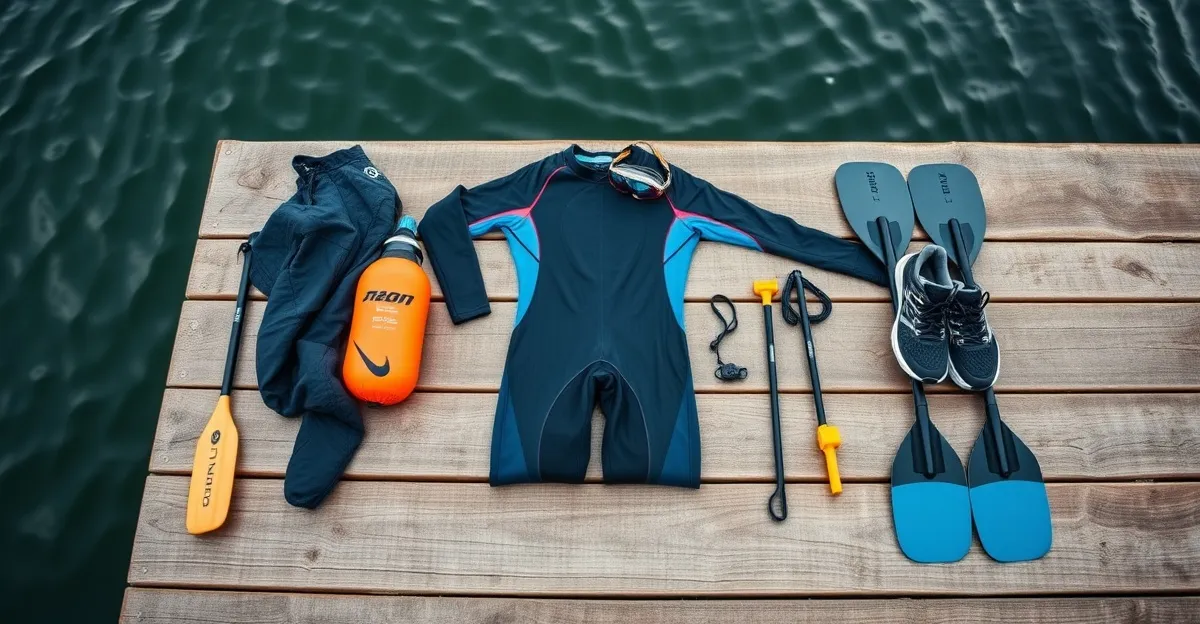
Swimrun Gear: What You Actually Need
Swimrun is mechanically simpler than triathlon. There is no bike to maintain, no transition bags to organize, no wheel changes to rehearse. But the simplicity is deceptive. In swimrun, you carry everything from start to finish. You swim in your running shoes. You run in your wetsuit. Every piece of equipment must function in both environments without compromise, and the wrong choice in any single category can turn a manageable race into a miserable one.
The "carry everything" rule is the defining constraint of swimrun equipment selection. Unlike triathlon, where you swap gear at each discipline boundary, swimrun demands that every item you wear or carry at the start line stays with you through every swim entry, every rocky scramble, every forest trail, and every open-water crossing until you reach the finish. This constraint shapes every purchasing decision, from wetsuit thickness to shoe weight to paddle attachment method.
The good news: a complete swimrun kit costs less than a triathlon setup. There is no bike, no aerobars, no power meter. The total outlay for a race-ready gear set ranges from $400 at the entry level to $1,200 for a competitive setup. The bad news: the sport is niche enough that finding the right equipment requires research. Most running shops do not stock swimrun-specific wetsuits. Most swim shops have never heard of hand paddles designed for open water. This guide covers what you need, what matters, and where to find it.
Wetsuits: Your Most Important Investment
The wetsuit is the single most consequential gear decision in swimrun. A bad wetsuit will overheat you on the run, restrict your stride, and leave you exhausted before the second swim. A good one disappears into the background, keeping you warm in the water and cool enough on land that you barely notice it.
What Makes Swimrun Wetsuits Different from Triathlon
Triathlon wetsuits are designed for a single purpose: fast swimming in open water, followed by immediate removal. They use thick neoprene (3-5mm) for maximum buoyancy, full-length legs for streamlining, and a rear zip designed for rapid stripping in transition. None of these characteristics work for swimrun.
Swimrun wetsuits are built around a fundamentally different set of trade-offs. They use thinner neoprene (1.5-3mm) because the wetsuit stays on during running sections that may last 30 minutes or longer. Thick neoprene traps heat, and overheating on a forest trail with no water access is a race-ending problem. The thinner material sacrifices some swim buoyancy in exchange for thermal regulation during running.
The legs are either knee-length or fully removable. Full-length neoprene legs restrict knee flexion and hip extension during running, particularly on technical terrain with steep climbs. Many swimrun wetsuits feature zip-off or roll-up lower legs, allowing athletes to expose their calves and knees during long run sections and restore coverage before cold water entries.
Built-in pockets are standard on swimrun wetsuits, typically located on the thighs, chest, or lower back. These store gels, bars, a pull buoy, or a whistle. In triathlon, nutrition lives in a transition bag or taped to a bike frame. In swimrun, it rides with you in your wetsuit.
Reinforced shoulders and chest panels protect against abrasion from rocky swim entries and exits. Scrambling over barnacle-covered rocks in a thin wetsuit will shred standard neoprene. Swimrun suits use higher-denier outer fabrics or Kevlar-reinforced panels in high-wear zones.
Front zip versus back zip presents a genuine trade-off. Front-zip designs allow ventilation during runs -- unzipping the chest panel drops core temperature quickly. Back-zip designs sit flatter against the chest and cause less drag in the water, but venting requires a partner's help. Most competitive swimrun athletes prefer front zip for the thermal management advantage.
Wetsuit Thickness Analysis
Neoprene thickness determines the balance between swim warmth and run comfort. The right choice depends on race location, water temperature, and your personal cold tolerance.
| Thickness | Best For | Swim Warmth | Run Comfort | Water Temp |
|---|---|---|---|---|
| 1.5mm | Warm races (>18C) | Low | Excellent | Mediterranean, summer |
| 2mm | Most races | Medium | Good | Spring/autumn Europe |
| 3mm | Cold water (<14C) | High | Moderate | Scandinavia, early season |
Most athletes racing in Northern Europe -- where the majority of swimrun events take place -- find 2mm to be the best all-round thickness. It provides adequate warmth for water temperatures between 14C and 18C while remaining light enough for sustained running. Athletes racing exclusively in Scandinavia or early-season events should consider 3mm, accepting the trade-off of increased heat retention on land.
Top Wetsuit Brands (2026)
Colting Wetsuits is the benchmark. Founded in Sweden and purpose-built for swimrun since the sport's earliest days, Colting's SR02 model remains the suit most frequently seen at the front of OTILLO races. The SR02 features variable-thickness panels (thicker in the torso for buoyancy, thinner in the arms and legs for mobility), integrated pockets, and removable lower legs. It is the standard against which all other swimrun wetsuits are measured.
Orca brings triathlon heritage to the swimrun market. Their dedicated swimrun line offers good entry-level options at lower price points than Colting. The Orca RS1 is a solid first swimrun wetsuit for athletes transitioning from triathlon who want a familiar brand with swimrun-specific features.
HEAD produces the Swimmaster series, which occupies the mid-range well. HEAD's swim background means their neoprene quality and panel construction are reliable. The Swimmaster suits lack some of the specialized pocketing and reinforcement found on the Colting SR02, but they swim well and run adequately.
Ark is a premium swimrun-specific brand that has gained traction among competitive racers. Their suits feature innovative panel designs and high-quality closures, competing directly with Colting at the top end of the market.
Budget Recommendations
Entry level ($200-250): Orca RS1 or HEAD Swimrun Aero. Both provide the essential swimrun-specific features -- thinner neoprene, shortened legs, basic pocketing -- at a price point accessible to athletes testing the sport for the first time. These suits will handle sprint and standard-distance swimrun races comfortably.
Mid-range ($300-400): Colting OpenWater or HEAD Swimmaster. Stepping up to this range brings better neoprene quality, more sophisticated panel construction, additional pockets, and improved durability in high-wear zones. Athletes planning to race multiple times per season should start here.
Premium ($400-600): Colting SR02 or Ark swimrun suits. The top tier delivers the best thermal regulation, lightest weight-to-warmth ratio, most functional pocket systems, and longest durability. Competitive athletes and anyone targeting long-course events like OTILLO will benefit from the investment.
Trail Shoes: Drainage is Everything
In triathlon, you strip off your wetsuit, towel off your feet, pull on dry socks, and lace up pristine running shoes. In swimrun, you climb out of the ocean onto a rocky shoreline, water streaming from every seam, and start running in shoes that weigh 100 grams more than they did at the start line. Drainage is not a nice-to-have feature. It is the primary selection criterion.
Key Requirements
Fast drainage means mesh uppers, drainage holes, and minimal foam layers that absorb water. A shoe that takes 3 minutes to drain adds dead weight to every run section following a swim. The best swimrun shoes shed water within 30 seconds of exiting the water, returning close to their dry weight before the first kilometre is complete.
Aggressive tread is non-negotiable. Swimrun courses include wet rock, muddy forest trails, slippery boat ramps, and algae-covered surfaces. A tread pattern with 4-5mm lugs provides the grip needed for these conditions. Vibram or Continental rubber compounds offer the best wet-surface traction.
Snug fit matters more than in any other running discipline. Swimming in shoes that are even slightly loose risks losing them during powerful kick strokes or when exiting through surf. The heel cup must lock the foot in place. Many swimrun athletes size down a half size from their normal trail shoe to ensure retention in the water.
Lightweight construction directly affects swim performance. Every 100 grams of shoe weight creates additional drag in the water. The ideal swimrun shoe weighs 250-350 grams dry, gaining 50-100 grams when wet. This range provides enough structure and protection for technical trails while keeping swim drag manageable.
The Shoe Drag Problem
Swimming in shoes is the least natural thing you will do in swimrun. Shoes disrupt your kick, increase frontal drag, and change your body position in the water. Heavier shoes exacerbate every one of these problems. The physics is straightforward: a shoe creates drag proportional to its surface area and the density of water it retains. A waterlogged shoe with thick foam midsole and dense rubber outsole can weigh 500 grams when wet -- more than double its dry weight. That is a kilogram of dead weight on your feet, fighting you on every stroke.
Lighter shoes with open mesh and minimal foam reduce this penalty substantially. The trade-off is underfoot protection: a thin-soled minimalist shoe drains faster and swims better, but provides less cushioning on rocky terrain. Most swimrun athletes find the sweet spot in lightweight trail shoes rather than road runners (which lack tread) or heavy mountaineering trail shoes (which drain poorly).
Top Shoe Recommendations
Salomon Speedcross remains the most popular choice in the swimrun field. The aggressive Contagrip tread provides exceptional grip on wet surfaces, the heel geometry locks the foot in place, and the Quicklace system allows mid-race tension adjustment. Drainage is decent but not outstanding -- the shoe uses a synthetic upper that sheds water reasonably well, though some athletes drill additional drainage holes in the midsole.
Inov-8 X-Talon is the ultralight alternative. At under 250 grams in most sizes, it is one of the lightest trail shoes suitable for swimrun. The Graphene-Grip rubber compound provides outstanding wet traction, and the minimal upper construction drains rapidly. The trade-off is underfoot cushioning -- the X-Talon is a true racing flat, and athletes accustomed to cushioned shoes may find it punishing on long rocky sections.
VIVOBAREFOOT Primus Trail appeals to minimalist runners who want maximum ground feel. The thin sole and wide toe box drain almost instantly, and the barefoot design encourages a natural forefoot strike that works well in swimrun. However, the minimal protection means this shoe is best suited for experienced minimalist runners who have conditioned their feet for rocky terrain.
La Sportiva VK BOA features a BOA dial closure system that allows precise, one-handed tightening -- useful when your hands are cold and wet after a long swim. The Frixion rubber compound grips well on wet rock, and the shoe weighs around 280 grams. The BOA system adds slight complexity (the dial mechanism must be kept clear of sand and debris) but offers the fastest lace adjustment available.
Hand Paddles: Propulsion vs Fatigue
Hand paddles are the most debated piece of swimrun equipment. They are not mandatory under any major swimrun ruleset, but the vast majority of competitive athletes use them. The reason is simple physics: swimming in shoes reduces your effective propulsion by 15-25%, and paddles restore most of that lost efficiency by increasing the surface area of each hand stroke by 30-60%.
The mechanics are straightforward. A larger hand surface catches more water per stroke, generating more forward propulsion. The catch phase of the freestyle stroke becomes more powerful, and the overall stroke count per lap decreases. For an athlete swimming 10-15km in a long-course swimrun, that efficiency gain compounds into minutes of time savings.
The cost is shoulder fatigue. Paddles increase the load on the rotator cuff, deltoids, and latissimus dorsi with every stroke. An athlete who trains without paddles and races with them will experience premature shoulder fatigue that degrades both swim technique and subsequent run performance. Paddles must be integrated into training progressively, starting with shorter intervals and building to full race-distance sets.
Sizing Guide
Paddle size is measured by the length of the blade surface. Choosing the right size depends on shoulder strength, swim distance, and experience level.
Small (15-17cm): The correct starting point for beginners and athletes racing shorter distances. Small paddles provide a noticeable propulsion boost without overwhelming the shoulder joint. They are also easier to carry during run sections (tucked into a wetsuit pocket or held in one hand) due to their compact size. Athletes with a history of shoulder injuries should stay at this size.
Medium (17-19cm): The most common size in the swimrun field. Medium paddles offer a strong balance of power generation and endurance sustainability. An athlete with 6+ months of paddle training and no shoulder issues can handle medium paddles through a full-day race without excessive fatigue. This is the default recommendation for most racers.
Large (19-22cm): Reserved for strong swimmers with well-conditioned shoulders, typically those with competitive swimming backgrounds or multiple seasons of swimrun experience. Large paddles generate the most propulsion but demand the most from the shoulder girdle. They are heavy to carry during runs and difficult to manage in rough water conditions. Use only if your swim sections consistently exceed 500 metres and your shoulders are trained for the load.
Usage Tips
Practice in training first. Shoulder fatigue from paddles is cumulative and sneaks up on athletes who have not trained with them. Add paddle swims to your training at least 8 weeks before race day, starting with 25% of your swim volume and building to 75% over the training block.
Remove for short swim sections. Sections under 200 metres often do not justify the overhead of deploying paddles. The time spent securing paddles, adjusting straps, and settling into a rhythm may exceed the propulsion benefit on a short crossing. Many experienced athletes keep paddles tucked in their wetsuit for sections under 200 metres and deploy them only for longer open-water crossings.
Strap attachment matters. Breakaway straps prevent wrist and finger injuries if a paddle catches on debris or another swimmer. Fixed straps that do not release under load can hyperextend fingers or torque the wrist. Look for paddles with tubing-based finger loops that slip off under excessive force rather than rigid plastic straps.
Pull Buoy: Float Your Legs
A pull buoy provides buoyancy to the legs during swim sections, lifting the lower body to a more horizontal position in the water. This serves two purposes in swimrun: it reduces drag from the legs and shoes, and it allows the legs to rest during swims, preserving them for run sections.
In pool swimming, a pull buoy is a training aid. In swimrun, it is race equipment. The buoyancy it provides is particularly valuable when wearing shoes, which pull the feet downward and create a body angle that increases frontal drag. A buoy between the thighs counteracts this effect, restoring a more efficient swim position.
Swimrun-Specific vs Pool Pull Buoys
Standard pool pull buoys are too large for swimrun. A typical pool buoy measures 24x18cm and is designed to be used in a controlled lane environment and left on the pool deck between sets. In swimrun, the buoy must be carried during every run section -- tucked inside the wetsuit, clipped to a belt, or held in one hand.
Swimrun-specific pull buoys are smaller (approximately 20x15cm), lighter, and shaped to fit inside a wetsuit without restricting movement. They are typically contoured to sit between the thighs without sliding out during vigorous kicking or to nestle against the chest inside a wetsuit panel. Some models feature a streamlined teardrop shape that reduces drag when tucked into the suit.
Storage During Run Sections
Most athletes tuck the pull buoy inside their wetsuit during runs. The two most common positions are between the thighs (held by the neoprene compression) and under the chest panel (against the stomach or lower ribs). Many swimrun wetsuits now include dedicated buoy pockets sized for standard swimrun buoys. Athletes without buoy pockets often use a small bungee cord or waist clip to secure the buoy externally.
When to Use It
Pull buoys become essential for races with long swim sections exceeding 500 metres per section. On these longer crossings, leg fatigue accumulates and body position deteriorates, making the buoy's buoyancy contribution significant. For sprint-distance swimrun races with short swim sections (under 200 metres), the buoy is optional -- the time spent deploying and stowing it may exceed its benefit.
Some athletes with strong swim backgrounds and efficient kick technique skip the pull buoy entirely, even in long races. If your natural body position in the water is already horizontal and your kick is not energy-intensive, the buoy provides marginal benefit. However, most recreational athletes benefit from the buoyancy support, particularly in the later stages of a race when fatigue degrades swim form.
Essential Accessories
Calf Guards and Gaiters
Sand, gravel, and small rocks will enter your shoes on every run section. Without calf guards or gaiters, debris accumulates in the shoe, creating hot spots and blisters that worsen with each water entry (salt water on abraded skin is as painful as it sounds). Knee-high neoprene socks or lightweight synthetic gaiters prevent debris entry while providing minor thermal benefit during swim sections. Most swimrun athletes consider calf guards mandatory rather than optional.
Race Whistle
A safety whistle is mandatory in many OTILLO-sanctioned races and recommended for all swimrun events. The whistle provides a signalling method for athletes in distress during open-water sections where shouting may not carry. Most athletes attach a small plastic whistle to their wetsuit zipper pull, where it is immediately accessible without interfering with movement. Cost is negligible ($2-5), weight is negligible, and the safety value is real.
Tow Rope
Swimrun is often raced in pairs, and a tow rope connecting partners is one of the sport's most distinctive features. The rope is an elastic cord, typically 2-3 metres in length, that attaches at the waist or hip belt of both athletes. During swim sections, the stronger swimmer tows the weaker swimmer, conserving the weaker swimmer's energy for run sections where they may be faster.
A quick-release mechanism is essential. The connection must detach instantly if either athlete needs to separate -- for safety during rough water, for navigating narrow passages, or for independent pacing on technical terrain. Quality tow ropes use a carabiner or magnetic release system rather than knots or fixed loops.
Goggles
Goggles are optional but useful for swim sections longer than 200 metres. Clear or lightly tinted lenses suit the variable light conditions of outdoor swimrun (overcast Scandinavian mornings to bright Mediterranean afternoons). The challenge is storage: goggles must be carried during runs, typically around the neck, on the forehead, or tucked into a wetsuit pocket. A low-profile pair with a thin silicone strap minimizes bulk during running.
Nutrition Storage
Gels and bars are stored in wetsuit pockets. This is straightforward in concept but requires attention to packaging: standard gel packets can burst under the compression of neoprene, and non-waterproof bar wrappers dissolve after repeated saltwater immersion. Use gels with robust packaging (flask-style containers are more reliable than single-use tearaway packets) and bars with waterproof wrappers. Test your nutrition packaging in training -- discovering a pocket full of dissolved gel at kilometre 15 is a race-altering experience.
Anti-Chafe Cream
This is the single most underestimated piece of swimrun equipment. The combination of saltwater, sand, and neoprene against skin for 4+ hours creates friction burns that rival anything produced by an ultra-marathon. Apply generously to the neck, armpits, inner thighs, and any point where the wetsuit seams contact skin. Reapply at aid stations if available. Products with lanolin or silicone bases last longer than water-based formulations because they resist saltwater washout. Skipping anti-chafe is the single most common gear mistake among first-time swimrun athletes, and it is the easiest one to prevent.
Gear Budget Breakdown
The following table breaks down a complete swimrun gear setup at three price tiers. All prices are approximate 2026 retail.
| Item | Entry ($400-600) | Mid-Range ($700-900) | Race Ready ($1000-1500) |
|---|---|---|---|
| Wetsuit | Orca RS1 ($200) | HEAD Swimmaster ($350) | Colting SR02 ($500) |
| Shoes | Salomon Speedcross ($130) | Inov-8 X-Talon ($140) | Salomon S/Lab Ultra 3 ($180) |
| Paddles | Generic ($30) | Colting Paddles ($50) | Lavacore Race ($70) |
| Pull buoy | Basic ($20) | Swimrun-specific ($35) | Colting SRP02 ($50) |
| Accessories | Whistle + gaiters ($30) | + tow rope ($50) | + goggles + anti-chafe ($80) |
| Total | $410 | $625 | $880 |
The entry tier covers everything required for a first swimrun race. The mid-range tier upgrades the wetsuit and adds race-specific accessories that improve comfort over longer distances. The race-ready tier represents gear that will perform reliably across a full season of events including long-course races.
One note on value: the single biggest performance gain per dollar comes from the wetsuit. An athlete wearing a $500 wetsuit with $130 shoes will outperform an athlete wearing a $200 wetsuit with $300 shoes in almost every condition. Allocate your budget to the wetsuit first, then shoes, then everything else.
Common Gear Mistakes
Five errors account for the majority of gear-related problems in swimrun. All are avoidable with basic preparation.
1. Using a Triathlon Wetsuit
This is the most expensive mistake because it often costs an entire race. Triathlon wetsuits use 3-5mm neoprene designed for 20-40 minutes of swimming followed by immediate removal. Wearing one for a 4-hour swimrun with alternating swim and run sections produces dangerous overheating during runs. The thick neoprene traps metabolic heat, core temperature rises, and performance deteriorates rapidly. Additionally, full-length legs restrict running stride and the lack of pockets means no nutrition storage. If you own a triathlon wetsuit, it stays at home on swimrun race day.
2. Wearing Road Running Shoes
Road shoes fail in swimrun on two fronts: drainage and traction. Road shoes use dense foam midsoles and closed uppers designed to keep water out, which means they retain water after every swim entry. A pair of waterlogged road shoes can gain 200-300 grams per shoe, creating dead weight through every subsequent run and swim. The smooth outsole compounds the problem -- wet rock, muddy trails, and slippery boat ramps require aggressive tread that road shoes do not provide. The result is slow, heavy, dangerous running.
3. Starting with Large Paddles
Enthusiastic beginners see fast swimmers using large paddles and buy the biggest size available. The result is shoulder fatigue within the first two swim sections, degraded technique for the remainder of the race, and potentially a rotator cuff strain that sidelines them for weeks. Start with small paddles. Train with them for at least two months. Move to medium only when your shoulders handle the small paddles through full race-distance training sessions without fatigue.
4. Forgetting Anti-Chafe
Anti-chafe cream costs $10 and takes 90 seconds to apply. Forgetting it costs you hours of increasing pain that worsens with every water entry. By the third hour of a race, saltwater on neoprene-abraded skin produces raw, bleeding friction burns at the neck, armpits, and inner thighs. This is not discomfort -- it is the kind of pain that causes athletes to DNF. Apply anti-chafe before the race, carry a small tube for reapplication, and test your application pattern in training.
5. Not Practising in Race Gear
Swimrun gear behaves differently when wet. Shoes that feel fast on a dry trail feel heavy after a swim. A wetsuit that fits well in the shop restricts differently after 30 minutes of running. Paddles that seem easy in a pool session cause shoulder burn after 2km of open water. Every piece of race equipment must be tested in race-like conditions -- ideally a training session that includes both swimming and running in the gear you plan to race in. Discovering that your wetsuit chafes at the collar or your shoes fill with sand from an ankle gap is a training problem, not a race-day problem.
Swimrun rewards thoughtful equipment selection more than most endurance sports. The right gear disappears into the background, letting you focus on the racing. The wrong gear announces itself at every transition, every water entry, and every rocky trail. Start with the complete swimrun overview if you are new to the sport, then use this guide to build a gear setup matched to your experience level and target races.
Frequently Asked Questions
What wetsuit do you need for swimrun?
A swimrun-specific wetsuit with thinner neoprene (1.5-3mm), shorter or removable legs, and reinforced shoulders. Regular triathlon wetsuits are too thick and restrict running. Budget $200-500.
Can you use triathlon shoes for swimrun?
Not recommended. Triathlon shoes lack drainage and tread for wet terrain. Use trail shoes with mesh uppers that drain quickly and aggressive tread for wet rock. Running shoes with drainage holes work as entry-level alternatives.
Are hand paddles required in swimrun?
Not mandatory by rules, but strongly recommended. Paddles offset the drag created by swimming in shoes. Most competitive athletes use them. Start with smaller paddles and work up as shoulder strength develops.
How much does swimrun gear cost?
Entry level: $400-600 total (wetsuit $200-250, shoes $120-150, paddles $30-50, pull buoy $20-30). Competitive setup: $800-1200 (premium wetsuit $400-500+, race shoes, multiple paddle sizes).
What size pull buoy for swimrun?
Smaller than pool pull buoys. A compact swimrun-specific buoy (about 20x15cm) that tucks into your wetsuit without restricting running. Some athletes skip the buoy for shorter races.
Ready to Train Smarter?
Get personalized training zones, race predictions, and performance insights with our free calculators.
