
Your Triathlon Background is an Advantage
If you've trained for triathlon — at any distance — you already have the two most important physical foundations for swimrun: open-water swimming fitness and running endurance. Your aerobic engine, your comfort in choppy water, and your ability to push through fatigue in a multi-discipline race all transfer directly.
But swimrun is not triathlon minus the bike. The sport has its own demands that will surprise you if you show up expecting a familiar experience. This guide covers exactly what transfers, what needs adaptation, and how to make the crossover efficiently.
What Transfers from Triathlon
- Open-water swimming: Your sighting, drafting, and wave-start experience is directly applicable. Many swimrun newcomers from running backgrounds struggle with open water — you won't.
- Aerobic base: The cardiovascular fitness from triathlon training (especially 70.3 and Ironman) is more than sufficient for swimrun distances.
- Multi-discipline mental toughness: You're used to switching disciplines mid-race and managing fatigue across different movement patterns.
- Race logistics: Gear prep, nutrition planning, pre-race logistics — the discipline of triathlon racing transfers to swimrun's race day routines.
- Pacing awareness: Knowing when to push and when to conserve across a long race is a skill triathlon has built in you.
What Doesn't Transfer (and Will Surprise You)
Swimming in Trail Shoes
This is the single biggest shock. Your clean, efficient freestyle stroke becomes a dragging, energy-intensive slog when you're wearing 300g trail shoes. Expect to lose 10-15 seconds per 100m compared to your normal open-water pace. The shoes act like anchors on your feet, forcing your legs lower in the water and disrupting your body position.
Adaptation: Hand paddles recover 5-8 seconds per 100m by increasing propulsion. A pull buoy lifts your legs and restores a flatter body position. Together, they get you within 5-10% of your normal pace. Practice with both in training before racing.
Running in a Wetsuit
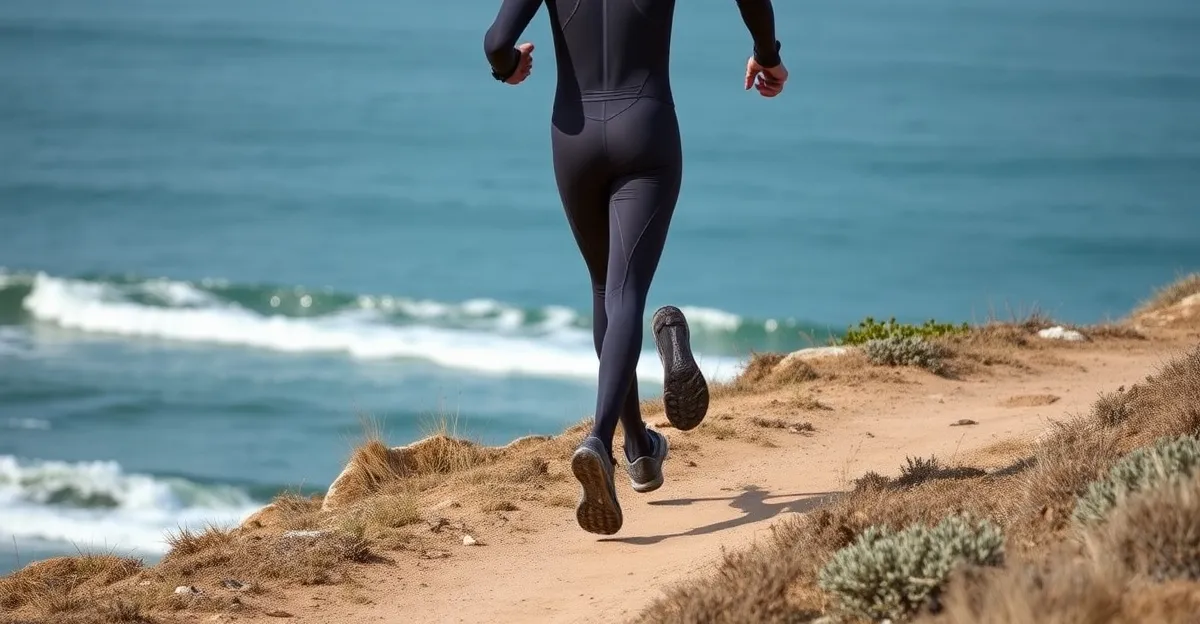
You run in your wetsuit. Always. On a warm day, this means overheating within the first kilometre. Triathlon wetsuits (3-5mm thick, full-length legs) are too hot and restrictive for this — you need a swimrun-specific suit at 1.5-3mm with shorter legs.
Even with the right suit, wetsuit running feels different. The neoprene restricts your stride slightly, your shoulders carry extra weight, and your core temperature climbs faster than expected.
No Transitions
In triathlon, transitions are a reset — you change shoes, remove your wetsuit, grab your bike. In swimrun, there is nothing. You emerge from the water, take three steps onto rocky shoreline, and start running. The mental shift from "swimmer" to "runner" happens in seconds, not minutes. There's no time to reset mentally or physically.
The Team Tether
You are physically connected to another person for the entire race. In the water, you draft behind each other or swim side by side. On land, the tether bounces between you as you navigate narrow trails. You must match pace, communicate constantly, and manage the emotional dynamics of shared suffering over 3-8+ hours.
For triathletes used to racing alone inside their own head, this is a fundamental shift. Many athletes describe the partnership as the best part of swimrun — but it requires practice.
Trail Terrain
Triathlon runs are typically on roads or paved paths. Swimrun runs are on rocky coastlines, root-covered forest trails, steep descents, and wet surfaces. Your road running pace is irrelevant — trail fitness, ankle stability, and agility matter more than raw speed.
Mapping Your Triathlon Fitness to Swimrun
| Your Triathlon Level | Ready For | Training Gap |
|---|---|---|
| Sprint triathlon finisher | Sprint swimrun (5-10km) | Shoe-swimming, trail running basics |
| Olympic distance finisher | Short/Medium swimrun (10-25km) | Trail running, partner training |
| Half Ironman (70.3) finisher | Long swimrun (30-50km) | Wetsuit running, nutrition in suit |
| Ironman finisher | Ultra swimrun (ÖTILLÖ World Championship) | All of the above + cold water adaptation |
Gear: What to Keep, What to Buy
- Keep: Your goggles, anti-chafe cream, race nutrition, GPS watch, heart rate monitor
- Replace: Wetsuit (need swimrun-specific), running shoes (need trail shoes with drainage)
- Buy new: Hand paddles, pull buoy, tether/tow rope, race whistle, calf guards
- Retire: Your bike (just for swimrun training days — keep it for triathlon)
Budget $300-500 for the transition if you already have a good GPS watch and basic accessories. See the full Swimrun Gear Guide for specific recommendations at each price point.
8-Week Crossover Training Plan
If you're already triathlon-fit, you don't need a full swimrun base-building phase. Instead, focus on the specific adaptations over 8 weeks before your first race:
Weeks 1-2: Gear Familiarisation
- Swim 2x per week in your trail shoes (pool first, then open water)
- Run 1x per week in your swimrun wetsuit (start with 3km, build to 8km)
- Practice with hand paddles and pull buoy in the pool
Weeks 3-4: Brick Sessions
- 1x per week swimrun brick: 400m swim → 2km run → 400m swim → 2km run (all in race gear)
- 1x per week trail run (replace one road run with trails)
- 1x per week open-water swim in full gear
Weeks 5-6: Team Training
- 2x per week with your partner: one swim session, one run session
- 1x per week tethered brick session together
- Practice communication, pacing together, water entry/exit coordination
Weeks 7-8: Race Simulation + Taper
- Week 7: Race simulation — 60-70% of target race distance with partner, full gear, real terrain
- Week 8: Taper — light sessions only, gear check, nutrition planning, course review
Picking Your First Swimrun Race
As a triathlete, you can skip the absolute beginner events and start with a short or medium distance. Good first-race options for triathletes:
- ÖTILLÖ Sprint/Merit events: Well-organised, 8-15km distances, strong community atmosphere
- Mudskipper events (North America): Accessible distances, good for testing the format
- My Swimrun Championships qualifiers: Competitive but welcoming, European focus
Browse the full race calendar and use the Swimrun Pace Calculator to estimate your finish time based on your swim and run paces.
Frequently Asked Questions
How does triathlon fitness transfer to swimrun?
Your swim and run aerobic base transfers directly. Open-water swimming skills are particularly valuable. The biggest adjustments are swimming in shoes (adds 10-15 seconds per 100m), running in a wetsuit (heat management), trail running technique (vs road), and working as a tethered team.
Do I need a different wetsuit for swimrun?
Yes. Triathlon wetsuits are too thick (3-5mm) and too restrictive for running. Swimrun wetsuits use thinner neoprene (1.5-3mm), have shorter legs, and include pockets for nutrition. Your triathlon wetsuit will overheat you within the first run section.
How much slower is swimming in shoes?
Expect to add 10-15 seconds per 100m compared to your pool or open-water pace. Trail shoes create significant drag. Hand paddles offset some of this — most swimrun athletes recover 5-8 seconds per 100m with paddles.
What triathlon distance prepares you for swimrun?
If you can complete a sprint triathlon (750m swim + 5km run), you're ready for a sprint swimrun (5-10km total). Olympic distance fitness (1.5km swim + 10km run) prepares you for medium swimrun (15-30km). Half Ironman fitness maps well to long swimrun courses.
How do I find a swimrun partner?
Start with your triathlon club — many triathletes are curious about swimrun. Local running and open-water swimming groups are also good sources. ÖTILLÖ and My Swimrun Championships have partner-finding forums. Race at a sprint distance first to test compatibility.
Ready to Train Smarter?
Get personalized training zones, race predictions, and performance insights with our free calculators.
