
IRONMAN Hamburg 2026 at a glance
IRONMAN Hamburg is Germany's big-city full-distance race and one of the fastest IRONMAN courses in Europe. If you want a personal best on an IRONMAN-branded course, with Kona slots on the table and a Rathausmarkt finish surrounded by Hanseatic architecture, this is the race to enter. The combination of an Alster lake swim, a pancake-flat bike course through Schleswig-Holstein, and a four-lap run entirely around the Alster makes Hamburg the European alternative to Copenhagen and Roth for sub-10 chasers.
Hamburg took over Germany's IRONMAN full-distance calendar slot alongside Frankfurt and has grown into a firm fixture since 2018. A tragic accident on the bike leg in 2023 led to a redesigned course with improved separation between cyclists and public traffic — the current route is the result of that safety review.
Key facts
| Detail | Information |
|---|---|
| Race date | Sunday, July 19, 2026 |
| Location | Hamburg, Germany (city centre start and finish) |
| Distance | 3.8 km swim · 180 km bike · 42.2 km run |
| Total elevation | Flat swim · ~1,000m bike · ~50m run |
| Cutoff time | 17 hours (standard IRONMAN) |
| Field size | ~2,800 athletes |
| Water temperature (avg) | 17-22°C — wetsuit usually legal |
| Expected 2026 entry fee | ~725-795 EUR |
| Registration window | Opens ~11 months before race day |
| Kona slots | Yes — IRONMAN World Championship qualification available |
| Course reputation | Flat, fast, PB-friendly — one of the three fastest in Europe |
The swim — Alster lake in central Hamburg
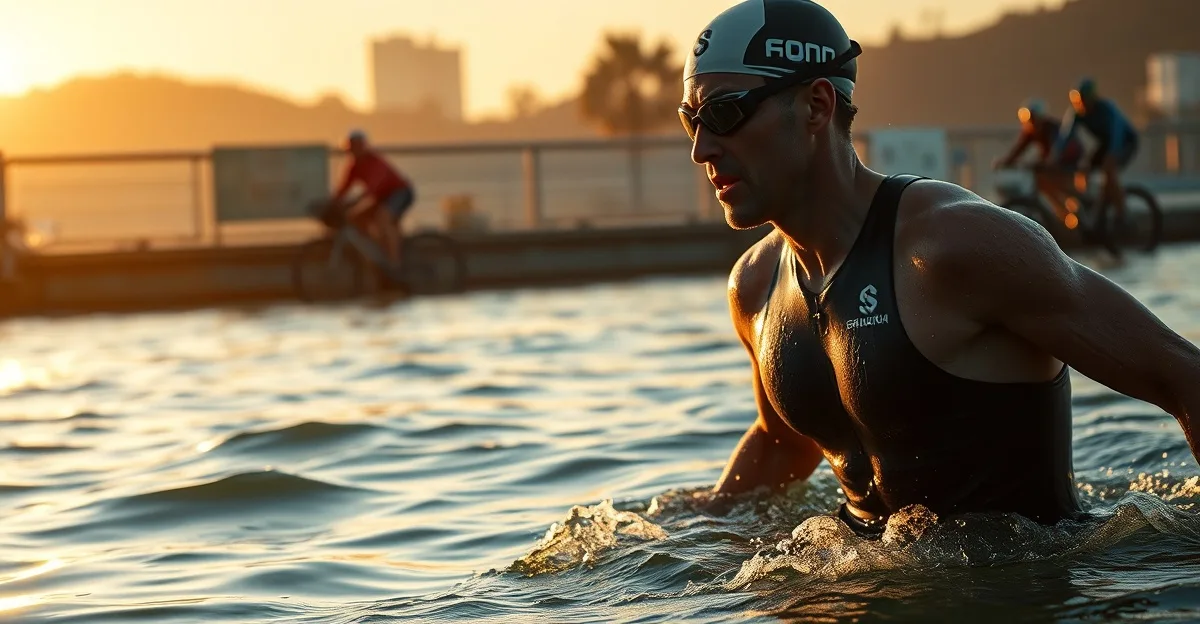
The Alster swim is one of the most photogenic starts in the sport. You wade into the Binnenalster — the smaller inner basin right next to Hamburg's city hall — and swim two laps that touch the larger Außenalster beyond. Spires, historic façades, and the Hamburg skyline form the backdrop. Very few IRONMAN swims put you this close to a European city centre.
Water temperature in the Alster is typically 17-22°C in July. Wetsuits are almost always legal. The lake is still, protected from wind on the inner basin, and there are no currents to fight. It's a friendly swim venue — good for a confident PB attempt and forgiving for swim-weaker athletes, though the two-lap format means you'll pass the crowded swim start buoys a second time.
Expected swim times by level:
- Pro: 45-52 minutes
- Strong age grouper: 55-65 minutes
- Mid-pack: 65-80 minutes
- Back-of-pack / swim-weak: 85-100 minutes (cutoff is 2:20)
The bike — one lap, flat, fast
This is the reason people pick Hamburg. The bike course leaves T1 near the Alster and heads west through the leafy Altona and Blankenese districts along the Elbe river, before pushing out into the flat, open farmland of Schleswig-Holstein. You ride a single long lap, turn around, and roll back into Hamburg via the Elbtunnel area and the western city approach.
Total elevation is around 1,000 metres over 180 km — one of the flattest IRONMAN bike courses in Europe, meaningfully flatter than Frankfurt (~1,600m) and comparable to Copenhagen or Vichy. The surface is mostly well-maintained German road. There's no headline climb, no category HC suffer-fest, no "break the race" moment. It's an honest aero effort from start to finish.
If you ride aero well and hold power on the flat, Hamburg rewards you. If you're a climber-type who needs varied terrain to hide inside, you'll find the sustained aero position more taxing than a rolling course like Roth.
Expected bike splits (intermediate male age grouper, 35-44): 5:15-6:00. Pros are closer to 4:10.
The run — four laps of the Alster
The Hamburg marathon is four laps around the Alster lake in the centre of Hamburg. Each lap is approximately 10.5 km and traces both sides of the Binnenalster and Außenalster. The profile is 100% flat, the surface is urban path and promenade, and the route passes directly in front of the Rathausmarkt (city hall square) on every lap — which is also where the finish line is.
Four-lap runs are divisive. The upside: you see your family on every lap, pacing is simple, aid stations are frequent, and the atmosphere is constantly full. The downside: it's mentally demanding. Lap three is where the race is won or lost — you've already covered the route twice, you know exactly how far remains, and there's no new scenery to distract you. Athletes who thrive here are the ones who can lock into a rhythm and refuse to bargain with it.
The finish at Rathausmarkt is one of the best in European triathlon — a paved historic square in the heart of the city with the Rathaus as the backdrop. You cross the line with the crowd pressed against the barriers on both sides.
Expected marathon splits (intermediate male age grouper, 35-44): 3:45-4:30.
Registration & Kona slots
IRONMAN Hamburg uses open registration. Entries typically open around 11 months before race day via the official IRONMAN website, with a tiered pricing structure (early-bird, regular, late) that rewards early commitment. The race sells to capacity but generally doesn't sell out in minutes the way Roth does — you usually have several months to decide.
As an IRONMAN-branded race, Hamburg offers Kona qualifying slots for the IRONMAN World Championship. Slot allocation depends on age-group field size. For the fastest age groupers targeting Kona, Hamburg's combination of a fast course and realistic podium depth makes it a strategic pick.
- Register via ironman.com/im-hamburg
- Tiered pricing — register early to lock in the lower fee
- IRONMAN active membership is mandatory and charged separately
- Bike transport via IRONMAN official partners is available for international athletes
Getting to Hamburg
By air
- Hamburg Airport (HAM) — the easy option. HAM is one of the most centrally-located airports of any major European city, about 20 minutes from the Alster by S-Bahn S1 or taxi. Good European connections and some long-haul routes
- Bremen (BRE) — 1 hour by train, useful if you find cheaper flights
- Frankfurt (FRA) or Munich (MUC): 3.5-4 hours by ICE train if you're on a long-haul arrival via one of the big hubs
By train
- Hamburg Hauptbahnhof (Hbf) is a major ICE hub with direct trains to/from Berlin, Frankfurt, Munich, Copenhagen, and Amsterdam
- From the Hauptbahnhof it's a 10-minute walk or one U-Bahn stop to the Alster and Rathausmarkt
- Deutsche Bahn offers bike transport on ICE trains for €10 with reservation
By car
- A1, A7, A23, and A24 autobahns all converge on Hamburg — driving in is straightforward from anywhere in northern Europe
- Central Hamburg has paid parking and limited space during race week. If you're driving, pick a hotel that includes parking
- Approximate drive times: Berlin 3h, Copenhagen 4.5h, Amsterdam 5h, Munich 8h
Where to stay
- Neustadt / Altstadt — the districts directly around the Alster and Rathausmarkt. Walk to swim start, T1, the run course, and the finish. The obvious choice if you can book one of the larger international chains here
- Rotherbaum / St. Georg — adjacent to the Alster on the north and east sides, slightly quieter, typically cheaper mid-range hotels
- HafenCity — modern harbourside area, 15-20 min by U-Bahn to the race precinct. Best if you want newer hotels
- St. Pauli — cheaper and more characterful, but further from the course and louder at night (not ideal race-eve)
- Hamburg has extensive U-Bahn and S-Bahn coverage, so a hotel one or two stops out is still practical — aim for something on the U1, U2, or U3 line
Training specific to Hamburg
Hamburg is a flat, PB-friendly course. That means the training priorities are different from a hilly race like Nice or Lanzarote — you're optimising for sustained aero power and run durability on flat surfaces, not climbing or descending.
- Long aero rides on flat terrain — 4-6 hour rides in your race position with minimal breaks. Hamburg's bike course doesn't give you natural recovery climbs, so you need to train the position itself
- Flat run economy — four laps of flat running will expose any inefficiency. Work on cadence and ground contact time rather than hill repeats
- Pacing discipline for the four-lap run — simulate multi-lap runs in training (5km loops × 8) to get used to returning past the same landmark. Mental prep is half the battle
- Nutrition dress rehearsal at race pace — flat courses mean you fuel at higher sustained effort than rolling ones. Practise at race HR, not just race distance
- Heat readiness — Hamburg in July is usually mild (18-24°C) but can spike. One or two heat sessions in the final month is cheap insurance
IRONMAN Hamburg vs Frankfurt vs Challenge Roth
Three German full-distance races, three different races. If you're picking one, here's the short version:
| Hamburg | Frankfurt | Challenge Roth | |
|---|---|---|---|
| Date (2026) | July 19 | June 28 | July 5 |
| Brand | IRONMAN | IRONMAN (EC) | Challenge Family |
| Swim | Alster lake (urban) | Langener Waldsee | Main-Donau Canal |
| Bike climb | ~1,000m (very flat) | ~1,600m (rolling) | ~1,300m (rolling) |
| Run character | 4 laps flat Alster | 4 laps Main riverside | 2 laps canal + stadium finish |
| Field size | ~2,800 | ~3,000 | ~3,500 + 650 relays |
| Cutoff | 17 hours | 17 hours | 15 hours |
| Kona slots | Yes | Yes | No |
| Best for | Fastest PB on IRONMAN brand | Prestige, EC status, deep field | Atmosphere, Solarer Berg, stadium finish |
Short version: Hamburg is the PB course. Frankfurt is the prestige European Championship race. Roth is the bucket-list experience. Your choice depends on what you're optimising for.
More information
- Official IRONMAN Hamburg website
- Challenge Roth 2026 race guide
- IRONMAN Frankfurt 2026 race guide
- Full Ironman training guide (distances, phases, methodology)
- Triathlon as a sport — distances, formats, finish times
Frequently Asked Questions
When is IRONMAN Hamburg 2026?
IRONMAN Hamburg 2026 takes place on Sunday, July 19, 2026 in Hamburg, Germany. Race week (expo, athlete briefings, swim course familiarisation) runs from the preceding Thursday.
Is IRONMAN Hamburg really one of the fastest IRONMAN courses in Europe?
Yes. Hamburg's bike course has roughly 1,000 metres of climbing across 180 km, making it one of the three flattest full-distance races in Europe alongside Challenge Roth and IRONMAN Copenhagen. The marathon is a four-lap circuit around the Alster lake — 100% flat, paved, and urban. If you're chasing a personal best on a big-city IRONMAN course, Hamburg is the obvious pick in Europe.
Where is the swim in IRONMAN Hamburg?
The swim is held in the Alster, a lake in the middle of Hamburg split into the Binnenalster (inner) and Außenalster (outer) basins. It's a two-lap course in one of the most photogenic swim venues in the sport — you swim in the shadow of Hamburg's skyline with the Rathaus (city hall) visible from the water. Water temperature is typically 17-22°C in July, so wetsuits are usually legal.
Is there a qualification requirement for IRONMAN Hamburg?
No. IRONMAN Hamburg is an open-registration race — first-come-first-served when entries open roughly 11 months before race day. It does offer Kona slots as an IRONMAN-branded race, so age groupers can qualify for the IRONMAN World Championship by placing in their category.
How much does IRONMAN Hamburg cost?
Individual entry is approximately €725-795 depending on when you register, plus the mandatory IRONMAN active membership fee. Hotels in Hamburg during race week sit in the €120-220/night range for mid-range options. Budget 1,500-2,500 EUR all-in for an international athlete with travel, accommodation, bike transport, and race-week meals.
Where should I stay for IRONMAN Hamburg?
Because the race is city-based, the practical choice is any hotel within walking distance of the Alster. The Rotherbaum, Neustadt, and Altstadt districts put you close to the swim start, T1, and the Rathausmarkt finish. The HafenCity area is slightly further from the run course but offers modern hotels. Everything is well-connected by U-Bahn and S-Bahn.
How does the course compare to IRONMAN Frankfurt?
Hamburg is flatter and faster on the bike (~1,000m vs ~1,600m of climbing) and has a more forgiving, 100%-flat four-lap run at the Alster versus Frankfurt's rolling Main riverside marathon. Frankfurt carries European Championship status and a deeper field, while Hamburg is the better pure PB course. Many German athletes use Hamburg specifically to chase sub-10 or sub-9 hour times.
Ready to Train Smarter?
Get personalized training zones, race predictions, and performance insights with our free calculators.
