
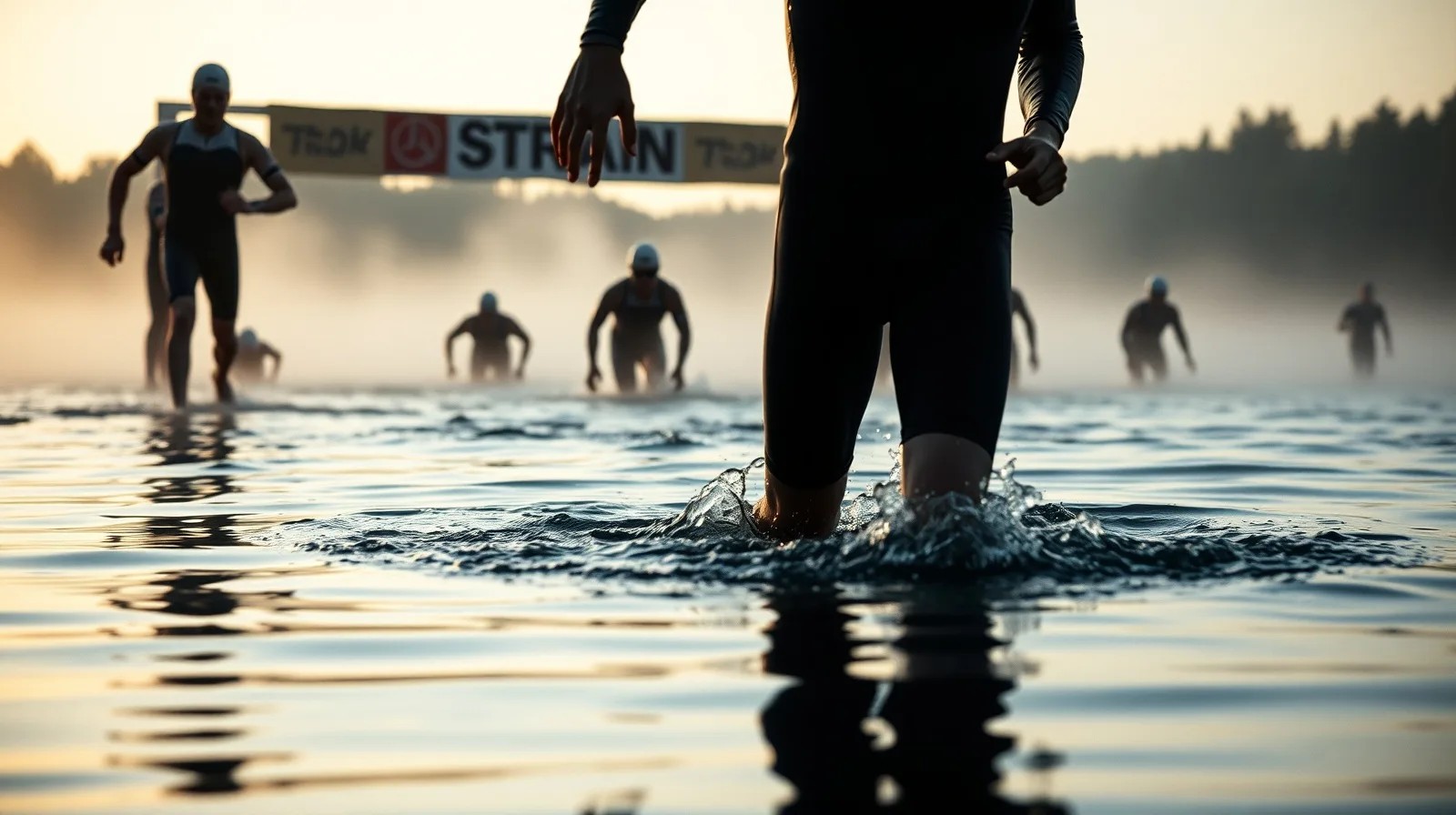
You signed up for a sprint triathlon. Maybe a friend talked you into it, maybe you just wanted something new on the calendar. Good call either way — it's one of the more useful things you can do to your fitness and your head in eight weeks. This plan gets you to the start line in one piece and finishing without hating it.
This plan assumes you're generally active but have zero triathlon experience. You can jog for 15-20 minutes without stopping. You can ride a bike around town without worrying about falling off. You can swim 50 metres in some recognisable stroke, even if it's ugly. That's it. If that sounds like you, you're ready. You don't need to be fast at any of the three sports — sprint distance rewards patience, not raw speed. It rewards people who show up consistently for 8 weeks, who learn a few small skills (transitions, sighting, pacing), and who don't panic on race morning.
One honest note before we start: this plan is designed to work with your life, not replace it. The peak week is around 6-7 hours of training. That's 3-4 sessions you can realistically fit around a full-time job, kids, or a social life. Anyone who tells you a first sprint needs 10+ hours a week is selling you something you don't need.
The sprint distance — what you're training for
A sprint triathlon is 750 metres swim, 20 kilometres bike, 5 kilometres run (0.47 mi / 12.4 mi / 3.1 mi). The name is misleading — it isn't actually a sprint for anyone who isn't a pro. A realistic first-timer finish time is 1 hour 15 minutes to 1 hour 45 minutes, depending on how much you already swim, bike, and run. Pros finish in around 55 minutes. You're not competing with pros. You're finishing.
Why is sprint the right place to start? Because the distances are short enough that you can finish on modest fitness, but long enough that you actually need a plan. A super-sprint is too short to learn pacing on. An Olympic is too long to attempt on 8 weeks of prep without some swim background. Sprint is the sweet spot: long enough to feel real, short enough to be survivable. Nearly every successful long-distance triathlete on the planet started with a sprint.
For the bigger picture of how the distances stack up, see the triathlon hub — it's the parent of this plan and covers sprint → Olympic → 70.3 → full distance.
Before week 1: the absolute minimums
Before you start the plan, do a quick and honest self-assessment. Three tests. If you can tick all three, you're ready to start at week 1. If you can't tick all three, add 2-4 weeks of pre-plan base work before starting.
- Swim test: Can you swim 50 metres continuously, in any stroke (freestyle, breaststroke, sidestroke), without touching the wall or bottom? If no — take 4-6 adult swim lessons before week 1 and work up to 50m freestyle or 100m breaststroke in your own time.
- Bike test: Can you ride a bike on a road or bike path safely, shift gears, brake confidently, and handle a bottle while riding? If no — spend two weeks doing 30-45 minute rides on quiet roads or trails until it feels automatic.
- Run test: Can you run or run-walk 3 kilometres without stopping for more than a short walk break? If no — spend two weeks doing couch-to-5K style sessions (2 min run / 1 min walk, building up) until you can cover 3km.
Pre-plan base work is boring but it's the difference between thriving and suffering. Sprint triathlon training compounds. If you start the 8-week plan without the base, you'll be chasing fitness you should already have, and small aches become injuries fast. Be honest with yourself here.
The 8-week plan — week by week
Here's the plan. Each week lists the sessions, total hours, and what you're trying to get out of that week. Sessions are deliberately simple — no heart rate zones, no FTP tests, no lactate thresholds. Effort is described in plain language: easy (you can talk in full sentences), moderate (you can talk in short phrases), tempo (you can only say a few words at a time). That's all you need for a first sprint.
Weeks 1-2: Build base (4-5 hours/week)
Goal: touch each discipline at least twice. Build the habit. Get your body used to swimming, biking, and running in the same week.
| Day | Week 1 | Week 2 |
|---|---|---|
| Mon | Rest | Rest |
| Tue | Swim 30 min: 4x50m easy + 4x50m moderate + 100m easy cooldown (rest 30s between 50s) | Swim 35 min: 200m easy + 6x50m moderate + 100m cooldown |
| Wed | Bike 45 min easy on flat terrain | Bike 50 min easy, throw in a couple of short hills |
| Thu | Run 25 min easy (walk breaks OK) | Run 30 min easy |
| Fri | Rest or optional 20 min walk | Rest or optional 20 min walk |
| Sat | Bike 50 min steady | Bike 60 min steady + 10 min easy jog off the bike (first brick) |
| Sun | Run 25 min easy OR swim 30 min | Swim 30 min: focus on breathing rhythm |
Weeks 3-4: Build duration (5-6 hours/week)
Goal: extend your longest session in each discipline. Introduce the brick (bike → run) as a weekly fixture.
| Day | Week 3 | Week 4 |
|---|---|---|
| Mon | Rest | Rest |
| Tue | Swim 40 min: 300m easy + 6x50m moderate + 200m cooldown | Swim 45 min: 400m easy + 8x50m moderate + 200m cooldown |
| Wed | Run 35 min easy | Run 40 min easy, last 10 min at moderate |
| Thu | Swim 35 min: 2x200m easy with 30s rest + 4x50m moderate | Swim 40 min: 2x250m easy + 6x50m moderate |
| Fri | Rest | Rest |
| Sat | Brick: Bike 70 min steady + Run 15 min easy immediately off the bike | Brick: Bike 75 min steady + Run 20 min easy |
| Sun | Run 40 min easy | Run 45 min easy OR 30 min run + 20 min walk |
Weeks 5-6: Build intensity (6-7 hours/week)
Goal: peak volume. Introduce tempo work — short efforts at a pace a bit harder than comfortable. This is where race-specific fitness appears.
| Day | Week 5 | Week 6 |
|---|---|---|
| Mon | Rest | Rest |
| Tue | Swim 45 min: 300m easy + 6x75m moderate + 4x50m harder + 200m cooldown | Swim 45 min: 400m continuous + 6x75m at target race effort + 150m cooldown |
| Wed | Run 45 min: 10 min easy + 4x3 min at tempo (2 min easy between) + 10 min easy | Run 45 min: 10 min easy + 5x3 min tempo + 10 min easy |
| Thu | Swim 40 min open water if possible (or pool): continuous 500m + sighting drills | Swim 45 min open water: continuous 600-700m + sighting drills |
| Fri | Rest or easy 20 min walk | Rest |
| Sat | Brick: Bike 90 min with 3x5 min at tempo + Run 20 min easy off the bike | Brick: Bike 90 min including one full 20km race-pace segment + Run 25 min at race effort |
| Sun | Run 50 min easy | Run 50 min easy OR long bike 90 min |
Week 7: Peak + race simulation (6 hours)
Goal: one full dress rehearsal. Practice transitions. Then start backing off.
| Day | Session |
|---|---|
| Mon | Rest |
| Tue | Swim 40 min: 750m continuous at race effort + 200m cooldown |
| Wed | Run 40 min: 10 min easy + 20 min at race effort + 10 min easy |
| Thu | Swim 35 min: 500m easy + 4x50m fast + 150m cooldown |
| Fri | Rest |
| Sat | Race simulation: Full sprint distance in training — 750m swim + T1 (practice it) + 20km bike + T2 (practice it) + 5km run. Use your race kit. Do not race this — run it at 85% effort to find your pacing. |
| Sun | Easy 30 min spin or walk. Nothing hard. |
Week 8: Taper + race (3 hours + race)
Goal: arrive rested, sharp, and with some nervous energy. This is the week beginners most often ruin with last-minute panic training. Don't.
| Day | Session |
|---|---|
| Mon | Rest |
| Tue | Swim 30 min: 300m easy + 4x50m moderate + 200m cooldown |
| Wed | Run 25 min easy with 4x30 second pickups at the end |
| Thu | Bike 30 min easy with 3x1 min at race effort |
| Fri | Rest. Pack race bag. Bike check. Sleep. |
| Sat | Easy 20 min jog OR 20 min spin. Lay out kit. Eat a normal, familiar dinner. Don't try anything new. |
| Sun | Race day. 750m / 20km / 5km. Enjoy it. |
Weekly structure: why this shape?
The plan above follows a consistent rhythm: Monday rest, Tuesday swim, Wednesday run (or bike), Thursday swim, Friday rest, Saturday brick, Sunday run. There's a reason for each choice.
- Monday rest — you had a hard Saturday brick and a Sunday run. Your legs need a full day off. This is also the easiest day to miss without consequence if life gets in the way.
- Two swims per week — swimming is the most skill-dependent of the three disciplines. Twice a week is the minimum to make progress. Three is better if you have pool access, but two is enough to finish.
- Saturday brick — brick sessions (bike immediately followed by run) teach your legs the weird, heavy feeling of running off the bike. Saturdays get the longest, hardest session because you have the whole day to recover.
- Friday rest before Saturday — you want to be fresh for the brick. Skipping Friday's rest is one of the top first-timer mistakes.
- Sunday run — slightly longer, easy-paced. Builds run endurance without wrecking you for Monday.
If your life demands a different layout (weekend work, shift patterns, kids' football on Saturdays), shift the days around — just keep the rest days adjacent to the hard sessions and don't stack back-to-back hard days.
Open water swimming: the biggest unknown
If there's one thing that makes first-time triathletes nervous, it's open water. Pool swimming and open water swimming are different sports. In a pool you have lane ropes, tiled walls, clear water, and a bottom you can see. In open water you have dark water, no visible bottom, possible current, other swimmers climbing over you, and the occasional fish. It's disorienting the first time. That's normal. Every triathlete has felt it.
Pool to lake progression
- Weeks 1-4: pool only. Build continuous swimming. Get to 500m without stopping.
- Weeks 5-6: first open water swims. Find a supervised lake, swim club, or safe swim area. Go with another swimmer or use a bright tow float. Your first open water swim should be 10 minutes of just getting in, putting your face in, and swimming parallel to shore. No distance goal.
- Week 6: second and third open water swims. Build to 400-600m continuous in open water. Practice sighting.
- Week 7: race simulation in open water if possible. Full 750m in the kind of water you'll race in.
Sighting drills
Sighting is lifting your eyes (not your whole head) to look forward every 6-10 strokes to see where you're going. In a pool you follow the black line. In open water, if you don't sight, you zigzag and swim 900 metres instead of 750. Practice it: every 6 strokes, lift your eyes just enough to clear the water, look at a landmark, drop your face back down. It should take half a stroke. Practice in the pool first by picking a landmark outside the pool (clock, window, sign) and glancing at it.
Wetsuit basics
If your race requires or allows a wetsuit, rent one for your first event — don't buy. A rental wetsuit costs 30-60 EUR for a weekend. Buying sits somewhere in the 150-400 EUR range for a beginner suit and closer to 800+ for high-end. Wetsuits make you float higher and swim faster with less effort, which is a gift for weaker swimmers. The catch: they feel restrictive around the shoulders and can cause panic if it's your first time in one. Do at least one full open water swim in your wetsuit before race day. Never race in a wetsuit you've never swum in.
Applying a wetsuit correctly matters more than people expect. Pull the legs up high so the crotch is snug. Work the material up the torso in sections — don't yank. Use a plastic bag over your foot to slide it through the leg. Lubricate neck, wrists, and ankles with anti-chafing balm to prevent rash and to make T1 faster.
Transitions (T1 and T2) — the fourth discipline
Triathlon has four disciplines, not three. The fourth is transition — the time between swim and bike (T1) and between bike and run (T2). Beginners routinely lose 3-5 minutes in transitions that faster athletes finish in under a minute. It's the single easiest time to save in a first race, because you save it with practice, not with fitness.
T1: swim to bike
- Exit the water, pull goggles to your forehead, start unzipping wetsuit on the way to your rack
- At your spot: wetsuit down to waist, step out of it (don't sit), kick it to the side
- Helmet on first — fasten the chin strap before you touch the bike. This is a rule at most races, and you get a penalty if you don't
- Race number belt (pre-clipped), sunglasses, socks if using, bike shoes
- Walk/jog the bike out of the transition area to the mount line. Only mount after the line
T2: bike to run
- Dismount at the dismount line. Walk/jog the bike back to your rack
- Rack the bike, helmet OFF only after the bike is racked
- Swap bike shoes for running shoes (or run barefoot if you're using quick-lace tri shoes)
- Rotate race number to the front, grab visor/hat if using, run out
Practice at home
Set up a mock transition in your garden, garage, or living room. Lay out a towel with your kit. Walk through T1 and T2 five or six times. Do it in week 6 and again in week 7. Ten minutes of living-room transition practice saves more time on race day than an extra week of swim training.
Common T1/T2 time-wasters: sitting down to dry your feet, fumbling with wet socks, struggling to get a sports gel out of a zipped pocket, realising your helmet is upside down, forgetting your race number belt. Plan for all of them.
Gear: minimum viable kit
This is the honest beginner kit list. You can borrow, rent, or buy used for most of it. Spend on the things that affect safety and basic function, save on everything else.
- Swim: Goggles (around 15-30 EUR — buy two pairs, one tinted and one clear), a swimsuit. A tri suit is nice-to-have but not required for a sprint. You can wear a normal swimsuit under a cycling kit.
- Bike: Any working bike with two functioning brakes and gears. A helmet (mandatory, no exceptions). Get a basic bike fit if you can — 50-100 EUR well spent. A water bottle cage and bottle. Optional: clip-on aero bars (30-50 EUR) if you want to experiment, but only if you've ridden them in training first.
- Run: Any running shoes you've already trained in. Don't buy new shoes for race day. A race belt (under 10 EUR) to clip your race number to.
- Transition: A small bright towel to mark your spot and wipe your feet. A bottle of water to rinse sand off your feet.
- Race day: Race kit (number, chip, swim cap — provided by the event). Body glide or anti-chafing balm.
Things you do NOT need for your first sprint: a tri bike, carbon race wheels, a power meter, a heart rate monitor, a GPS watch, a wetsuit (unless the water is cold), aero socks, an aero helmet, carbon-plated race shoes, nutrition products beyond water, or anything marketed as "race-specific." All of it will be there when you want it later. For now: keep it simple, finish the race, and figure out what you actually like.
Race day pacing strategy
The single most common first-triathlon mistake is going too hard too early. Here's how to avoid it, discipline by discipline.
- Swim: start conservative. The first 100 metres will feel like chaos — elbows, splashing, other swimmers climbing over you. Breathe. Swim wide if you have to. If you feel panic, flip onto your back for a few seconds and reset. You are allowed to do that. Nobody gets disqualified for floating. Your goal on the swim is not to set a time, it's to arrive at T1 feeling calm and in control.
- Bike: moderate effort, don't chase. People will fly past you on the bike. Let them. Many of them will blow up on the run and you'll pass them back. Ride at an effort where you can breathe steadily and still eat/drink. Save something for the run.
- Run: start controlled for the first kilometre, then settle in. Your legs will feel heavy and weird for the first 3-5 minutes (classic post-brick). Run easier than you think you need to for the first kilometre. Then let it build. The last kilometre is where you spend whatever you have left.
A simple rule: swim 7/10 effort, bike 7/10 effort, run starts at 7/10 and finishes at 9/10. If you're above 8/10 on the swim or bike, you're paying for it on the run.
Common mistakes first-timers make
- Going out too hard on the swim. Chaotic start + adrenaline + cold water = panic. Start at the back or the side of your wave. Breathe every 2-3 strokes. Sight early. The first 100m is always hardest.
- Forgetting goggles, swim cap, or timing chip. Pack the night before. Double-check in the morning. Take a photo of your kit laid out.
- Trying new gear on race day. New shoes, new shorts, new nutrition, new goggles — all banned. Everything you use on race day should have at least 2-3 training sessions on it.
- Dehydrating or skipping breakfast. Eat a normal, familiar breakfast 2-3 hours before the race. Something you've eaten before long training sessions. Sip water up until 20 minutes before the start.
- Overtraining in week 8. The taper feels wrong. Your legs feel heavy and you feel sluggish. That's normal — it's the body absorbing the training load. Trust the plan. Don't add workouts.
- Not checking the race bag and briefing. Most races have a mandatory briefing the day before. Go. Read the bag. Know where T1 and T2 are and how the course flows.
What happens after the sprint
Most people who finish their first sprint triathlon fall into one of two camps: "that was enough, I'm done" or "when can I do the next one?" If you're in the second camp, here's the natural progression.
- Another sprint in 8-12 weeks. Nothing better than a second sprint for building confidence and refining transitions. Aim to take 5-10 minutes off your first time.
- Olympic distance (1.5 km / 40 km / 10 km). The classic next step. About double the sprint distance and roughly 2-3x the training commitment. Give yourself 12-16 weeks from a solid sprint base. See the Olympic beginner plan.
- 70.3 / half distance (1.9 km / 90 km / 21.1 km). This is the first "long distance" triathlon and it's a big step up — 20+ hours of weekly training in peak weeks, 5-6 months of prep. Don't rush it. See the 70.3 beginner plan.
- Full distance / Ironman (3.8 km / 180 km / 42.2 km). The destination for a small percentage of triathletes. Usually 2-3 years after the first sprint, once you have a few halves under your belt. See my live Ironman training journey.
For a full overview of where sprint fits in the triathlon world, see the triathlon hub — distances, formats, finish times, and all the plans in one place.
Whatever comes next, the first sprint is the hardest one mentally. Every race after it is easier in that one specific sense: you already know you can finish.
Frequently Asked Questions
Can I train for a sprint triathlon in 8 weeks?
Yes — if you're generally active and can already jog for 15-20 minutes, ride a bike safely, and swim 50m without stopping, 8 weeks is enough to finish a sprint triathlon comfortably. If you can't tick all three of those boxes yet, add 2-4 weeks of base work before starting the plan. 8 weeks is a build window, not a from-zero window.
Do I need a tri bike for my first sprint triathlon?
No. Any working bike with a helmet is legal and plenty fast for a sprint. Road bikes, gravel bikes, hybrids, even a mountain bike will get you through 20 km. A tri bike saves maybe 1-3 minutes over a sprint, and at the beginner level you'll lose more time to poor transitions and conservative pacing than to aero. Spend the money on a bike fit and good running shoes instead.
How many hours per week to train for a sprint triathlon?
A beginner sprint plan averages 4-7 hours per week, peaking around weeks 5-6 before tapering. Week 1-2 is about 4-5 hours, weeks 3-4 are 5-6 hours, weeks 5-6 peak at 6-7 hours, week 7 is 6 hours with a race simulation, and week 8 is a 3-hour taper ending on race day. It's very manageable alongside a full-time job.
How do I train for a sprint triathlon without a pool?
You have three options: open water swimming in a lake or safe swim area (always with a buddy or a tow float), a gym with a small pool, or hotel / hostel pools when you travel. If you truly have no swim access for the first few weeks, you can front-load the bike and run and compress the swim into the last 4 weeks — but you need access to water at some point before race day. Never skip the swim entirely and plan to wing it.
What's a realistic sprint triathlon finish time for a beginner?
Most first-time sprint triathletes finish between 1:15 and 1:45. A rough breakdown: swim 750m in 15-22 minutes, T1 2-4 minutes, bike 20km in 40-55 minutes, T2 1-2 minutes, run 5km in 25-35 minutes. Strong runners with weak swim/bike backgrounds often land around 1:20-1:30. Slower finishers in the 1:45-2:00 range are completely normal and respected at any beginner-friendly race.
Can I walk during a sprint triathlon run?
Absolutely. A run-walk strategy on the 5km is one of the smartest first-triathlon choices you can make, especially after a hard bike leg. Try 4 minutes running, 1 minute walking, and repeat. You'll often pass people who went out too hard. No one at the finish line cares whether you walked — they care that you finished.
Do I need a wetsuit for a sprint triathlon?
Only if the water is cold enough to require one — most races allow wetsuits below ~22°C and mandate them below ~16°C. Check your specific race's rules. For a warm lake or pool swim sprint, you don't need a wetsuit at all. If you do need one, renting for your first race is completely reasonable — don't drop 300+ EUR on a wetsuit before you know you'll stick with the sport.
What if I can't swim freestyle?
You can race. Breaststroke and sidestroke are both legal in almost every sprint triathlon. Many first-timers use breaststroke for sighting and rest, and drop into freestyle when they feel comfortable. Aim to build 750m of any stroke, continuously, by week 6. If you're truly a non-swimmer, take 4-6 adult learn-to-swim lessons before you even start this plan — that investment pays off more than any other purchase.
Ready to Train Smarter?
Get personalized training zones, race predictions, and performance insights with our free calculators.
