
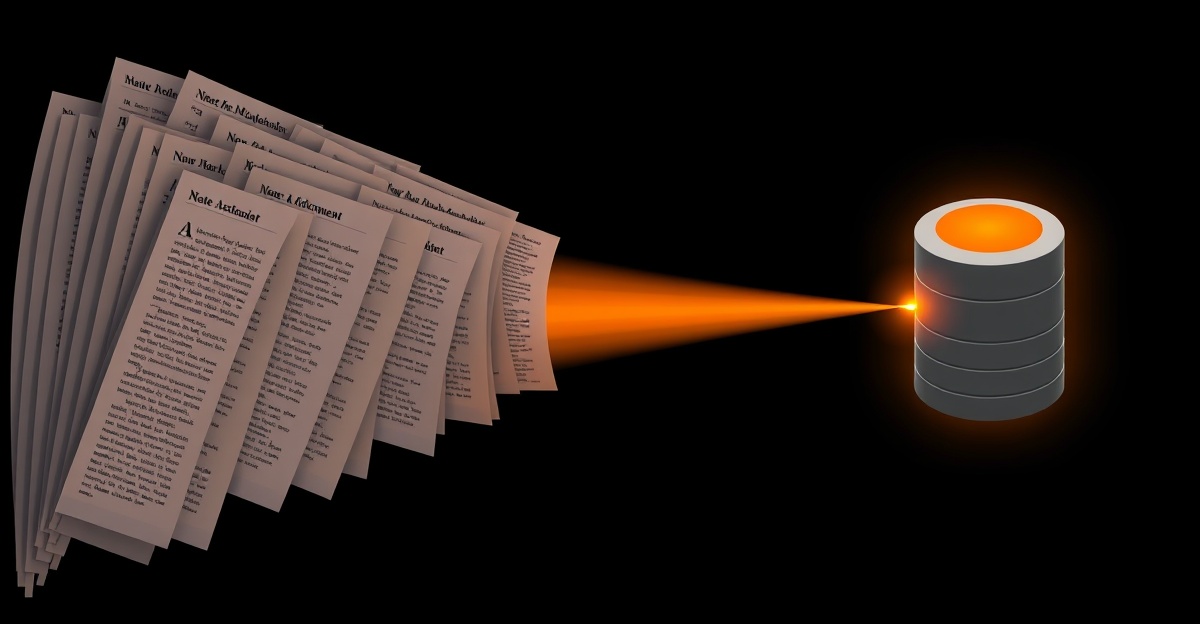

You can chat with your own Obsidian notes in a couple hundred lines of Python, because the vault is
already plain markdown on disk. You walk the vault for .md files, strip the frontmatter
and [[wiki-links]] to clean text, split each note into overlapping word windows, embed
each chunk with OpenAI's text-embedding-3-small (1536 dimensions), and store the
vectors in a sqlite-vec vec0 table inside one SQLite file. To ask a
question, you embed it, retrieve the nearest chunks, and hand them to gpt-4.1-mini,
which answers from your notes and cites the source file. No Pinecone, no LangChain.
Key Takeaways
- Your vault is already the corpus. — An Obsidian vault is a folder of plain .md files on disk. There is nothing to export and no API to call — you walk the directory, read the files, and you have your source content. That is the whole reason Obsidian is a good RAG target.
- The markdown needs a light clean, not a parser. — Strip the YAML frontmatter block and flatten wiki-link syntax to its display text, and what is left is readable prose. You do not need a full markdown AST; a few regular expressions get you to clean text the embedder can use.
- The vector store is a file, not a service. — sqlite-vec registers a vec0 virtual table inside an ordinary SQLite database. The "vector database" is a file on disk you can copy, back up, and delete. There is nothing else running and no account to manage.
- Every answer points back to a note. — Each chunk carries the relative path of the note it came from, so the answer can cite the exact file. You are not trusting the model — you are using it to find the note and then reading the note yourself.
Why build this on an Obsidian vault at all?
Because the hardest part of most "chat with your data" projects is getting the data out of whatever
app it lives in, and Obsidian doesn't have that problem. A vault is a folder of plain markdown files
sitting on your disk. There is no database to dump, no API to authenticate against, no export button
to babysit. You point os.walk at the directory and you are already holding your corpus.
That matters because it changes what the project is. I am not building a data pipeline; I am building a small retrieval layer over text I already own and already wrote. The content is in my own words, which is exactly what you want a personal assistant grounded in — it should sound like my thinking because it is reading my thinking. The rest of this post is the actual build, in the order the notes flow through it. I built the same stack for a published website in Build Ask Tom; here the only real difference is the corpus and the markdown cleanup it needs.
What is the full stack?
Five pieces, and only two of them cost anything to run. The source is a folder you already have, the storage is a single file, and the framework is no framework.
| Stage | What I use | Why this and not the obvious alternative |
|---|---|---|
| Source corpus | The Obsidian vault folder (.md files) | Already plain markdown on disk — no export, no API, no database to dump. |
| Cleanup | Regex strip of frontmatter + wiki-link flattening | A few regular expressions beat a full markdown parser for getting to readable text. |
| Chunking | Overlapping word windows | Fixed windows with overlap beat a clever semantic chunker for prose, and there is nothing to debug. |
| Embeddings | OpenAI text-embedding-3-small (1536-dim) | Cheap, fast, and accurate enough for retrieving notes; a larger model buys precision I don't need. |
| Vector store | sqlite-vec (a vec0 virtual table) | The vectors live in one SQLite file. No separate vector database to run, bill, or back up. |
| Generation | OpenAI gpt-4.1-mini | The retrieved chunks do the work, so the model can be fast and cheap rather than frontier. |
What is the build sequence, start to finish?
Six steps. The first four build the index from your vault; the last two are the live question. You run the first four once (and again whenever you want to re-index), and the last two on every query.
- Walk the vault. Recurse the vault directory for
.mdfiles, keeping each note's path relative to the vault root. - Clean the markdown. Strip the YAML frontmatter block and flatten
[[wiki-links]]to their display text, leaving readable prose. - Chunk. Split each note into overlapping word windows so passages near a boundary survive intact.
- Embed & store. Embed each chunk with text-embedding-3-small and insert the vector, the text, and the note path into a sqlite-vec
vec0table. - Retrieve. At query time, embed the question and run a similarity search to pull the closest chunks and their note paths.
- Generate. Hand the top chunks and the question to gpt-4.1-mini and return an answer that cites the source notes.
How do you turn a vault of markdown into clean text?
This is the only Obsidian-specific step, and it is smaller than it sounds. Walk the vault, read each
file, and run two cleanups: remove the YAML frontmatter block at the top of the note (everything
between the opening and closing --- fences), and flatten Obsidian's wiki-link syntax so
[[Project Plan|the plan]] becomes just the plan. What is left is prose the
embedder can use. You do not need a markdown AST for this — two regular expressions do it:
import os, re

def clean_markdown(text):
    # drop the YAML frontmatter block if the note starts with one
    text = re.sub(r"^---\n.*?\n---\n", "", text, count=1, flags=re.DOTALL)
    # [[link|alias]] -> alias ; [[link]] -> link
    text = re.sub(r"\[\[([^\]|]+)\|([^\]]+)\]\]", r"\2", text)
    text = re.sub(r"\[\[([^\]]+)\]\]", r"\1", text)
    return text.strip()

def read_vault(vault_dir):
    for root, _, files in os.walk(vault_dir):
        for name in files:
            if name.endswith(".md"):
                path = os.path.join(root, name)
                rel = os.path.relpath(path, vault_dir)
                with open(path, encoding="utf-8") as f:
                    yield rel, clean_markdown(f.read())
Each note comes back as a (relative_path, clean_text) pair. The path is the citation:
it travels with every chunk so the answer can point you back to projects/q3-planning.md
rather than to a vague "your notes."
How do you chunk and embed the notes?
The part people skip is overlap. If you cut a note into hard, non-overlapping blocks, a sentence that explains the exact thing you asked about gets split across two chunks and retrieved as neither. Overlapping windows fix that for almost no cost. The chunker is fixed-size word windows with a small slide, and each chunk keeps the note path it came from:
from openai import OpenAI
client = OpenAI()

def chunk(text, size=220, overlap=40):
    words = text.split()
    step = size - overlap
    for start in range(0, len(words), step):
        window = words[start:start + size]
        if window:
            yield " ".join(window)

def embed(texts):
    resp = client.embeddings.create(
        model="text-embedding-3-small",
        input=texts,
    )
    return [d.embedding for d in resp.data]

# build (path, chunk_text, vector) records for the whole vault
records = []
for rel, text in read_vault(VAULT_DIR):
    chunks = list(chunk(text))
    for body, vector in zip(chunks, embed(chunks)):
        records.append((rel, body, vector))
size and overlap are the only two knobs, and for prose notes a couple
hundred words with a small overlap is a sane default you rarely have to touch. In a real run you'd
batch the embed calls so you aren't making one request per chunk, but the shape is this.
How does sqlite-vec store and search the vectors?
This is the piece that replaces the managed vector database. You load the extension, declare a
vec0 virtual table with the embedding dimension and the columns you want to keep
alongside each vector, and from then on it is just SQL. Storage is an INSERT; search is
a SELECT ordered by distance:
import sqlite3, sqlite_vec
from sqlite_vec import serialize_float32

db = sqlite3.connect("vault.db")
db.enable_load_extension(True)
sqlite_vec.load(db)

# the entire "vector database": one virtual table in one file
db.execute("""
  CREATE VIRTUAL TABLE notes USING vec0(
    embedding float[1536],
    path TEXT,
    body TEXT
  )
""")

# store every chunk
for path, body, vector in records:
    db.execute(
        "INSERT INTO notes(embedding, path, body) VALUES (?, ?, ?)",
        (serialize_float32(vector), path, body),
    )
db.commit()

# query: nearest chunks to the embedded question
q_vector = embed([question])[0]
rows = db.execute("""
  SELECT path, body, distance
  FROM notes
  WHERE embedding MATCH ?
  ORDER BY distance
  LIMIT 6
""", [serialize_float32(q_vector)]).fetchall()
That LIMIT 6 is the top-k handed to the model. The whole store is the
vault.db file: re-indexing the vault is deleting that file and rebuilding it, and there
is no migration to run because there is no separate database.
How does it turn retrieved chunks into a cited answer?
The retrieved chunks and their note paths go into the prompt, the question goes after them, and gpt-4.1-mini answers constrained to what it was handed — and told to attribute each claim to the note it came from. Because retrieval already narrowed the context to the relevant passages, the generation model doesn't have to be large; it has to be fast and obedient:
context = "\n\n".join(f"[{path}]\n{body}" for path, body, _ in rows)

prompt = f"""Answer the question using only the notes below.
Cite the source note in parentheses after each claim, e.g. (projects/plan.md).
If the notes don't contain the answer, say so.

Notes:
{context}

Question: {question}"""

answer = client.chat.completions.create(
    model="gpt-4.1-mini",
    messages=[{"role": "user", "content": prompt}],
).choices[0].message.content
print(answer)
The whole thing now runs as a loop: read a question from the terminal, embed it, retrieve, generate, print. You are chatting with your own notes, and every answer tells you which file it came from so you can open it and read the full context yourself. That citation is the feature — a personal-notes bot earns its keep as a retrieval shortcut, not as an oracle you take on faith.
What is the honest limitation?
It indexes the text of your notes, not the link graph. Obsidian's real power is the web of
[[backlinks]] between notes — the structure that turns a pile of files into a thinking
tool — and this pipeline flattens those links to plain text and throws the graph away. So it answers
"what did I write about X" very well and "which notes connect to X" poorly, because that relationship
lived in the links I discarded during cleanup.
The fix is a second project: index each note's outbound links as their own signal and let retrieval walk the graph, not just the prose. I deliberately left that out of the first build, because the version that reads your prose and cites the source note is the one that earns its keep on day one, and the graph layer is real work for a narrower payoff. That trade — spend complexity only where it changes the answer — is the same discipline behind every choice here: the file instead of the service, the fixed chunker instead of the clever one, the small model instead of the frontier one. For the strategy case on why a citable, searchable vault beats another note-taking app in the first place, I made the argument in Build a Second Brain That Answers Back on ctaio.dev. And if you're still deciding where your notes should live before you wire retrieval on top, the We The Flywheel Radar verdict on Obsidian vs Notion is the place to start.
FAQ
Why is Obsidian a good fit for a RAG pipeline?
Because an Obsidian vault is already a folder of plain markdown files on your disk, with no proprietary database and no export step. Most "chat with your data" tutorials spend half their length getting the data out of some app; with Obsidian you skip all of that and start from os.walk over the vault directory. The notes are also written by you, in your own words, which is exactly the corpus you want a personal assistant grounded in. The only Obsidian-specific work is cleaning the markdown — stripping the YAML frontmatter and flattening [[wiki-links]] to plain text — and that is a handful of regular expressions, not a parser.
Do I need a vector database like Pinecone to build this?
No, and that is the point of using sqlite-vec. It is a SQLite extension that adds a vec0 virtual table, so your embeddings live as rows in an ordinary SQLite file and you query them with a normal SELECT ordered by distance. For a personal vault of a few thousand notes, a hosted vector database is a network hop, a monthly bill, and an account to manage in exchange for nothing you can feel. The whole "vector database" here is one file you can copy with cp and delete when you re-index. If you ever genuinely outgrow it, you swap the storage layer and keep the rest of the code.
How does the bot cite which note an answer came from?
Every chunk is stored alongside the relative path of the note it was cut from. When the similarity search returns the closest chunks, it returns those paths too, and the prompt instructs the model to attribute each claim to its source note. So an answer comes back with something like "(from projects/q3-planning.md)" attached, and you open that file to read the full context. This matters more than it sounds: a personal-notes bot is most useful not as an oracle but as a retrieval shortcut — it finds the right note faster than you would, and then you trust the note, not the model.
Which models does it use and what does it cost to run?
Two OpenAI models. Embeddings come from text-embedding-3-small at 1536 dimensions, which is the cheap, fast embedding model and more than accurate enough for retrieving prose notes. Generation runs on gpt-4.1-mini, which is fast and inexpensive — because the retrieved chunks do the heavy lifting, the generation model does not need to be a frontier model. The dominant cost is embedding the vault once, plus one small embedding per question at query time. For a personal vault the monthly spend is rounding error, and there is no managed vector-database line item at all because the vectors sit in the SQLite file.
What is the biggest limitation of this setup?
It indexes the text of your notes, not the Obsidian link graph. Obsidian’s real power is the web of [[backlinks]] between notes, and this pipeline flattens those links to plain text and throws the graph away. So it answers "what did I write about X" very well, and answers "which notes connect to X" poorly, because that relationship lived in the links you discarded. The fix is to index the backlinks as their own signal — store each note’s outbound links and let retrieval walk them — but that is a second project. For a first build, indexing the prose and citing the source note is the version that earns its keep.
Ready to Transform Your AI Strategy?
Get personalized guidance from someone who's led AI initiatives at Adidas, Sweetgreen, and 50+ Fortune 500 projects.
