
IRONMAN 70.3 Barcelona 2026 at a glance
First thing to get straight: the race is not in Barcelona city. It's held in Calella, a coastal resort town on the Costa Brava roughly 50 km north-east of Barcelona along the Mediterranean coast. The "Barcelona" in the name refers to the province and the nearest major airport (BCN). This catches a surprising number of first-timers every year — they book a hotel in central Barcelona, wake up race morning, and realise they need to get to a town an hour up the coast. Don't be that athlete.
With that out of the way: IRONMAN 70.3 Barcelona is one of the largest and fastest half-distance triathlons in the world. Around 3,500 athletes line up each year, the course is flat enough on the run and rolling enough on the bike to produce genuine PBs, and early-October weather on the Catalan coast is usually warm, dry, and wetsuit-legal in the Mediterranean. It's a destination race as much as a performance target — most international athletes spend a few days either side exploring Barcelona city, which gives the weekend a vacation feel you don't always get at race-focused events in German industrial parks or French spa towns.
Key facts
| Detail | Information |
|---|---|
| Race date | Sunday, October 4, 2026 |
| Location | Calella, Costa Brava, Catalonia, Spain (~50 km NE of Barcelona city) |
| Distance | 1.9 km swim · 90 km bike · 21.1 km run |
| Total elevation | Sea-level swim · ~900 m rolling bike · flat run (negligible elevation) |
| Field size | ~3,500 athletes — one of the largest 70.3s in the world |
| Water temperature (avg) | 19-22°C — wetsuit legal in nearly every edition |
| Air temperature (avg) | 18-24°C — mild and dry, typical Catalan early autumn |
| Expected 2026 entry fee | ~395-445 EUR + Active.com processing |
| Registration window | Opens within days of previous edition — fills several months ahead |
| 70.3 World Championship slots | Yes — distributed across age groups |
| Organiser | IRONMAN (WTC) |
The swim — Mediterranean off Calella beach
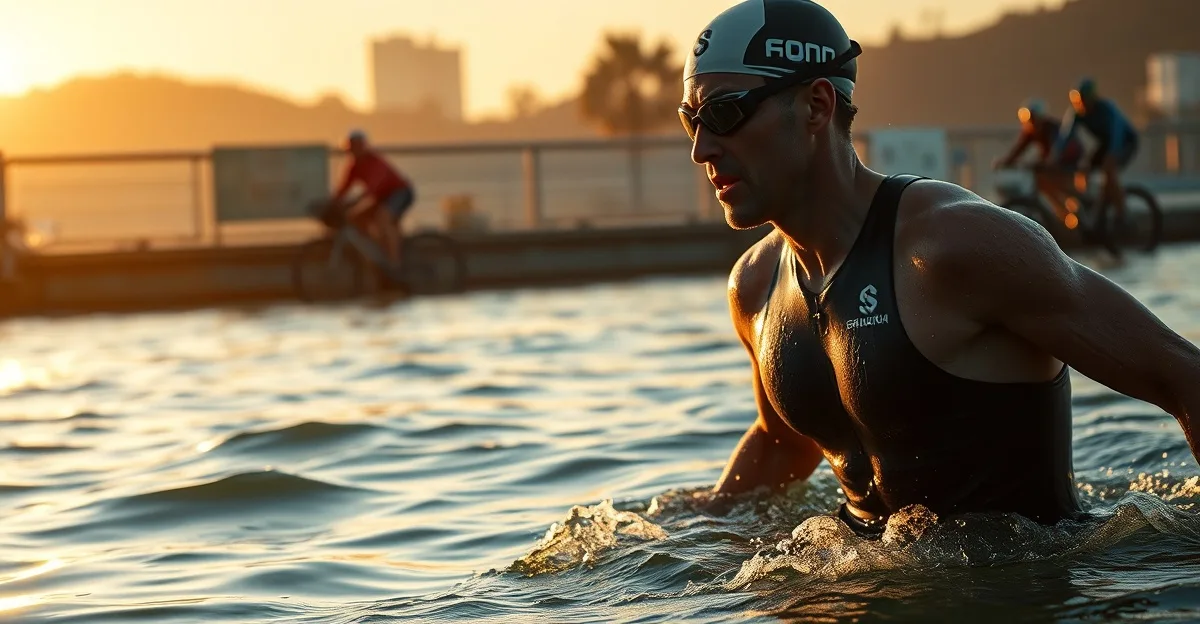
The swim is a one-lap, 1.9 km out-and-back in the Mediterranean Sea directly off Calella's main beach. Athletes run down the sand, enter the water, swim roughly 950 m straight out to a large turn buoy, and come back to the beach exit. Self-seeded rolling starts mean you're not dealing with a 3,500-athlete washing machine — the field spreads out inside the first 300 m.
Water temperature in early October is consistently 19-22°C, cool enough to justify a full wetsuit and well below the 24.5°C age-group cutoff. Visibility is usually good by open-water standards (5-10 m), and the Costa Brava coastline gives you a clean sight line back to the beach. The main risk is wind-driven chop on an exposed day — the bay isn't deeply sheltered, so if the morning forecast shows an onshore breeze, expect a slightly rougher swim than advertised. In calm conditions, this is one of the most relaxed 70.3 swims in Europe.
Expected swim times by level:
- Pro: 22-26 minutes
- Strong age grouper: 28-32 minutes
- Mid-pack: 34-40 minutes
- Back-of-pack / swim-weak: 42-55 minutes
The bike — one lap through the Costa Brava
The 90 km bike course is a single lap that rolls north out of Calella along coastal roads, turns inland through small Catalan villages and vineyards, and comes back to town via rolling agricultural country. Total elevation is around 900 m — enough to be interesting, not enough to blow apart pacing for anyone who's prepared. The surface is mostly good Spanish tarmac, and the course is closed to traffic in the key sections.
The character of the ride is "rolling with purpose" rather than flat or mountainous. You're rarely sitting up, but you're also rarely out of the saddle. The hills reward pacing rather than punching, and strong aero-position riders tend to do well here. Wind is a variable — the inland sections can get gusty in October, and on a bad day a tramontana northerly will make the outbound leg harder than it looks on the elevation profile. On a good day, this is one of the most PB-friendly 70.3 bike courses in Europe.
Expected bike splits (intermediate male age grouper, 35-44): 2:35-3:00. Pros are closer to 2:05-2:15.
The run — three flat laps on the Calella seafront
The half-marathon is a three-lap out-and-back along the Calella seafront promenade. It is, by every measure, flat — total elevation over 21.1 km is in the single-digit metres. The surface is paved promenade and town roads, and both sides of each lap are lined with spectators for most of the day. Aid stations every 2-2.5 km are well-staffed and well-stocked.
Three laps is a double-edged sword. The positive side is the atmosphere — the Calella seafront is packed, you see your fellow athletes constantly, and the aid stations become familiar landmarks by lap two. The negative side is the mental game of passing the finish chute twice before you can actually turn in. If you're the kind of athlete who falls apart when the finish line taunts you, practice three-lap runs in training.
Early October in Calella is mild and dry (typically 18-24°C), which means the run rarely blows up on heat. That's a big reason this course produces fast half-marathon splits.
Expected half-marathon splits (intermediate male age grouper, 35-44): 1:45-2:10.
Registration & qualification
IRONMAN 70.3 Barcelona is open registration — no qualification needed — and is sold first-come, first-served via ironman.com. The race is popular and fills ahead of time most years, but it's not the instant sell-out that Roth is. Plan ahead, but you don't need to set a 60-second timer.
- Registration for the following year typically opens within days of the previous edition
- 2026 individual entry is approximately 395-445 EUR plus Active.com processing
- Relay team entries are available and fill slower than individual slots
- 70.3 World Championship qualification slots are distributed across age groups — exact count varies year to year
- Tri Club and charity entries sometimes open additional paths — check the event page
Getting to Calella
By air
- Barcelona–El Prat Airport (BCN) — the main airport, served by direct flights from every major European hub and most long-haul cities. From BCN, it's about 1h by train or 45-60 min by car to Calella
- Girona–Costa Brava Airport (GRO) — 50 km north, smaller, mostly Ryanair. Sometimes cheaper from the UK or Ireland
- Reus (REU) — further away (near Tarragona), generally not worth the detour
By train
- The Rodalies R1 commuter line runs directly from Barcelona Sants and Passeig de Gràcia stations to Calella in about 1 hour
- Trains run frequently (every 20-30 minutes most of the day) and are bike-friendly — you can bring a boxed bike on weekends and off-peak
- Calella station is a 10-minute walk from the transition area and main hotels
By car
- From Barcelona: take the C-32 motorway north, exit at Calella. Total drive 45-60 minutes in normal traffic
- Parking in Calella is limited on race weekend — park-and-ride options are usually offered by the organiser
- If you're driving your bike from elsewhere in Europe, Calella is well-connected to the main French and Spanish motorway network
Where to stay: Calella or Barcelona city
This is the single biggest logistical decision for the race, and the answer depends on what you're optimising for.
- Calella — the obvious choice for race performance. Walking distance to transition, the swim start, and the finish line. Dozens of mid-range hotels and apartments at 70-150 EUR/night. Book 4-6 months ahead for anything within 10 minutes of the transition area. The town is quiet and resort-y, which is either a plus (easy sleep) or a minus (less to do post-race) depending on your taste
- Barcelona city — the choice for athletes combining the race with a destination trip. 1h by Rodalies R1 train from Sants or Passeig de Gràcia to Calella. Full range of hotels, food, nightlife, sightseeing. The downside is a 4:30 AM train on race morning with your bag full of race gear, and no ability to pop back to the room for a forgotten item. Best if you're arriving Thursday or Friday and spending a week
- Coastal towns nearby — Pineda de Mar, Santa Susanna, Malgrat de Mar are all 5-10 minutes from Calella by car or local train, usually cheaper, and a good middle-ground option
- IRONMAN maintains an official hotel partner list on the event page with negotiated rates
Training specific to a fast 70.3
Barcelona rewards athletes who've trained for speed on flat-to-rolling terrain, not climbers or heavy-duty heat specialists. If you're preparing specifically for this race, bias your training toward:
- Aero-position threshold rides — 2-3 hour rides at 80-90% of threshold in your race position. Barcelona is a course where you can hold aero for most of the ride, and the athletes who've trained that position win the bike leg
- Brick runs off hard bike efforts — the run is flat enough that you'll be tempted to push the bike too hard. Practise running 10-15 km off a hard 2-hour ride to calibrate what your legs can actually take
- Half-marathon pace work — because the run is so flat, your half-marathon split is a direct read of your open half-marathon pace minus 10-20 seconds per km. Know that number
- Open-water swimming in wetsuit — at least 6 sessions in the 8 weeks before race day. The Mediterranean is friendly but it's still salt water, sighting-on-waves practice matters
- Race-distance nutrition rehearsal — 90 km of bike plus a half-marathon is long enough to run into stomach issues if you haven't practiced your fuelling. 70-90 g carbohydrate/hour on the bike, rehearsed on long rides
Barcelona 70.3 vs other European 70.3s
Barcelona sits in a specific spot in the European 70.3 calendar — late-season, flat-fast, and destination-friendly. Here's how it compares:
| Barcelona | Kraichgau | Mallorca | Nice | |
|---|---|---|---|---|
| Date | Early October | Early June | Mid-May | Mid-September |
| Bike elevation | ~900 m | ~1,100 m | ~1,200 m | ~1,400 m |
| Run profile | Flat promenade | Rolling | Mostly flat | Flat seafront |
| Field size | ~3,500 | ~2,500 | ~2,500 | ~2,500 |
| Typical AG finish | 5:15-6:00 | 5:30-6:15 | 5:30-6:15 | 5:30-6:15 |
| Destination feel | Very strong | Low | Strong | Very strong |
| PB potential | High | Moderate | Moderate | Moderate |
Short version: if you want a late-season PB attempt with a destination-city week built around it, Barcelona is the clear pick. If you want early-season fitness validation or mountain terrain, look at Kraichgau, Nice, or Mallorca instead.
More information
- Official IRONMAN 70.3 Barcelona event page
- IRONMAN 70.3 training guide — phases, volume, race prep
- Triathlon as a sport — distances, formats, finish times
Frequently Asked Questions
When is IRONMAN 70.3 Barcelona 2026?
IRONMAN 70.3 Barcelona 2026 takes place on Sunday, October 4, 2026 in Calella, on the Costa Brava coast approximately 50 km north of Barcelona city. Race-week activities (expo, athlete briefing, check-in, welcome events) run Thursday through Saturday of race week.
Is the race actually in Barcelona city?
No — and this trips up a lot of first-timers. The race is held in Calella, a coastal town on the Costa Brava roughly 50 km north-east of Barcelona city. The 'Barcelona' name refers to the province and the nearest major airport. Swim, bike, run, and finish line are all in and around Calella. Many athletes stay in Barcelona city and take the commuter train (Rodalies R1) up to Calella, but the actual racing is on the coast.
Is IRONMAN 70.3 Barcelona a fast course?
Yes — it's regarded as one of the fastest 70.3 courses in Europe. The swim is a straight out-and-back in the Mediterranean (usually wetsuit legal, 19-22°C water in early October), the bike is a single lap through the Costa Brava with roughly 900 m of rolling elevation, and the run is three laps on the flat Calella seafront promenade. An intermediate male age grouper (35-44) can realistically target 5:15 to 6:00, which is faster than most German or French 70.3s.
How big is the field at IRONMAN 70.3 Barcelona?
Around 3,500 athletes, making it one of the largest 70.3 races in the world and consistently among the biggest in Europe. Expect crowded T1 and T2, rolling swim starts, and a lively run course with spectators lining the seafront promenade for all three laps.
How much does entry cost and how do I register?
2026 individual entry is approximately 395-445 EUR plus the Active.com processing fee. Registration is via ironman.com/im703-barcelona and typically opens within a few days of the previous edition finishing. The race fills well in advance most years but is not a lottery — first-come-first-served. 70.3 World Championship qualification slots are available and distributed across age groups.
Is the swim wetsuit legal?
Almost every year, yes. Mediterranean water temperature off Calella beach in early October is typically 19-22°C, comfortably below the 24.5°C age-group wetsuit cutoff. The swim is a one-lap out-and-back starting from the beach, with rolling self-seeded starts. Conditions are usually calm but the Mediterranean can throw up chop on a windy race morning.
Where should I stay — Calella or Barcelona city?
Both work and athletes split roughly 50/50. Calella puts you walking distance from transition, the swim start, and the finish line — best for race-day logistics. Barcelona city is a 1-hour Rodalies R1 commuter train ride away and gives you a full destination-city experience, which is why many athletes combine the race with a tourism week. If you're travelling with non-racing family, Barcelona city is the obvious call. If you're optimising purely for race performance and sleep, stay in Calella.
Ready to Train Smarter?
Get personalized training zones, race predictions, and performance insights with our free calculators.
