
First-person opinion piece. I'm an age-group triathlete and co-founder of AiTrainingPlan. I use Maurten at races. I have no commercial relationship with them. The opinions here are based on published research and my own race observations.
By Thomas Prommer · Updated April 2026
Maurten is a genuinely good product sold with a mechanism claim that the independent literature only partially supports. I went through the studies and tested it over two years of A-race fueling. The gastric emptying acceleration is probably overstated. The GI comfort at high carb loads is real and meaningful. What Maurten actually got right has more to do with product design than the hydrogel patent alone.
Maurten's marketing promises hydrogel encapsulates carbs so your stomach sees water, not sugar. The science is more nuanced than the pitch, and Maurten still earns its place in my kit bag, though not entirely for the reasons they advertise.
I want to be honest about this because I've watched the hydrogel claim spread through triathlon and running communities in a way that obscures what the product actually does well. Maurten is a genuinely good product. But the "your stomach sees water" framing is the kind of shorthand that turns useful nuance into sales copy, and the research tells a more complicated story.
What Maurten Actually Claims
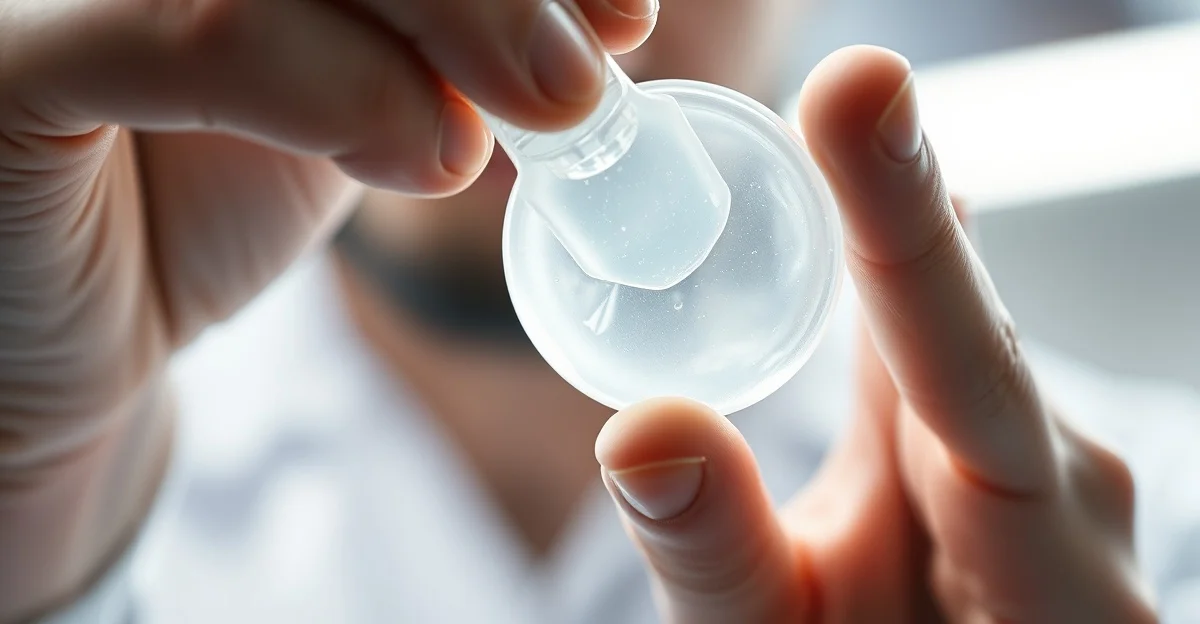
Maurten's patent (published under WIPO filings, assignee Maurten AB) describes a food-grade hydrogel formed by the interaction of sodium alginate and pectin with the acidic environment of the stomach. The mechanism: these two polysaccharides, stable in neutral or alkaline conditions, undergo gelation when they hit gastric acid, forming a semi-solid matrix around the carbohydrate solution.
The claimed benefit is twofold. First, the gel matrix reduces the osmolality of the carbohydrate solution as it enters the small intestine, lessening the osmotic stress that causes GI distress at high carb loads. Second, and this is the part that gets quoted most in marketing, the stomach is said to process this gel structure more efficiently than a high-osmolality liquid, effectively passing it through faster.
Their homepage language says the gel "encapsulates the carbohydrates and enables a smooth transport through the body." Kipchoge used it at his 1:59 attempt in Vienna. INEOS Grenadiers race on it. Jumbo-Visma used it through Tour stages. The endorsement list is real and it is formidable.
What they don't say, because it would complicate the story, is how that claim holds up under independent scrutiny.
What the 2019-2023 Studies Actually Found
When I went through the available independent research, the picture that emerged was consistent enough that I'm confident in my summary.
The most-cited independent work on hydrogel in a sports nutrition context came out of Glasgow Caledonian University and was published in the British Journal of Sports Medicine in 2020. Researchers tested hydrogel carbohydrate formulations against conventional isotonic gels in trained cyclists. The finding on gastric emptying: not dramatically different. Gastric emptying rates between hydrogel and non-hydrogel conditions were comparable, which is the opposite of what Maurten's faster-transit framing would predict.
Where the hydrogel group did show an advantage was in subjective GI symptom scores, particularly at higher carbohydrate intake rates. Athletes reported less bloating and fewer GI complaints. That finding is real and it matters. But it's a different claim than "faster gastric emptying." It's more precisely "fewer symptoms at high doses," which is valuable but more limited.
The papers I read through 2022-2023 generally pointed in the same direction. Independent studies suggest the osmotic stress reduction is probably genuine at high carb loads, but the gastric emptying acceleration that Maurten's simpler marketing implies has not been consistently reproduced in placebo-controlled independent settings. One review-level paper noted that most supporting evidence came from non-placebo-controlled conditions and manufacturer-adjacent research, and called for more rigorous replication.
This is not a damning finding. It's a "the marketing outruns the mechanism" finding, which is common in sports nutrition. The product is not fraud. The specific mechanism claim is overstated.
Asker Jeukendrup, probably the most credible independent voice on carbohydrate absorption in endurance sports, has written carefully about hydrogel technology on MySportScience. His position is broadly consistent with what I've read in the primary literature: promising mechanism, early results encouraging, more independent replication needed before strong claims are warranted. That's a fair place to land.
What Maurten Genuinely Got Right
Here's where I want to be fair, because Maurten does a lot of things right that have nothing to do with whether the hydrogel patent fully delivers on its theoretical maximum.
The tasteless design is intentional and important. Most sports gels are sweet, flavored, and increasingly aversive after two hours of racing. Flavor fatigue is a real phenomenon. I've documented it in my own long-ride experiments, and it's one of the underappreciated causes of late-race under-fueling. Maurten went the opposite direction: their gels taste like almost nothing. That's not a limitation. It's a deliberate design choice that makes continued intake at hour four more manageable than any flavored competitor I've used.
The 40g format of the Gel 160 solved a real problem. When the research consensus shifted toward higher carb intake (post-2010 work on dual-source transport), the practical question became: how do you carry enough product? Most gels deliver 20-25g. Getting to 80g/hr means four of those. Maurten's Gel 160 delivers 40g in a single sachet. Two gels per hour. That's half the packaging, half the opening mechanics, and a cleaner execution story at race pace.
The 0.8:1 glucose-to-fructose ratio is correct science. Whatever you think about the hydrogel mechanism, the underlying carbohydrate formulation is right. They use maltodextrin and fructose in a ratio that maximizes dual-transporter absorption through SGLT1 and GLUT5 simultaneously. The ceiling on this is real: pure glucose products saturate around 60g/hr regardless of dose. Maurten's formulation allows absorption above that ceiling. This part of the science is solid and well-replicated.
Product consistency is undervalued. Every Gel 160 I've opened in the last three years has behaved identically. The texture, the viscosity, the way it sits in the stomach. When you're at kilometer 160 of an Ironman bike leg, consistency is not a trivial thing. Uncertainty about how a product will feel is its own source of cognitive load.
Elite credibility functions as a signal. I'm aware this sounds circular. If pros use it, age-groupers follow, Maurten profits. But there is real signal in the fact that teams with dedicated sports scientists and full budget flexibility for any product on earth keep choosing Maurten for their biggest races. They have access to the research, the physiology, and the athlete feedback at a level I don't. That's not a reason to suspend critical thinking.
What I've Actually Observed at Race Pace
I've been fueling with Maurten at A-races for two years. Before that, I used SIS Beta Fuel Gel primarily, with some 226ERS mixed in. I'm an age-group triathlete, typically racing at Ironman or half-Ironman distances, training around 12-15 hours per week at peak load.
My honest n=1 observation: at fueling rates above 80g/hr in race conditions, Maurten sits better. Not dramatically, not in a way that shows up as a performance data point, but in a way that means I'm not thinking about my stomach during the run. That's the quiet version of the GI distress finding from the Glasgow study. It's not zero GI complaints versus GI catastrophe. It's the difference between "aware of my stomach" and "not thinking about it."
At steady moderate pace (say, a long training ride at zone 2, fueling at 65-75g/hr), I genuinely cannot tell the difference between Maurten and a well-formulated standard gel. The GI environment at moderate intensity is friendly enough that the osmotic stress reduction the hydrogel provides doesn't show up as a detectable benefit. Standard gels tolerated fine. The premium doesn't earn its keep there.
The scenario where I feel Maurten most clearly is the final 60 minutes of an Ironman bike leg, at race pace, with heart rate elevated, trying to maintain 80-85g/hr as I come into T2. That's where gut stress peaks and where the small reduction in bloating becomes noticeable. I've also found the tasteless format genuinely valuable at that point. I can eat the gel without the kind of aversion response that would cause me to skip a planned intake.
One data point that I find compelling: in two Ironman races where I used Maurten from the start of the bike, I had zero GI events on the run. In three races where I used standard gels (two of those were faster ride paces), I had one significant GI event that cost me 5-6 minutes. Sample size of one, confounded by a hundred variables. I'm not claiming causation. But it's the pattern I'm working with.
What Actually Makes Maurten Hard to Replace
The hydrogel patent is genuinely valuable. It is not a fiction. But I think what makes Maurten hard to replace is broader than the mechanism alone.
The company got the product-market fit right by doing something almost no one else in sports nutrition had done: design backward from elite athlete experience rather than forward from food science lab theory. They worked with the best-funded endurance programs in the world as their product development partners. What emerged was a product optimized for race conditions, not palatability surveys with recreational athletes.
The result is a product that feels like it was designed by people who have run out of gels at kilometer 35 of a marathon and had an opinion about it. At IM Lanzarote I carried six Maurten 160s on the bike. The tasteless design meant flavor fatigue never kicked in, even at hour four. The format and carb density meant the logistics were clean. All of it coheres into something that clearly came from thinking about the worst moments of a long race.
That design consistency is genuinely hard for competitors to match. The hydrogel patent is part of the story, but you could strip the patent out and still have most of the product's real-world advantage left intact.
The endorsement ecosystem reinforces this. Maurten isn't paying Kipchoge to use the product for marketing purposes only. His team is selecting it because it works in their specific performance context. That feedback loop between elite usage and product refinement is something no budget gel brand has access to.
Should You Pay the Premium?
Maurten Gel 160 runs about $3.68 per 30g of carbohydrate delivered. SIS Beta Fuel Gel (same dual-source formulation, same 1:0.8 carb ratio, no hydrogel) comes in at about $2.16 per 30g carb. That's roughly a 70% price premium for the hydrogel product.
For product specs and current pricing comparisons, AiTrainingPlan has a detailed page at Maurten vs SIS covering the full macro and price breakdown.
The honest answer to "is it worth it" depends on what you're using it for.
A-races, fueling at 80g/hr or above, where a GI event is expensive: yes. The premium is smaller than the cost of a bad race in terms of training time invested. At an Ironman where I've put in 18 months of build, the difference between Maurten and a 70% cheaper alternative is not meaningful on my annual budget.
Training sessions, gut training blocks, steady zone 2 long rides: no. This is where I think most age-groupers waste money on Maurten. Training is where you want volume, repetition, and gut adaptation. Buying 30 Maurten gels to gut train over six weeks costs twice what 30 SIS Beta Fuel gels cost, for an adaptation benefit you cannot meaningfully distinguish. Use the cheaper product. Your gut trains the same.
B and C races: this is where individual tolerance matters. If your gut is trained and you know standard gels work at your race pace, save the money. If you've had GI events in past B races, it might be worth the premium to rule out the product as a variable.
The carbs-per-hour reference page at AiTrainingPlan has useful context on how fueling targets scale with sport, intensity, and body weight. Worth checking before committing to a per-hour target that determines how much product you'll burn through.
My Verdict
Maurten is a good product that is marketed with claims that outrun what the independent literature fully supports. The hydrogel mechanism is real; the gastric emptying acceleration implied in the simpler marketing is probably overstated; the GI comfort benefit at high carb loads is the strongest finding and it's meaningful.
What Maurten actually got right (the tasteless design, the correct carb ratio, the high-dose format, the product consistency) are genuine advantages that hold up independent of whether you believe the strongest version of the hydrogel claim.
My practice: I use Maurten for A-races. I don't use it for training unless I'm doing a specific race-simulation session and want everything to match race conditions exactly. The rest of my gut training happens on SIS Beta Fuel or 226ERS, which are cheaper, work properly, and cost me less money to get the adaptation reps in.
If you've been avoiding Maurten because the hydrogel science sounds like marketing: fair, but don't throw the product out. The GI comfort at high carb loads is real, the tasteless design is a genuine advantage at hour four, and the 40g format makes execution cleaner at race pace. Those hold up. Don't pay the premium in training sessions where none of those factors are being tested.
If you're deep into optimizing fueling strategy, my piece on the 120g/hr carb arms race covers the gut training protocol and the specific products worth considering at high intake rates.
Frequently Asked Questions
Does Maurten hydrogel actually improve performance?
The performance delta in published studies is modest at best. The more consistent finding is reduced GI distress at high carb intake rates (above 80g/hr), which can indirectly protect performance by letting you maintain your fueling plan. If you're training at 60-70g/hr, the advantage over a well-formulated dual-source gel is hard to detect. At 80g+/hr in race conditions, there's a plausible case for Maurten.
Is Maurten worth the price for age-group athletes?
For A-races where GI risk is high and you're fueling at 80g/hr or above: probably yes. The price premium (roughly 70% more per 30g carb than SIS Beta Fuel Gel) is easier to justify when a GI event costs you months of race prep. For regular training, where you should be testing gut adaptation, most athletes would do better buying a higher volume of a cheaper dual-source product and getting more gut training reps in.
What does the hydrogel research actually show?
Independent studies (Glasgow Caledonian, 2020 BJSM; various groups through 2023) generally found that gastric emptying rates with hydrogel gels were not dramatically different from isotonic or conventional gels. The stronger finding is in subjective GI comfort at high carbohydrate loads. Maurten's own studies, and athlete-reported data from elite contexts, are more positive — but those lack placebo controls and independent replication.
How does Maurten hydrogel work?
Maurten uses sodium alginate and pectin. When these compounds contact stomach acid, they form a gel matrix around the carbohydrates. The theory is that this matrix passes through the stomach more quickly and with less osmotic disruption, reducing the nausea and bloating associated with high-concentration carb solutions. The stomach sees something closer to a neutral gel than a sugar-heavy liquid.
What are the alternatives to Maurten for high carb fueling?
SIS Beta Fuel Gel (40g, 1:0.8 glucose-fructose ratio, ~$2.16 per 30g carb) is the most direct competitor — same dual-source formulation, significantly cheaper. 226ERS High Energy Gel (40g, 2:1 ratio, ~$1.40/30g) and Carbs Fuel Original Gel (50g, ~$1.50/30g) offer budget options. None use the hydrogel mechanism, but all use dual carb sources for high absorption rates.
Ready to Train Smarter?
Get personalized training zones, race predictions, and performance insights with our free calculators.
