
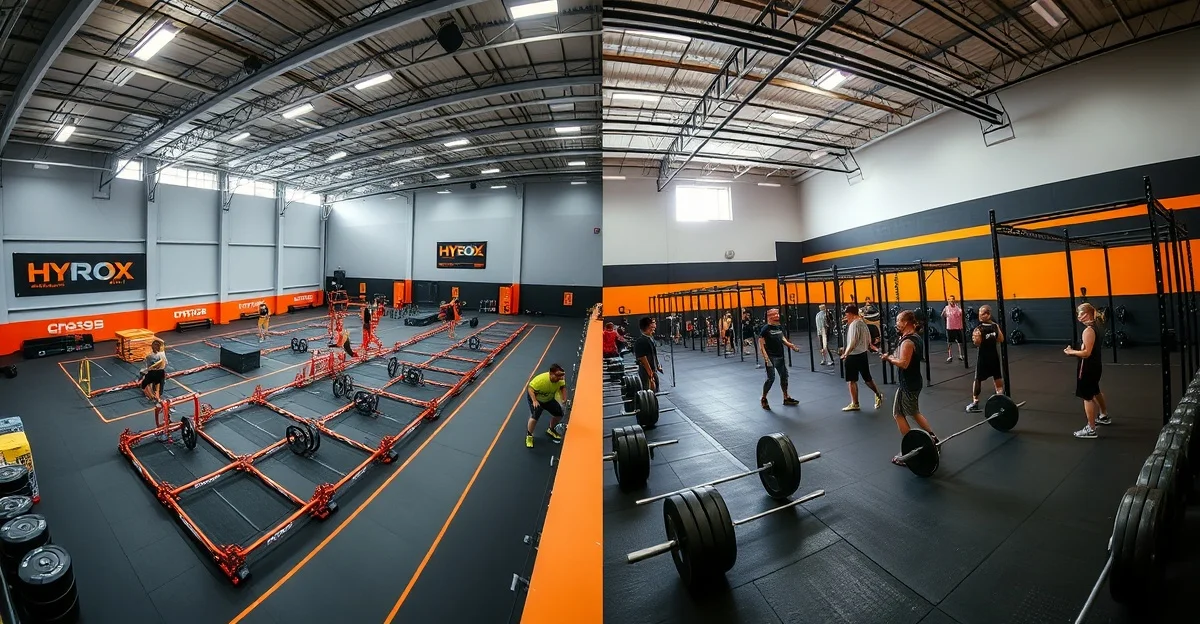

What's the difference between HYROX and CrossFit?
HYROX is a race. CrossFit is a training methodology. HYROX combines 8km of running with 8 functional workout stations in a standardized format, every HYROX event worldwide uses the same exercises, distances, and weights. CrossFit is a daily-varied fitness program performed in affiliate gyms (called boxes), with optional competitions like the CrossFit Open and CrossFit Games.
If you want a specific event to train toward with a predictable format, choose HYROX. If you want a daily training community with constantly varied workouts that build broad fitness, choose CrossFit. Many athletes do both.
Side-by-Side Comparison
| Category | HYROX | CrossFit |
|---|---|---|
| Format | Standardized race (8×1km run + 8 stations) | Daily-varied workouts (WODs) |
| Duration | 60-90+ minutes per race | 5-30 minutes per WOD |
| Movements | SkiErg, Sled Push, Sled Pull, Burpee Broad Jump, Rowing, Farmers Carry, Sandbag Lunges, Wall Balls | Olympic lifts, gymnastics, running, rowing, kettlebells, pull-ups, handstands |
| Running Volume | 8km per race (high) | Occasional (low-moderate) |
| Technical Skill | Low, all movements are accessible | High, Olympic lifts and gymnastics require coaching |
| Competition | Race events globally, World Championships | CrossFit Open, Quarterfinals, Games |
| Cost | €65-150 per race + any gym | €100-250/month box membership |
| Injury Risk | Overuse (running volume) | Technique-related (Olympic lifts, kipping) |
| Founded | 2017 (Christian Toetzke) | 2000 (Greg Glassman) |
What Is HYROX?
HYROX is a global fitness race series founded in 2017 in Hamburg, Germany. Every race follows the exact same format: athletes alternate between 1km running segments and functional workout stations for a total of 8km running and 8 exercises. The stations are always in the same order: SkiErg, Sled Push, Sled Pull, Burpee Broad Jump, Rowing, Farmers Carry, Sandbag Lunges, and Wall Balls.
This standardization is what makes HYROX unique, you can compare your time at a race in London directly against someone who raced in Chicago. Divisions include Open (individual), Doubles (pairs), Pro, and age groups, with weights adjusted accordingly.
HYROX races take place in large indoor arenas, often accommodating thousands of participants per weekend. The atmosphere is electric, with music, crowds, and a stadium-like experience that sets it apart from traditional fitness events.
What Is CrossFit?
CrossFit is a branded fitness methodology founded by Greg Glassman in 2000. It combines elements of Olympic weightlifting, gymnastics, and high-intensity interval training into daily workouts called WODs (Workouts of the Day). These workouts change every day, that variety is a core principle.
Training happens in affiliate gyms called "boxes," which pay a licensing fee to use the CrossFit name. Boxes typically offer coached group classes, creating a strong community atmosphere. The competitive pathway runs from the CrossFit Open (global online qualifier) through Quarterfinals, Semifinals, and ultimately the CrossFit Games.
CrossFit athletes develop broad fitness across many domains, strength, endurance, power, speed, flexibility, and coordination. The trade-off is that the technical demands (Olympic lifts, muscle-ups, handstand walks) require months of coaching to perform safely.
Key Differences
Training Structure
HYROX training is predictable. You know exactly which exercises you'll face, so you can build a structured program targeting each station and your running fitness. Most HYROX training plans run 12-16 weeks with progressive overload on station-specific work and running volume.
CrossFit training is intentionally varied. The daily WOD is unknown until you arrive. This builds broad fitness and mental adaptability, but makes it harder to peak for a specific event.
Movement Complexity
Every HYROX movement can be learned in a single session. Sled Push, Rowing, Wall Balls, these are fundamental movements with low technical barriers. This makes HYROX accessible to beginners and runners transitioning into functional fitness.
CrossFit includes Olympic lifts (snatch, clean and jerk), gymnastics movements (muscle-ups, handstand walks), and complex barbell work. These require months of dedicated practice and coaching to perform safely and efficiently.
Competition Format
HYROX is pure racing, you compete against the clock and against other athletes on the same course. Your finish time is your result, directly comparable to any HYROX event globally. The World Championship qualifies athletes based on race times.
CrossFit competition is multi-event. The CrossFit Open consists of several different workouts over weeks. Higher-level competition (Quarterfinals, Semifinals, Games) tests athletes across many unknown events, rewarding the most well-rounded athletes.
Cost Comparison
HYROX is cheaper overall. Race entry costs €65-150 depending on the event and division. You can train at any gym that has a rowing machine, SkiErg, sleds, and wall balls, no special membership required. Many athletes train at commercial gyms or build home setups.
CrossFit requires a box membership, typically €100-250 per month depending on location. This includes coached classes, programming, and community, but it's a significant ongoing commitment. CrossFit competition entry fees are separate (Open is free, Games qualifiers vary).
Community and Culture
CrossFit built its reputation on community. The box is a social hub, athletes know each other by name, cheer each other through WODs, and often socialize outside the gym. This tight-knit culture is CrossFit's biggest strength and a major reason people stick with it.
HYROX community is growing but different. It centers around race day energy, the arena atmosphere, training partners preparing together, and the shared suffering of race day. Between races, HYROX athletes often train alone or in small groups. The Doubles division adds a strong partnership element.
Injury Risk
HYROX injuries tend to be overuse-related: runner's knee, shin splints, and shoulder strain from high-volume training. The movements themselves are low-risk, but the running volume (30-50km per week for serious competitors) can cause repetitive strain.
CrossFit injuries are more often technique-related: lower back issues from heavy deadlifts, shoulder injuries from kipping pull-ups, or wrist problems from heavy snatches. Proper coaching dramatically reduces these risks, which is why the box model exists.
Which Should You Choose?
Your choice depends on what motivates you and how you like to train.
- Choose HYROX if you enjoy running, want a clear race goal, prefer predictable training, or want lower ongoing costs
- Choose CrossFit if you love variety, thrive on community, enjoy learning new skills, or want daily coached classes
- Choose HYROX if you're a runner wanting to add functional fitness without learning Olympic lifts
- Choose CrossFit if you want to build broad fitness across strength, endurance, power, and gymnastics
- Choose either if you want to compete, both have clear competitive pathways from local to world-class level
Can You Do Both?
Absolutely. Many athletes cross-train between HYROX and CrossFit. CrossFit builds the functional strength and work capacity that translates directly to HYROX stations. HYROX training adds the running endurance that most CrossFit athletes lack.
A practical approach: use CrossFit as your base training 3-4 days per week, and add 2-3 dedicated running sessions for HYROX preparation. In the 8-12 weeks before a HYROX race, shift the balance toward race-specific station work and running volume. After the race, return to a CrossFit-dominant program.
The skills transfer well in both directions. Wall Balls, Rowing, and Burpees appear in both disciplines. Sled Push and Farmers Carry build the same posterior chain strength that helps with deadlifts and cleans. The main gap to bridge is always running, CrossFit athletes need more of it, and HYROX athletes benefit from CrossFit's strength programming.
Frequently Asked Questions
Is HYROX harder than CrossFit?
It depends on how you define hard. HYROX is an endurance test lasting 60-90+ minutes with continuous effort. CrossFit workouts (WODs) are typically shorter but more intense, often under 20 minutes. HYROX demands more aerobic fitness; CrossFit demands more explosive power and technical skill.
Can CrossFit training prepare you for HYROX?
Partially. CrossFit builds excellent functional strength and work capacity, which helps with HYROX stations. However, CrossFit alone won't prepare you for the 8km of running between stations. You'll need to add dedicated running volume, most HYROX athletes run 3-5 times per week.
Which is better for weight loss, HYROX or CrossFit?
Both are effective for weight loss. CrossFit sessions produce higher calorie burn per minute due to their intensity. HYROX training, with its endurance focus, burns more total calories per session. The best choice is whichever you'll do consistently, adherence matters more than the format.
Is HYROX safer than CrossFit?
HYROX movements are simpler, no Olympic lifts, no kipping pull-ups, no handstand walks. This lower technical complexity means fewer technique-related injuries. However, the high volume of running in HYROX training can lead to overuse injuries. Both are safe when coached properly.
How much does HYROX cost compared to CrossFit?
HYROX race entry costs €65-150 per event, and you can train at any gym with basic equipment. CrossFit requires a box membership at €100-250 per month. Over a year, CrossFit is significantly more expensive, though it includes coaching and community that HYROX athletes often arrange independently.
Calculate Your HYROX Splits
Use our pace calculator to plan your running and station times based on your goal finish time.
