

Key Takeaways
- Any fan beats no fan — dramatically — Lab-tested across 30-minute structured efforts with six core temperature sensors: adding any focused fan produces 52% better heat dissipation compared to riding with no airflow. This is the single most impactful change you can make to your trainer setup.
- Focused blower > oscillating fan, always — A blower that holds a constant column of air on your torso and head is measurably more effective than an oscillating fan at the same wattage. The oscillation means you only get full airflow for a fraction of each sweep cycle.
- The $80 setup rivals a $249 smart fan — A Lasko U15617 blower ($66-85) plus a Kasa smart plug ($12-15) gives you speed-variable cooling tied to your workout without pairing via ANT+ or Bluetooth — and independent testing puts its airspeed at 15.8 mph, which is more than adequate.
- The Honeywell HT-900 is on every list and should not be — Independently measured at only 4.1 mph of airspeed at 40 inches distance. That is about ten times weaker than a Lasko blower from the same distance. Fine as a face fan. Useless as your primary trainer fan.
Why Cooling Is the Most Underrated Trainer Upgrade
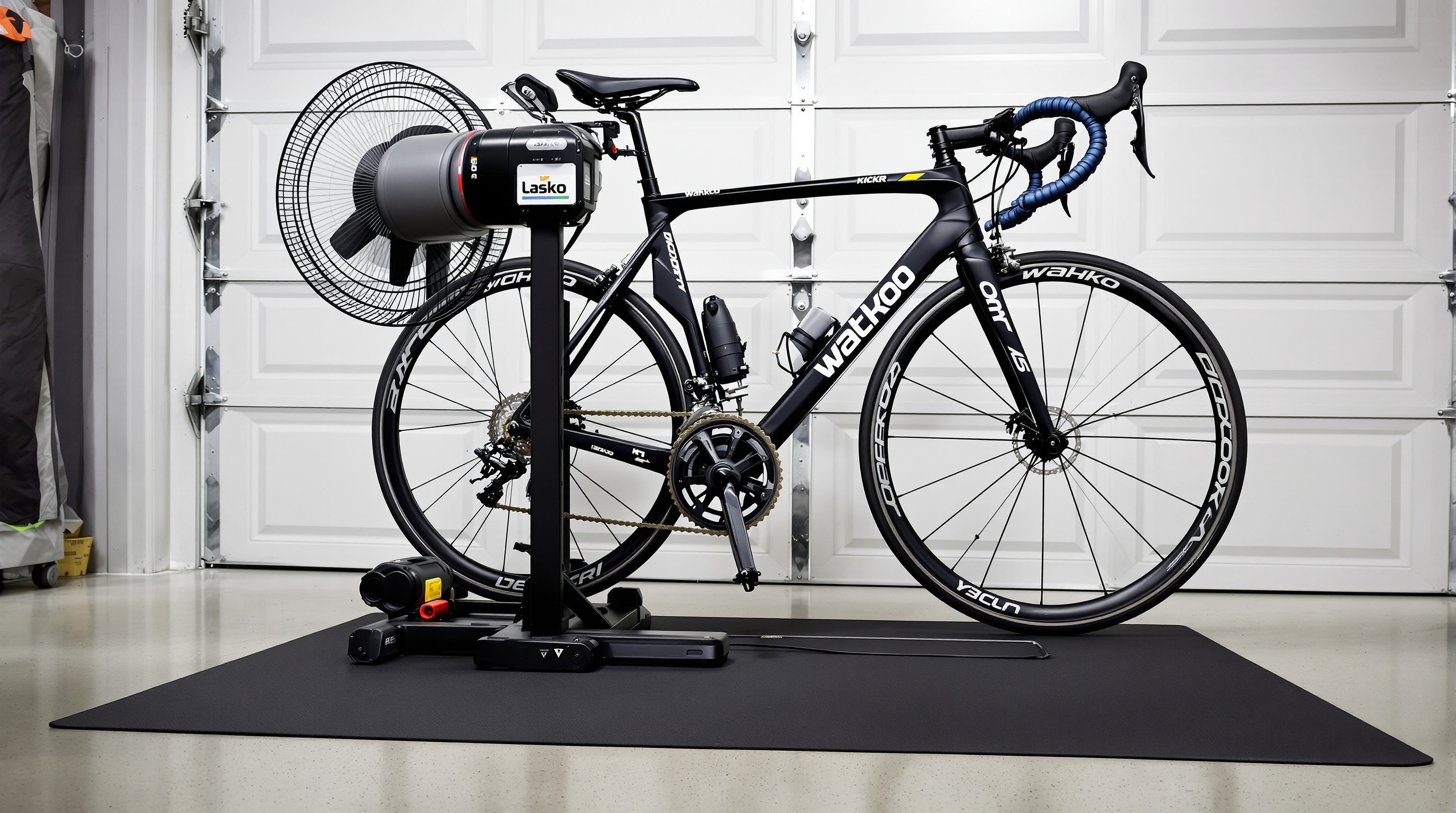
I have a Wahoo KICKR Core 2 set up in a spare room that gets warm quickly. For months I rode without a dedicated fan, occasionally borrowing a small desk fan from another room when intervals got brutal. Then I spent a few weeks reading everything the indoor cycling community has published about airflow and heat, and I realised I had been handicapping myself for an entirely fixable reason.
The definitive test comes from a Velo/Outside lab study that strapped six CORE temperature sensors to a rider, ran 30-minute structured efforts under identical power targets, and measured heat dissipation with and without a fan. The result: a focused fan produced 52% better heat dissipation than no fan. Not 10%. Not 20%. Fifty-two percent. That is not a marginal comfort improvement — it is a fundamentally different physiological environment.
The mechanism is straightforward. Your body cools itself through sweat evaporation. Without airflow, the humid air immediately around your skin saturates and evaporative cooling stalls. Heart rate drifts upward at constant power — what TrainerRoad calls cardiac drift — as your cardiovascular system compensates for the thermal load. Power at the same RPE drops. Multiple riders in the TrainerRoad forum have noted "a few extra watts" that materialised once they added proper cooling: not from fitness gains, but from removing an artificial limiter they had accepted as normal. One user wrote that their FTP test result jumped 8 watts between identical tests when the only change was adding a blower — a number well within the margin of environmental factors rather than genuine fitness change.
The practical implication: before spending money on a power meter, a better trainer, or a Zwift subscription, fix your airflow. It is the cheapest performance upgrade available to indoor cyclists, and it is backed by the clearest lab evidence of anything on this list.
Smart Fans: What ANT+ Speed-Reactive Actually Means
A smart fan pairs to your trainer, heart rate monitor, or power meter via ANT+ or Bluetooth and adjusts its speed in real time based on your effort. When you are soft-pedalling a recovery interval, the fan runs quietly at low speed. When you are pushing a 5-minute VO2max effort at 120% FTP, the fan spins up to maximum automatically. You never have to reach for a dial mid-interval, which sounds minor until you have done it a hundred times.
The KICKR Core 2 broadcasts via ANT+ FE-C (Fitness Equipment Control), which is the same protocol most smart fans use. Pairing is typically straightforward in the ecosystem it is designed for, and occasionally frustrating when crossing brands. Here is how the three main options compare.
Wahoo KICKR Headwind ($249)
The Headwind is the default recommendation for Wahoo ecosystem users because it is native: open the Wahoo app, select the fan, done. It produces up to 30 mph of airspeed and runs at around 55 dB at full speed — audible but tolerable with headphones. The pairing story is clean because Wahoo controls the whole stack. Heart rate pairing is also supported, so you can tie fan speed to HR rather than trainer speed if you prefer.
The forum consensus is split on value. A common thread on r/Zwift reads: "The price is CRAZY for a fan, but I've never once had to think about it." That framing captures the Headwind accurately — it is overpriced for what a fan should cost, and it works without friction in a way that has real value during hard workouts. If you are in the Wahoo ecosystem and find the ANT+ automation genuinely useful, the premium is defensible. If you are buying your first trainer fan and are not sure you will use smart features, the Lasko + smart plug covers the same use case for a third of the price.
Elite Aria ($349)
The Elite Aria is the most sophisticated fan in this space and DC Rainmaker's pick for riders who use a separate power meter. It offers 10 tilt positions, power meter integration (not just speed or HR), and carbon filters that clean the air passing over you. At $349 it is expensive, and the app has drawn consistent criticism for being "pretty finicky" in reviews and forum threads — Elite's hardware is excellent but their software has never matched Wahoo's polish. If you train with a crank-based power meter and want the most accurate effort-to-fan-speed mapping available, the Aria earns consideration. Otherwise the Headwind is simpler for less.
Cycplus Smart Fan (~$220)
The newest entrant to the smart fan market, and the quietest: Cycplus rates it at under 45 dB, which is the lowest of the three. road.cc gave it 8/10 and highlighted the handlebar remote as a practical addition — you can override the smart speed manually without reaching back to the fan body. The adjustable height and angle give it more placement flexibility than the Headwind's fixed stand. At $220 it sits between the Lasko-plus-plug approach and the Headwind, which makes it the sensible middle-ground pick if noise is a genuine concern and you want native smart connectivity.
The $80 Setup That Rivals a $250 Smart Fan
This is the recommendation that comes up most consistently across TrainerRoad, Slowtwitch, and BikeForums whenever someone asks for a budget trainer fan, and independent testing has validated why: the Lasko U15617 blower paired with a Kasa smart plug delivers serious airflow at a price point that makes the smart fan argument much harder to justify.
The Lasko U15617 costs $66-85 depending on retailer and timing. It is a focused barrel blower — not an oscillating pedestal fan — which means it maintains a sustained column of air rather than sweeping past you briefly. Buckyrides, an independent tester who measured multiple fans with a calibrated anemometer, clocked it at 15.8 mph at 40 inches with 59 dB noise. That is a genuine, substantial airflow from a $70 fan. Paired with a Kasa KP115 smart plug ($12-15), you can build Zwift automations that switch the fan on when a workout starts and off when it ends — and with more sophisticated Home Assistant integrations, you can vary the outlet power based on current heart rate or power. Total cost: around $80.
The Wahoo Headwind at full speed produces 30 mph, which is roughly double the Lasko's 15.8 mph. That difference is real in a hot room during a 20-minute threshold block. But the Lasko's focused blower column hits your core more consistently than a wider fan at moderate speed, and for most workouts in a room below 25°C the cooling is more than adequate. The community workhorse reputation is earned: it has appeared in "what fan do you use" threads for years and keeps winning by doing the job without complexity.
There is a more DIY variation worth knowing: the Harbor Freight router speed controller hack. A variable router speed controller (around $10) wired into the Lasko's power circuit lets you dial the fan speed manually like a knob. It is not smart, it is not wireless, and it requires some comfort with basic electrical components — but it gives you variable speed control for a total of roughly $80-90 without any app or subscription. A subset of the TrainerRoad forum still swears by it for its simplicity.
What the Community Measured (Not What Amazon Says)
Fan marketing is almost entirely useless for comparison purposes. CFM ratings use different measurement methodologies. "High velocity" claims are unverified. The only data that matters for trainer use is actual airspeed at realistic distances — and a handful of people in the indoor cycling community have done the work with calibrated anemometers to give us real numbers.
The most referenced dataset comes from Buckyrides, who tested multiple fans at 40 inches distance — roughly the distance from a floor-standing fan to your torso on a bike — and published the results. The XPOWER P-230AT produced 42.8 mph near the funnel (it is an industrial blower designed for floor drying, loud and powerful). The Lasko U15617 came in at 15.8 mph at 59 dB. The Honeywell HT-900 — the fan that appears on more "best indoor cycling fan" affiliate listicles than any other product — measured at 4.1 mph. The Velo/Outside lab test separately validated the Vacmaster Cardio54 as their top-ranked fan for heat dissipation in structured testing.
Here is how the commonly discussed options compare on actual measured performance:
| Fan | Price | Measured Airspeed | Noise | Smart Features | KICKR Core 2 Compatible |
|---|---|---|---|---|---|
| Wahoo KICKR Headwind | $249 | 30 mph (rated) | ~55 dB | ANT+ / BT speed, HR | Yes — native |
| Elite Aria | $349 | ~28 mph (rated) | ~52 dB | ANT+ power, speed, HR | Yes — ANT+ FE-C |
| Cycplus Smart Fan | ~$220 | ~22 mph (rated) | <45 dB | ANT+ / BT speed, HR | Yes — ANT+ / BT |
| Vacmaster Cardio54 | ~$100 | Lab-tested #1 by Velo/Outside | ~62 dB | None | Yes — manual |
| Lasko U15617 | $66-85 | 15.8 mph (measured) | 59 dB (measured) | None (smart plug compatible) | Yes — manual / smart plug |
| Vacmaster AM201R | ~$150 | ~18 mph (reported) | ~61 dB | None | Yes — manual |
| XPOWER P-230AT | ~$80 | 42.8 mph near funnel (measured) | ~68 dB | None | Yes — very loud |
| Honeywell HT-900 | $20-30 | 4.1 mph (measured) | 47 dB (measured) | None | Supplemental only |
A few notes on the table: rated airspeed figures from manufacturers should be treated with skepticism unless independently verified. The XPOWER's 42.8 mph is an industrial blower measurement near the outlet funnel — at 40 inches real-world distance the number drops considerably, and at 68+ dB it is obnoxious in a home setting. The Headwind's 30 mph rating is widely accepted as accurate based on community testing and matches its cooling performance in hot-room reports. For the full comparison guide including the AiTrainingPlan test methodology, see the full comparison guide on AiTrainingPlan.
Why the Honeywell HT-900 Is on Every Listicle and Why It Sucks
If you search "best fan for indoor cycling" right now, the Honeywell HT-900 will appear in the top-three of almost every result. It is cheap ($20-30), compact, widely available, and has an Amazon rating above 4.5 stars from tens of thousands of reviews. It is also one of the least effective options for trainer use that has been independently measured, and the gap between its reputation and its actual performance is striking.
Buckyrides measured the HT-900 at 4.1 mph at 40 inches distance. Other testers have found it as low as 2.7 mph. The Lasko U15617 measured 15.8 mph at the same distance. That is between four and six times the airspeed from a fan in the same price category (the Lasko costs $66-85, so around three times the price of a HT-900 — but the performance gap is significantly larger than the price gap). Put another way: the Honeywell provides airflow roughly equivalent to a mild breeze. The Lasko provides airflow closer to riding at 12 mph on a calm day. For a rider doing a 40-minute threshold effort that can push their core temperature well above comfortable levels, these are not comparable.
The reason it appears on every list is simple: affiliate economics. The HT-900 has one of the highest Amazon affiliate conversion rates in this category because it is cheap, has great reviews (it is genuinely good as a desk fan), and is impulse-purchase price. The reviewers putting it on "best indoor cycling fan" lists are almost never testing with an anemometer — they are selecting products that will convert and happen to have indoor cycling in the title copy. A TrainerRoad user put it plainly after upgrading: "My new Lasko is much more powerful than my crappy Honeywell — it's not even close."
Use the HT-900 as a supplemental face fan if you have one lying around. Aim it at your face from close range — at that distance its airspeed is adequate for a small target area and the quiet operation is a genuine advantage. But do not let it be the only fan cooling you during a serious workout.
My Recommendation by Budget
Based on the community data, independent testing, and my own research process ahead of picking up a fan for my KICKR Core 2 setup, here is how I would split the decision across three budget tiers.
Budget: $70-100
Lasko U15617 + Kasa smart plug (~$80 total) is the clear winner at this price point. You get independently-measured airspeed, a focused blower column rather than an oscillating fan, and optional smart plug integration that covers the core use case of most ANT+ smart fans — turning on and off with your workout. If you are in the UK or Europe, the Vacmaster Cardio54 (~$100) is worth seeking out: it was the top performer in the Velo/Outside lab test and is more readily available in European markets.
Mid: $150-220
The Cycplus Smart Fan (~$220) is the pick here if noise is a genuine constraint — under 45 dB is meaningfully quieter than the Lasko's 59 dB, which matters if you are in a shared space or listening to structured workout audio. The handlebar remote is a practical addition. For raw power without smart features, the Vacmaster AM201R (~$150) is reported to outperform the Lasko in airspeed and is worth considering in this range if you do not need wireless connectivity.
Premium: $250+
Wahoo KICKR Headwind ($249) if you are in the Wahoo ecosystem and value the one-app pairing experience. The friction-free setup and reliable ANT+ connectivity justify the premium over the Cycplus if you are already using Wahoo hardware and do not want to think about fan management. Elite Aria ($349) if you train with a crank-based or pedal-based power meter and want power-to-fan-speed integration rather than HR or trainer speed — DC Rainmaker's recommendation stands for that specific use case, though the app quality remains a valid complaint.
Two-fan setup for hot rooms
If your training space regularly exceeds 25°C (77°F) in summer, the enthusiast approach is to run two fans: a high-output blower (Lasko, Vacmaster, or Headwind) aimed at your torso from the front, plus a smaller oscillating or fixed fan aimed at your face from the handlebars or a second stand. The face fan does not need to be powerful — even the Honeywell HT-900 is adequate for this supplemental role at close range. The combination handles heat dissipation from your torso while addressing the intense discomfort of a hot face during hard efforts.
Testing Protocol: What Comes Next
Everything in this article is based on community data, independent tests by third parties, and forum consensus. I have not yet run my own hands-on comparison across the shortlisted fans. I plan to do that, and I want to be transparent about the methodology I will use so you can evaluate the results when they arrive.
The protocol I am designing: the same 45-minute 2x20 sweet spot workout (90% of FTP, two 20-minute blocks with five minutes recovery between), repeated three times with each fan under test. The variables I will standardise: room temperature and humidity (target 20-22°C, recorded throughout), fan placement (same position relative to bike, same height), time of day (morning sessions only, to keep ambient conditions consistent). The variables I will measure: HR drift during each 20-minute block at constant power, actual wind speed at torso height via a calibrated anemometer, noise level in dB from the rider position, and perceived exertion on the RPE scale.
I will run three repeats per fan and average the results to smooth out day-to-day variability. The comparison fans I am planning to test: Lasko U15617 (the community baseline), Wahoo KICKR Headwind (the smart fan benchmark), and Cycplus Smart Fan (the quiet alternative). If the Vacmaster Cardio54 becomes available locally, it will join the test as the lab-validated budget option.
When that data is published, it will appear in an updated version of this article with a clear "tested" marker on each fan that went through the protocol. Until then, the research above is what the community and independent labs have established — and it is already actionable enough to make a confident buying decision.
Do I need a smart fan for indoor cycling?
No. Any focused blower dramatically improves cooling compared to no fan — the lab data shows 52% better heat dissipation regardless of whether the fan is speed-reactive. Smart fans add convenience (the fan speed tracks your effort automatically so you never have to reach for a dial mid-interval), not cooling power. If you are on a budget, a basic blower gets you 90% of the benefit for 25% of the cost.
What's the best fan under $100 for a bike trainer?
The Lasko U15617 is the most consistently recommended fan across TrainerRoad, Slowtwitch, and BikeForums — typically $66-85. It is a focused blower column (not oscillating), runs at a fixed high speed, and has been independently measured at 15.8 mph airspeed. Paired with a $12-15 Kasa smart plug, you can tie it to a Zwift automation and get basic speed-reactive control. The Vacmaster Cardio54 ($100) is lab-tested to slightly higher performance if you can find it in your region.
Does the Wahoo Headwind work with non-Wahoo trainers?
Yes. The Headwind pairs via ANT+ or Bluetooth to any heart rate monitor, speed sensor, or power meter — it is not locked to Wahoo hardware. It reads heart rate or speed data and adjusts its fan speed accordingly. Many users run it with Tacx, Elite, or Saris trainers without any issues. The only Wahoo-specific advantage is that if you use the Wahoo app, pairing is one tap instead of navigating the Headwind app.
How many fans do I need for indoor cycling?
One good blower aimed at your core and face is sufficient for most riders. The enthusiast consensus on TrainerRoad and Slowtwitch is that in rooms above 25°C (77°F), a two-fan setup adds meaningful benefit: one high-output blower on a stand aimed at your torso, and a smaller fan on the handlebars or floor aimed at your face. Below that temperature, a single well-placed blower handles most workouts.
Can I use the Wahoo KICKR Core 2 to control the Headwind?
Yes. The KICKR Core 2 broadcasts speed and power data via ANT+ FE-C, which the Headwind reads to adjust its fan speed automatically. In practice, most riders pair the Headwind to their heart rate monitor rather than the trainer speed, because heart rate responds more directly to cooling needs — your HR climbs well before your power drops from heat. Both pairing modes work natively with the Wahoo ecosystem.
Is the Honeywell HT-900 good enough for indoor cycling?
Not as a primary fan. Independent anemometer testing by Buckyrides measured the HT-900 at 4.1 mph at 40 inches — and other measurements put it as low as 2.7 mph. For comparison, a Lasko U15617 measures 15.8 mph at the same distance. That is a 4x difference in actual airspeed, not a minor gap. The HT-900 is a fine personal desk fan and works as a secondary face fan, but it cannot generate the airflow your body needs during a hard indoor effort. Do not buy it as your main trainer fan despite its prominent placement on affiliate listicles.
Ready to Train Smarter?
Get personalized training zones, race predictions, and performance insights with our free calculators.
